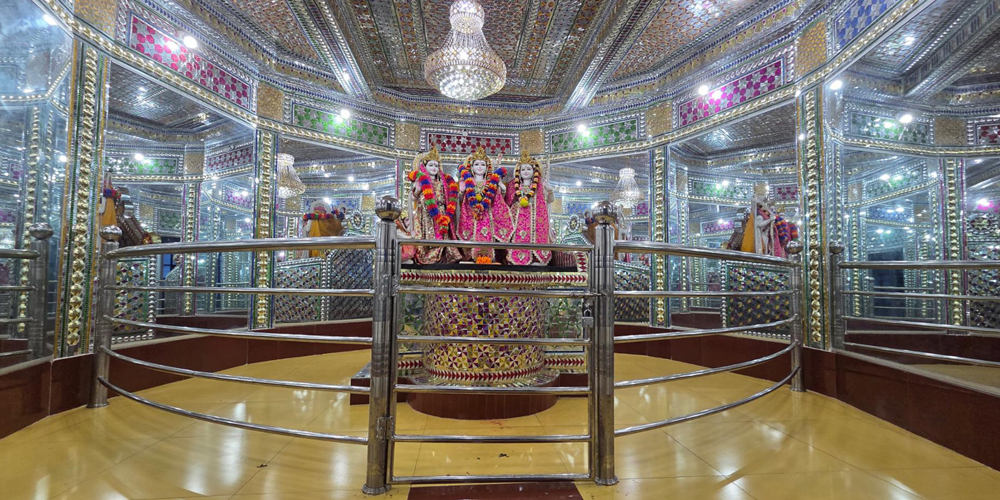
The beautifully crafted Mirror Palace (Sismahal) at Shree Laxmi Narayan Temple in Chisapani Rangashala, Ward No. 5 of Hetauda Sub-Metropolitan City, Makwanpur, has become an increasingly popular attraction for religious tourists visiting central Nepal.
While devotees primarily visit the temple to worship Lord Laxmi Narayan, the two intricately designed mirror palaces located within the temple complex have become a major highlight for visitors. According to Ramanuj Wagle, Chairman of the Laxmi Narayan Temple Management Committee, the mirror palaces have significantly enhanced the temple’s appeal, attracting both pilgrims and tourists seeking a unique spiritual and cultural experience. Unlike many mirror palaces across Nepal that require an entry fee, visitors can explore both structures at the temple completely free of charge, making them accessible to people of all backgrounds.

Two Unique Mirror Palaces Built Through Community Support
The temple complex houses two distinct mirror palaces. The Radha-Krishna Sismahal was constructed with financial assistance of NPR 800,000 from the then District Development Committee, while the Sita-Ram Sismahal was built at a cost of approximately NPR 2 million, funded entirely through donations from devotees. Temple officials say the addition of these structures has helped transform the temple into an emerging destination for religious tourism, encouraging visitors not only to offer prayers but also to appreciate the artistic craftsmanship and spiritual symbolism reflected in the mirror palaces.
Temple Inspired by Tirupati Balaji
Established in 1975 (2032 B.S.) by Ananta Shri Vibhushit Parankushacharya, the institution has been managed by the Laxmi Narayan Temple Management Committee since its inception. It was formally registered with the District Administration Office, Makwanpur, in 2004 (2061 B.S.). One of the temple’s distinctive features is its architectural and religious resemblance to the famous Tirupati Balaji Temple in South India. The temple follows similar architectural styles, worship methods, and religious rituals, offering devotees an experience comparable to one of Hinduism’s most revered pilgrimage sites. Spread across nearly two kathas of land, the temple complex has gradually expanded with several religious and community-oriented structures.
Accommodation and Educational Support for Pilgrims and Students
To better serve pilgrims, the temple provides accommodation with six residential rooms, capable of hosting 10 to 12 visitors at a time. The facility supports devotees traveling from different parts of Nepal who wish to stay overnight for worship and spiritual activities. Beyond serving pilgrims, the temple also contributes to education and social welfare. It currently provides residential facilities and educational support to five Vedic students from remote districts, including Mugu and Humla. Alongside traditional Vedic studies, the students receive formal school education, reflecting the institution’s commitment to preserving religious knowledge while promoting modern learning.
Center for Spiritual Learning and Community Wellness
The temple has evolved into a center for spiritual education and community service. Religious discourses by respected spiritual leaders are organized regularly, while yoga sessions are conducted daily to promote physical and mental well-being. Within the temple premises, the Laxmi Narayan Vyas Peeth, established in 2001 (2058 B.S.), hosts daily recitations of the Vedas, the Bhagavad Gita, and the Shrimad Bhagavatam. The temple also operates the Kasturi Yoga Meditation Center, where approximately 40 residents of Hetauda practice yoga daily.

Marble Bhagavad Gita and Daily Worship
One of the temple’s remarkable attractions is the complete inscription of all 18 chapters of the Bhagavad Gita on marble slabs within the temple complex. The project, completed six years ago for NPR 350,000, was made possible through financial contributions from 18 individual donors, each sponsoring one chapter of the sacred scripture. According to temple priest Bhakti Dahal, daily worship is conducted from 6:00 a.m. to 10:00 a.m. and again from 4:00 p.m. to 8:00 p.m. The temple witnesses particularly large gatherings during major Hindu festivals and auspicious occasions.
Major Festivals Attract Thousands of Devotees
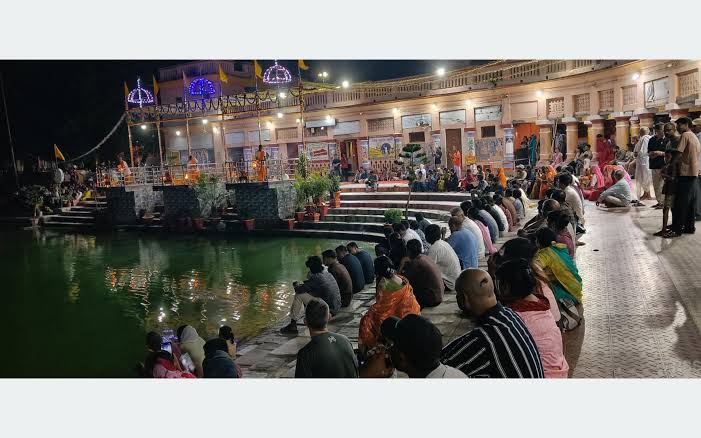
The temple celebrates several important religious festivals throughout the year, with the annual Mahalaxmi Festival, held during the Nepali month of Poush, serving as one of its biggest events. Other major celebrations include Ram Navami, Krishna Janmashtami, Vijayadashami (Dashain), and the Jhulan Festival, each drawing large numbers of devotees from Makwanpur and neighboring districts.
Temple committee member Gomadevi Wagle said the institution aims to develop the temple not only as a place of worship but also as a center for spiritual awakening, cultural preservation, education, and social service. With its unique mirror palaces, South Indian-inspired architecture, and expanding community programs, the Laxmi Narayan Temple is steadily establishing itself as one of Bagmati Province’s emerging destinations for religious and cultural tourism.