The Nepal Rastra Bank (NRB), the country’s central monetary authority, has released the official foreign exchange rates for Sunday, reflecting fluctuations in global currency markets. These exchange rates serve as a benchmark for banks, financial institutions, businesses, and individuals involved in foreign currency transactions across Nepal. The central bank also clarified that these rates are subject to revision as needed and may differ from commercial bank rates.
U.S. Dollar Maintains Stability
According to the exchange rate bulletin published by the NRB, the buying rate for the U.S. Dollar (USD) has been fixed at Rs. 139.77, while the selling rate is set at Rs. 140.37. The USD remains the most traded foreign currency in Nepal due to remittance inflows, trade settlements, and international tourism. The stable performance of the dollar in recent days has contributed to a relatively narrow spread between the buying and selling rates.
Euro and British Pound Among Strongest Currencies
The Euro (EUR) has been priced at a buying rate of Rs. 159.51 and a selling rate of Rs. 160.20, indicating slight strength in the European currency against the Nepali rupee. Likewise, the British Pound Sterling (GBP) continues to hold a higher value with a buying rate of Rs. 184.02 and a selling rate of Rs. 184.81, reflecting its strong performance in global currency markets.
The Swiss Franc (CHF), another strong European currency, is listed with a buying rate of Rs. 171.28 and a selling rate of Rs. 172.01, maintaining its consistent valuation in Nepal’s exchange tables.
Exchange Rates for Major Global Currencies
The NRB has also provided rates for several widely used global currencies. The Australian Dollar (AUD) stands at Rs. 89.88 for buying and Rs. 90.26 for selling, while the Canadian Dollar (CAD) is listed at Rs. 100.77 (buying) and Rs. 101.20 (selling). Similarly, the Singapore Dollar (SGD) is priced at Rs. 107.67 for buying and Rs. 108.13 for selling.
From Asia, the Japanese Yen (JPY), priced per 10 units, has a buying rate of Rs. 9.30 and a selling rate of Rs. 9.34. The Chinese Yuan (CNY) stands at Rs. 19.38 for buying and Rs. 19.46 for selling, reflecting China’s ongoing importance as Nepal’s second-largest trading partner.
Middle Eastern Currencies Reflect Remittance Ties
Due to Nepal’s substantial migrant worker population in the Middle East, the exchange rates for Gulf currencies are of particular relevance. The Saudi Arabian Riyal (SAR) is listed at Rs. 37.26 for buying and Rs. 37.42 for selling, while the Qatari Riyal (QAR) stands at Rs. 38.34 for buying and Rs. 38.51 for selling.
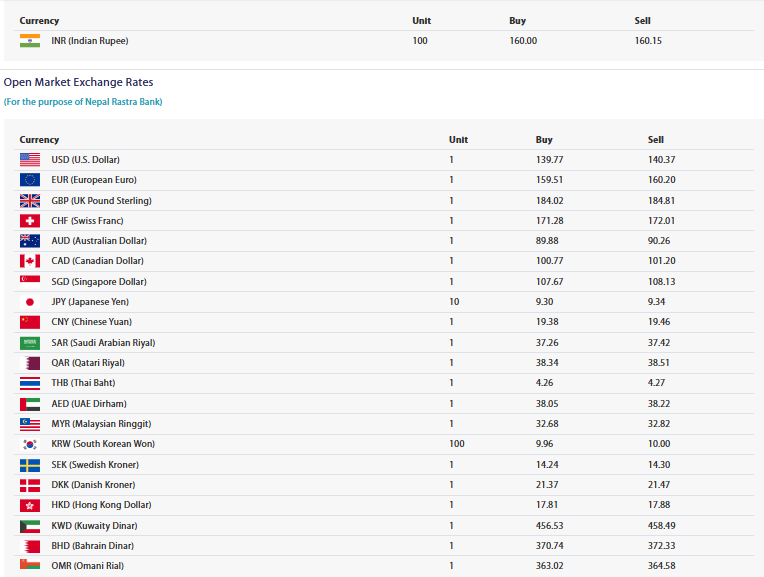
The UAE Dirham (AED), another widely transacted currency, has a buying rate of Rs. 38.05 and a selling rate of Rs. 38.22. Similarly, the Omani Riyal (OMR) and the Bahraini Dinar (BHD), two of the highest-valued currencies, are fixed at Rs. 363.02 (buying) and Rs. 364.58 (selling) for OMR, and Rs. 370.74 (buying) and Rs. 372.33 (selling) for BHD.
Notably, the Kuwaiti Dinar (KWD), considered the world’s strongest currency in terms of exchange rate, is priced at a buying rate of Rs. 456.53 and a selling rate of Rs. 458.49.
South and Southeast Asian Currencies Also Included
The Thai Baht (THB) is recorded at Rs. 4.26 for buying and Rs. 4.27 for selling, while the Malaysian Ringgit (MYR) is listed at Rs. 32.68 (buying) and Rs. 32.82 (selling). From the Korean peninsula, the South Korean Won (KRW), per 100 units, is pegged at Rs. 9.96 for buying and Rs. 10.00 for selling.
Other European currencies listed include the Swedish Krona (SEK) at Rs. 14.24 for buying and Rs. 14.30 for selling, and the Danish Krone (DKK) at Rs. 21.37 (buying) and Rs. 21.47 (selling).
Indian Rupee Rate Remains Fixed
The Indian Rupee (INR), which has a fixed exchange rate with Nepal under a long-standing bilateral agreement, remains unchanged. The NRB has set the exchange for 100 Indian Rupees at Rs. 160.00 for buying and Rs. 160.15 for selling. This fixed peg is crucial for daily trade, travel, and remittance flows between the two neighboring countries.
Exchange Rates Subject to Revision
The NRB clarified that these rates are indicative and subject to change at any time based on market dynamics. The exchange rates used by commercial banks may vary slightly depending on supply and demand, transaction volumes, and operational margins. The central bank advised the public and institutions to check the latest rates through the NRB’s official website or authorized financial institutions before proceeding with large transactions.
In its statement, the NRB emphasized the importance of transparency and real-time information sharing in maintaining currency market stability and facilitating smooth financial operations across sectors.
The foreign exchange rate announcement by the Nepal Rastra Bank provides vital guidance for individuals and businesses dealing with foreign currencies, whether for travel, trade, remittances, or investment. As Nepal continues to engage with the global economy, particularly through its large migrant workforce and tourism sector, daily updates like these remain crucial for informed financial decision-making.