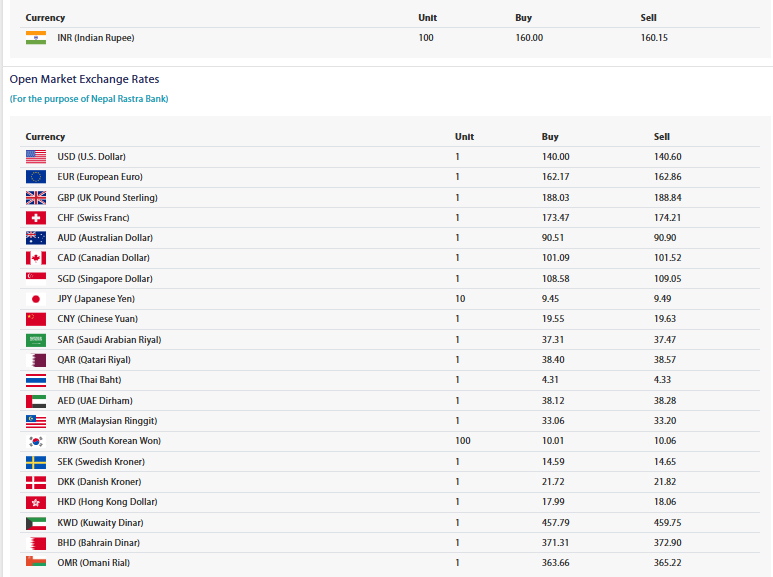
Nepal Rastra Bank (NRB), the country’s central bank, has published the official foreign exchange rates for today, outlining the buying and selling values of key global currencies against the Nepalese Rupee (NPR). According to the announcement, the buying rate for one US Dollar has been fixed at NPR 140.00, while the selling rate stands at NPR 140.60. This update provides a reference point for commercial banks, financial institutions, businesses engaged in international trade, and the general public involved in currency exchange.
Euro, Pound Sterling, and Swiss Franc Rates Adjusted
In today’s update, the buying rate for one European Euro has been set at NPR 162.17, with the selling rate at NPR 162.86. Similarly, the British Pound Sterling’s buying rate is NPR 188.03, and the selling rate is NPR 188.84. The Swiss Franc, another major global currency, is being traded at a buying rate of NPR 173.47 and a selling rate of NPR 174.21. These rates reflect the global currency market trends, with fluctuations influenced by international trade balances, inflation rates, and monetary policies in major economies.
Australian, Canadian, and Singapore Dollar Rates Announced
The Australian Dollar is currently being exchanged at a buying rate of NPR 90.51 and a selling rate of NPR 90.90. For the Canadian Dollar, the buying rate is NPR 101.09, while the selling rate is NPR 101.52. Meanwhile, the Singapore Dollar is valued at a buying rate of NPR 108.58 and a selling rate of NPR 109.05. These currencies hold particular importance for Nepal due to migration patterns, tourism, and business links with Australia, Canada, and Singapore.
Asian Currency Exchange Rates Updated
Among Asian currencies, the Japanese Yen’s rate for 10 units is NPR 9.45 (buying) and NPR 9.49 (selling). The Chinese Yuan is priced at NPR 19.55 for buying and NPR 19.63 for selling. For the Gulf region, the Saudi Arabian Riyal stands at NPR 37.31 for buying and NPR 37.47 for selling, while the Qatari Riyal is set at NPR 38.40 for buying and NPR 38.57 for selling. These rates are significant for Nepal’s large migrant worker population in Japan, China, and Gulf nations, as they directly impact remittance inflows.
Additional Global Currency Rates Released
The Thai Baht is being exchanged at NPR 4.31 for buying and NPR 4.33 for selling. The United Arab Emirates Dirham is at NPR 38.12 (buying) and NPR 38.28 (selling), while the Malaysian Ringgit is valued at NPR 33.06 for buying and NPR 33.20 for selling.
South Korean Won, quoted per 100 units, has a buying rate of NPR 10.01 and a selling rate of NPR 10.06. Among European currencies, the Swedish Krona is valued at NPR 14.59 (buying) and NPR 14.65 (selling), and the Danish Krone is at NPR 21.72 (buying) and NPR 21.82 (selling). These rates reflect Nepal’s growing trade relations and migration ties with Southeast Asia, the Middle East, and Europe.
High-Value Currency Rates for Trade and Investment
The Hong Kong Dollar is trading at NPR 17.99 for buying and NPR 18.06 for selling. Among the highest-value currencies, the Kuwaiti Dinar is fixed at NPR 457.79 for buying and NPR 459.75 for selling, while the Bahraini Dinar stands at NPR 371.31 (buying) and NPR 372.90 (selling). The Omani Riyal is priced at NPR 363.66 for buying and NPR 365.22 for selling. These strong currencies are of particular interest to traders, investors, and remittance beneficiaries due to their significant value in the international market.
Indian Rupee Rate Maintained
Given the close economic relationship between Nepal and India, the Indian Rupee remains one of the most important currencies in daily transactions. The rate for INR 100 has been set at NPR 160.00 for buying and NPR 160.15 for selling. This rate impacts cross-border trade, tourism, and personal remittances between the two countries, as the Indian currency is widely used in border towns and for various import-export activities.
Commercial Banks May Offer Slightly Different Rates
While the Nepal Rastra Bank sets the official exchange rate, the central bank has clarified that commercial banks may determine their own rates based on market conditions. These bank rates can vary slightly from the official figures due to operational costs, supply and demand for specific currencies, and transaction volumes. Nonetheless, NRB’s daily rates serve as the primary benchmark for foreign exchange transactions nationwide.
Rates Subject to Change Without Prior Notice
The central bank has also emphasized that these rates are subject to change at any time if necessary. Fluctuations in the global currency market, geopolitical developments, commodity price shifts, and changes in monetary policy can lead to quick adjustments in foreign exchange rates. NRB updates its rates daily to reflect the latest market movements and ensure stability in Nepal’s currency market.
Importance for Businesses, Migrants, and the Public
Foreign exchange rates play a crucial role in Nepal’s economy, affecting import costs, export competitiveness, remittance values, tourism revenue, and foreign investment. Businesses engaged in international trade rely on accurate and timely exchange rate updates to plan their transactions, while migrant workers and their families use these rates to calculate remittance values. Tourists also benefit from knowing the latest rates to manage travel expenses.
Today’s update from Nepal Rastra Bank underscores the dynamic nature of the global currency market and its impact on Nepal’s economy. By publishing official buying and selling rates for major international currencies, the central bank provides essential guidance for commercial banks, traders, and the general public. As global economic conditions shift, the NRB remains committed to ensuring transparency, stability, and timely updates in the country’s foreign exchange market.