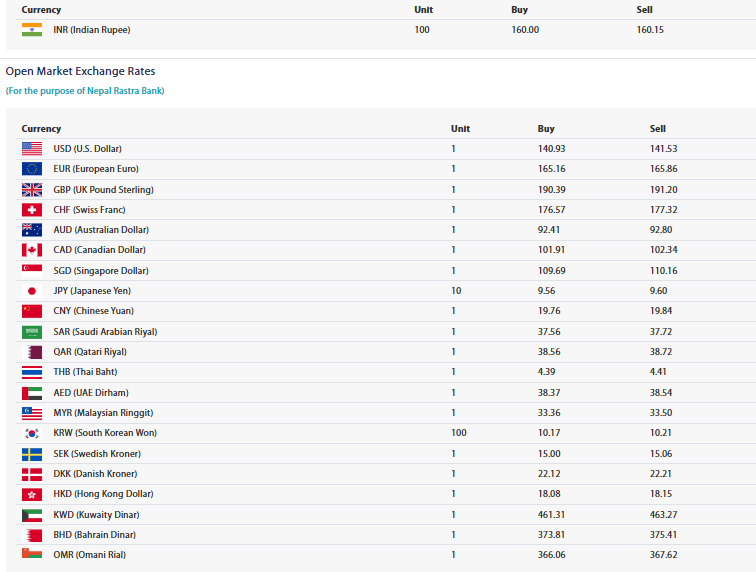
Nepal Rastra Bank (NRB) has published the official foreign exchange rates for today, setting the benchmark for commercial banks and financial institutions. According to the central bank, the buying rate for one US dollar is set at NPR 140.93, while the selling rate is NPR 141.53. The euro is valued at NPR 165.16 for buying and NPR 165.86 for selling. Similarly, the British pound sterling stands at NPR 190.39 for buying and NPR 191.20 for selling.
The Swiss franc is trading at NPR 176.57 (buying) and NPR 177.32 (selling), reflecting its continued strength in the global market.
Rates for Major Global Currencies
The Australian dollar has been fixed at NPR 92.41 for buying and NPR 92.80 for selling, while the Canadian dollar is priced at NPR 101.91 and NPR 102.34, respectively. The Singapore dollar is trading at NPR 109.69 for buying and NPR 110.16 for selling.
The Japanese yen, calculated per 10 units, is set at NPR 9.56 for buying and NPR 9.60 for selling. The Chinese yuan is valued at NPR 19.76 for buying and NPR 19.84 for selling. Among Middle Eastern currencies, the Saudi Arabian riyal is priced at NPR 37.56 (buying) and NPR 37.72 (selling), while the Qatari riyal is at NPR 38.56 and NPR 38.72, respectively.
Asian Currency Updates
For other Asian currencies, the Thai baht is priced at NPR 4.39 for buying and NPR 4.41 for selling. The UAE dirham stands at NPR 38.37 for buying and NPR 38.54 for selling. The Malaysian ringgit is trading at NPR 33.36 and NPR 33.50, while the South Korean won (per 100 units) is at NPR 10.17 and NPR 10.21.
From Europe, the Swedish krona is set at NPR 15.00 for buying and NPR 15.06 for selling, while the Danish krone is at NPR 22.12 and NPR 22.21, respectively.
High-Value Currencies: Dinar and Rial
The Hong Kong dollar is trading at NPR 18.08 (buying) and NPR 18.15 (selling). Among the highest-valued currencies, the Kuwaiti dinar has been fixed at NPR 461.31 for buying and NPR 463.27 for selling. The Bahraini dinar stands at NPR 373.81 and NPR 375.41, while the Omani rial is at NPR 366.06 and NPR 367.62, respectively.
These currencies, especially from the Gulf region, hold high value due to their strong economic backing and stable exchange rates, making them significant for Nepal’s remittance-dependent economy.
Indian Rupee Remains Stable
The Indian rupee, which has a fixed exchange rate mechanism with Nepal, is set at NPR 160.00 for buying and NPR 160.15 for selling per INR 100. This rate plays a vital role in Nepal’s trade and financial transactions, given the large volume of imports and exports between the two countries, as well as the high flow of remittances from Indian cities.
Exchange Rate Adjustments Possible
According to NRB, these exchange rates are subject to revision at any time if required by market conditions. The central bank also highlighted that the exchange rates determined by commercial banks may differ slightly from the official NRB rates. The updated rates are always made available on the official NRB website for public reference.
Impact on Trade and Remittance
The daily updates on foreign exchange rates are crucial for Nepal’s international trade, importers, exporters, and the tourism sector. Fluctuations in major currencies like the USD, Euro, and Pound Sterling can directly affect the cost of imports such as petroleum products, industrial raw materials, and consumer goods.
Similarly, remittance inflows from countries like the USA, UK, Australia, Canada, Saudi Arabia, Qatar, UAE, and Malaysia are impacted by the currency conversion rates. A stronger foreign currency against the Nepali rupee means higher remittance value for recipients in Nepal, while a weaker rate reduces the amount received.
Role of Nepal Rastra Bank in Forex Management
As Nepal’s central bank, NRB plays a pivotal role in managing the stability of the national currency and setting daily reference rates. The bank intervenes in the foreign exchange market when necessary to prevent excessive volatility, safeguard economic stability, and support the country’s balance of payments. The bank’s foreign exchange policy also aims to ensure that businesses and individuals have predictable access to foreign currencies for legitimate trade, travel, and educational purposes.