Nepal Rastra Bank (NRB), the country’s central monetary authority, has announced the official foreign currency exchange rates for today. The rates have been fixed by the Foreign Exchange Management Department of the bank and are effective for all commercial and financial transactions conducted through licensed banks and financial institutions. These daily updates provide a reliable benchmark for importers, exporters, travelers, remittance services, and financial markets that depend heavily on international currency conversion.
According to the announcement, the exchange rate of the United States dollar (USD), the most widely used foreign currency in Nepal, has been set at a buying rate of NPR 141.22 and a selling rate of NPR 141.82 per dollar. The American dollar continues to play a significant role in Nepal’s financial system, particularly for remittances, foreign trade, and international reserves.
Key Exchange Rates of Major Currencies
The central bank has also specified exchange rates for several other major global currencies. The European euro (EUR) has been fixed at NPR 165.03 for buying and NPR 165.73 for selling. Similarly, the British pound sterling (GBP) has been valued at NPR 190.78 for buying and NPR 191.59 for selling, making it one of the strongest currencies in comparison to the Nepali rupee.
The Swiss franc (CHF), another major European currency, stands at NPR 176.64 for buying and NPR 177.39 for selling. These strong currencies often influence global trade, tourism, and financial investments, and therefore their exchange values hold considerable importance for Nepal’s economy.
Exchange Rates of Dollar-Denominated Currencies
Among other dollar-linked currencies, the Australian dollar (AUD) has been fixed at NPR 93.30 for buying and NPR 93.69 for selling, while the Canadian dollar (CAD) stands at NPR 101.70 for buying and NPR 102.14 for selling. Similarly, the Singapore dollar (SGD) has been valued at NPR 109.91 for buying and NPR 110.37 for selling.
These currencies are particularly important for Nepali students, workers, and businesses engaged with countries such as Australia, Canada, and Singapore. With thousands of Nepalis residing in these nations for employment and education, fluctuations in these currencies directly affect remittance inflows and the cost of overseas education.
Asian Currencies and Regional Trade Links
The NRB has also updated exchange rates for several Asian currencies. The Japanese yen (JPY), calculated on a 10-yen basis, stands at NPR 9.54 for buying and NPR 9.58 for selling. The Chinese yuan (CNY) has been fixed at NPR 19.82 for buying and NPR 19.91 for selling. Both Japan and China are among Nepal’s key trading partners, and their currency values directly influence bilateral trade transactions.
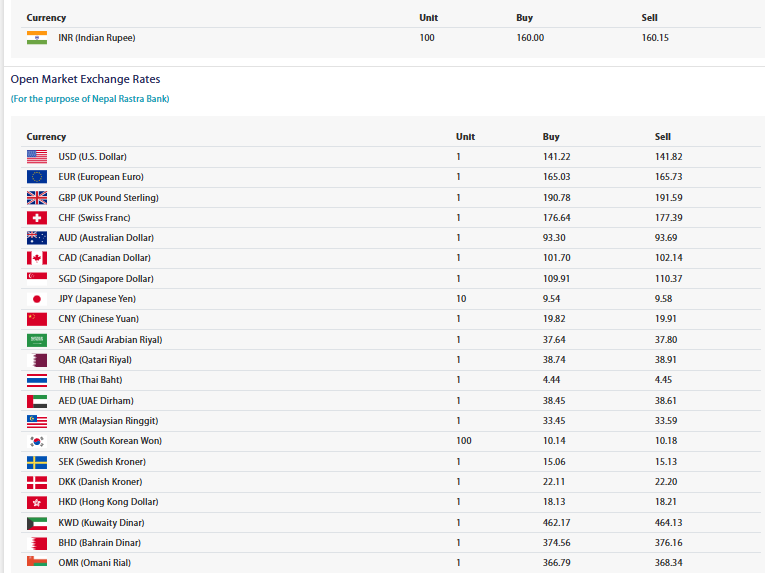
Similarly, the Saudi Arabian riyal (SAR) stands at NPR 37.64 for buying and NPR 37.80 for selling, while the Qatari riyal (QAR) has been set at NPR 38.74 for buying and NPR 38.91 for selling. These Middle Eastern currencies are of great significance due to Nepal’s large migrant worker population in the Gulf region, where remittances form a substantial portion of the national economy.
South Asian and Middle Eastern Currency Updates
The Thai baht (THB) has been valued at NPR 4.44 for buying and NPR 4.45 for selling, while the UAE dirham (AED) is set at NPR 38.45 for buying and NPR 38.61 for selling. The Malaysian ringgit (MYR) stands at NPR 33.45 for buying and NPR 33.59 for selling. Meanwhile, the South Korean won (KRW), calculated on the basis of 100 won, is NPR 10.14 for buying and NPR 10.18 for selling. In Europe’s Nordic currencies, the Swedish krona (SEK) is NPR 15.06 for buying and NPR 15.13 for selling, while the Danish krone (DKK) stands at NPR 22.11 for buying and NPR 22.20 for selling.
The Hong Kong dollar (HKD) has been fixed at NPR 18.13 for buying and NPR 18.21 for selling. Among high-value Gulf currencies, the Kuwaiti dinar (KWD) has been fixed at NPR 462.17 for buying and NPR 464.13 for selling, making it the strongest foreign currency against the Nepali rupee today. Similarly, the Bahraini dinar (BHD) is NPR 374.56 for buying and NPR 376.16 for selling, while the Omani rial (OMR) has been valued at NPR 366.79 for buying and NPR 368.34 for selling.
Indian Rupee Exchange Rate
The exchange rate of the Indian rupee (INR), Nepal’s closest trading partner currency, has also been updated. For INR 100, the buying rate has been fixed at NPR 160.00, while the selling rate is NPR 160.15. Given the long-standing peg of the Nepali rupee to the Indian rupee, this exchange rate is crucial for Nepal’s cross-border trade, tourism, and financial dealings with India.
Flexibility in Exchange Rate Adjustments
The NRB has clarified that the published exchange rates are subject to revision at any time if necessary, depending on fluctuations in the international currency market. While these are the official rates announced by the central bank, it has also noted that commercial banks may apply slightly different rates when conducting transactions with their customers. The most updated exchange rates are always made available on the official website of Nepal Rastra Bank.
Implications for the Economy
Foreign exchange rates play a vital role in determining the country’s trade balance, import costs, remittance inflows, and overall economic stability. For a country like Nepal, which relies heavily on remittances from its diaspora community, the valuation of currencies like the US dollar, Gulf riyals, and Indian rupee has direct implications for household incomes and consumer spending.
Businesses engaged in imports and exports also depend on these rates for financial planning and pricing strategies. A stronger dollar, for instance, increases the cost of imports but boosts remittance inflows. Similarly, fluctuations in the Gulf currencies impact the earnings of millions of Nepali workers abroad. By publishing daily updates, the central bank aims to ensure transparency, stability, and uniformity in currency exchange practices across the financial sector.