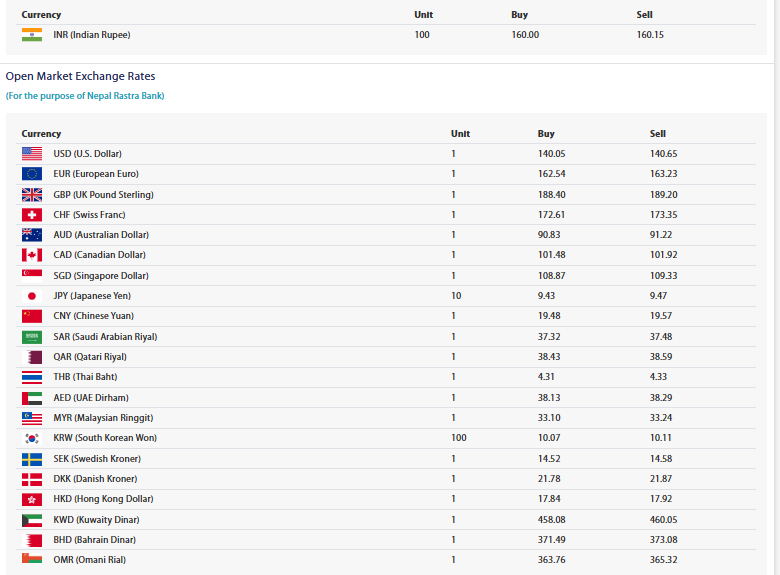
Nepal Rastra Bank (NRB), the country’s central bank, has announced the official foreign exchange rates applicable for today. According to the latest update, the buying rate for one U.S. dollar has been set at NPR 140.05, while the selling rate is NPR 140.65. These rates are applicable for transactions involving commercial banks and foreign exchange dealers across the nation.
The central bank updates these rates daily to reflect fluctuations in the international currency market, ensuring that foreign trade and remittance activities in Nepal are based on accurate and up-to-date values.
Exchange Rates for Major Global Currencies
In addition to the U.S. dollar, the NRB has set the buying rate for one European euro at NPR 162.54 and the selling rate at NPR 163.23. The British pound sterling stands at NPR 188.40 for buying and NPR 189.20 for selling. The Swiss franc is being bought at NPR 172.61 and sold at NPR 173.35.
For the Australian dollar, the buying rate is NPR 90.83, with the selling rate at NPR 91.22. Similarly, the Canadian dollar is set at NPR 101.48 for buying and NPR 101.92 for selling. The Singapore dollar stands at NPR 108.87 for buying and NPR 109.33 for selling.
Asian Currency Rates
The Japanese yen, calculated per 10 units, has been fixed at NPR 9.43 for buying and NPR 9.47 for selling. The Chinese yuan is being traded at NPR 19.48 for buying and NPR 19.57 for selling.
Among Gulf currencies, the Saudi Arabian riyal is set at NPR 37.32 for buying and NPR 37.48 for selling. The Qatari riyal stands at NPR 38.43 for buying and NPR 38.59 for selling.
Other International Currencies and Gulf Rates
The Thai baht is set at NPR 4.31 for buying and NPR 4.33 for selling, while the UAE dirham stands at NPR 38.13 for buying and NPR 38.29 for selling. The Malaysian ringgit is traded at NPR 33.10 for buying and NPR 33.24 for selling. The South Korean won, calculated per 100 units, has been set at NPR 10.07 for buying and NPR 10.11 for selling.
For Scandinavian currencies, the Swedish krona is priced at NPR 14.52 for buying and NPR 14.58 for selling, while the Danish krone is at NPR 21.78 for buying and NPR 21.87 for selling.
The Hong Kong dollar is fixed at NPR 17.84 for buying and NPR 17.92 for selling. Among the high-value Middle Eastern currencies, the Kuwaiti dinar stands at a significant NPR 458.08 for buying and NPR 460.05 for selling. The Bahraini dinar is set at NPR 371.49 for buying and NPR 373.08 for selling. The Omani rial is valued at NPR 363.76 for buying and NPR 365.32 for selling.
Exchange Rate with Indian Rupee
Given Nepal’s open border and close economic ties with India, the Indian currency remains a key component of Nepal’s foreign exchange framework. For today, the buying rate for INR 100 is set at NPR 160.00, while the selling rate is NPR 160.15.
Since the exchange rate between the Indian and Nepali currencies is pegged, fluctuations are minimal compared to other international currencies, but the central bank still publishes official rates daily for record-keeping and transaction purposes.
Central Bank’s Role in Currency Stability
NRB plays a crucial role in stabilizing Nepal’s currency against global currencies by regularly monitoring the foreign exchange market and adjusting rates as necessary. This is particularly important for a country like Nepal, which depends heavily on imports, remittances, and tourism for its foreign currency reserves.
The daily exchange rate announcements are critical for banks, remittance companies, importers, exporters, and individuals engaged in foreign transactions. The rates affect not only large-scale international trade but also personal remittances sent by millions of Nepalis working abroad.
Possible Revisions and Commercial Bank Variations
The central bank has stated that it reserves the right to revise the published exchange rates at any time if necessary, depending on global currency fluctuations. It also clarified that the rates set by commercial banks may differ slightly due to transaction fees and operational costs.
For the most accurate and updated exchange rates, NRB advises individuals and businesses to check its official website, where real-time updates are made available.
Economic Implications of Today’s Rates
The value of the U.S. dollar remains a significant benchmark for Nepal’s economy, influencing import costs, remittance inflows, and tourism revenues. A stronger dollar generally benefits Nepalis receiving remittances from countries like the United States, Australia, and the Gulf, as they receive more in Nepali currency. However, it also increases the cost of importing fuel, machinery, electronics, and other goods priced in dollars.
Similarly, the euro and pound sterling rates are crucial for Nepal’s trade with Europe, while Gulf currencies like the Saudi riyal, Qatari riyal, and Kuwaiti dinar have a direct impact on the remittance income from a large number of Nepali migrant workers based in those countries.
The exchange rates also play a role in determining tourism competitiveness. For instance, a weaker Nepali rupee against major foreign currencies makes Nepal a more affordable destination for international travelers, potentially boosting tourism revenue.
The updated foreign exchange rates announced by Nepal Rastra Bank for today reflect both global market movements and Nepal’s domestic currency stability objectives. While these rates benefit certain sectors such as remittances and tourism, they also pose challenges for import-dependent industries. By closely monitoring currency trends and adjusting rates accordingly, NRB continues to play a pivotal role in ensuring Nepal’s financial stability in an increasingly interconnected global economy.