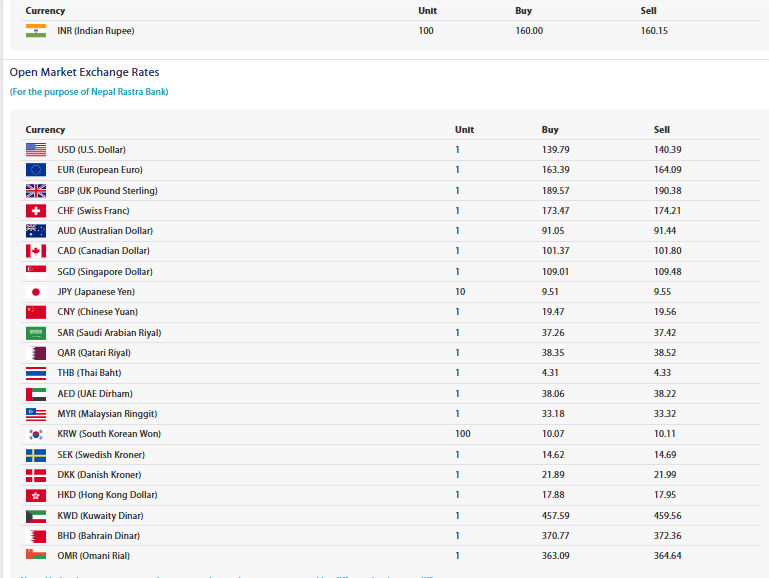
Nepal Rastra Bank (NRB), the central bank of Nepal, has published the foreign exchange rates applicable for Sunday. According to the latest update, the buying rate of one U.S. dollar has been fixed at Rs. 139.79, while the selling rate stands at Rs. 140.39. The U.S. dollar continues to remain a benchmark currency for international trade and remittance inflow in Nepal, and even minor fluctuations in its rate impact the national economy, particularly in import bills and foreign debt repayment.
Euro and Pound Sterling Rates
In addition to the U.S. dollar, the bank has also set the rates for the European currencies. One Euro can be purchased at Rs. 163.39 and sold at Rs. 164.09. Similarly, the buying rate of one British Pound Sterling is Rs. 189.57, while the selling rate is Rs. 190.38. Given the strong trade ties and remittance flows from European countries, these rates are closely monitored by both businesses and individuals.
Swiss Franc and Other Major Currencies
The central bank has also announced the exchange rate for the Swiss Franc, with one Franc priced at Rs. 173.47 for buying and Rs. 174.21 for selling. The Swiss Franc, though not a frequently traded currency in Nepal, holds significance for financial transactions and foreign investments. Meanwhile, the Australian Dollar has been fixed at Rs. 91.05 for buying and Rs. 91.44 for selling, whereas the Canadian Dollar is priced at Rs. 101.37 and Rs. 101.80 respectively.
The Singapore Dollar, a currency often linked to trade and business travelers, has been set at Rs. 109.01 for buying and Rs. 109.48 for selling.
Asian Currencies: Yen and Yuan
Among Asian currencies, the Japanese Yen (for 10 units) has been fixed at Rs. 9.51 for buying and Rs. 9.55 for selling. Similarly, the Chinese Yuan has been set at Rs. 19.47 for buying and Rs. 19.56 for selling. Both currencies are important for Nepal due to cross-border trade and increasing business transactions with Japan and China.
The Saudi Arabian Riyal, a key currency for Nepali migrant workers in the Gulf, has been set at Rs. 37.26 for buying and Rs. 37.42 for selling. Similarly, the Qatari Riyal is fixed at Rs. 38.35 for buying and Rs. 38.52 for selling.
Gulf Region and Middle Eastern Currencies
The United Arab Emirates Dirham has been valued at Rs. 38.06 for buying and Rs. 38.22 for selling. Given the large number of Nepali workers in the UAE, this exchange rate directly affects remittance inflows into Nepal. The Kuwaiti Dinar, considered one of the strongest currencies globally, has been priced at Rs. 457.59 for buying and Rs. 459.56 for selling. Similarly, the Bahraini Dinar has been set at Rs. 370.77 for buying and Rs. 372.36 for selling, while the Omani Riyal has been set at Rs. 363.09 for buying and Rs. 364.64 for selling. These currencies are particularly significant for Nepali families receiving remittances from the Middle East.
South and East Asian Currencies
The Thai Baht has been fixed at Rs. 4.31 for buying and Rs. 4.33 for selling. Similarly, the Malaysian Ringgit has been valued at Rs. 33.18 for buying and Rs. 33.32 for selling. Another important Asian currency, the South Korean Won (per 100 units), has been set at Rs. 10.07 for buying and Rs. 10.11 for selling. These rates are crucial for workers and businesses dealing with East and Southeast Asia.
The Swedish Krona has been priced at Rs. 14.62 for buying and Rs. 14.69 for selling, while the Danish Krona has been set at Rs. 21.89 and Rs. 21.99 respectively.
Hong Kong Dollar and Indian Rupee
The Hong Kong Dollar has been set at Rs. 17.88 for buying and Rs. 17.95 for selling. Meanwhile, the Indian Rupee, Nepal’s most crucial neighboring currency, has been fixed at Rs. 160 per 100 units for buying and Rs. 160.15 per 100 units for selling. The exchange rate with the Indian Rupee is particularly significant since Nepal shares open borders with India, and a majority of daily trade, travel, and transactions depend on this currency.
Exchange Rates Subject to Change
The central bank has clarified that the announced exchange rates are subject to revision as per market needs and global currency fluctuations. While NRB publishes official reference rates daily, the commercial banks of Nepal may set slightly different rates for buying and selling currencies based on their own market conditions.
The bank has also reminded the public that the latest updated rates are always available on the NRB’s official website and that individuals and businesses should rely on these official sources before making foreign exchange transactions.
Nepal Rastra Bank’s announcement of the daily foreign exchange rates provides crucial guidance to businesses, importers, exporters, remittance receivers, and ordinary citizens. With the U.S. dollar continuing to play a central role in Nepal’s economy and other international currencies influencing trade and remittances, these daily rates are a vital indicator of the country’s financial stability.
The announcement highlights not only the importance of foreign exchange in sustaining Nepal’s import-driven economy but also the direct impact these rates have on millions of Nepali households who rely on remittances from abroad. As the global economy fluctuates and the value of currencies shifts, the role of NRB in ensuring transparency and stability in foreign exchange remains central to Nepal’s financial system.