The Nepal Rastra Bank (NRB), the central monetary authority of the country, has released the official foreign exchange rates for today, providing detailed buy and sell values of major global currencies. According to the NRB, the exchange rate is subject to revision as per market conditions, and commercial banks across the country may adopt slightly different rates within the prescribed margin.
US Dollar, Euro, and Pound Sterling
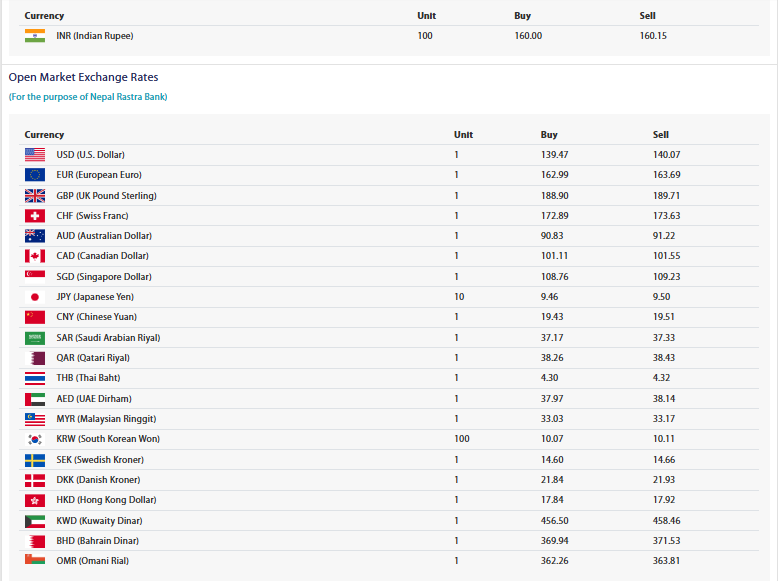
As per today’s update, the US Dollar remains one of the most closely monitored currencies in Nepal’s financial market. The central bank has set the buying rate of one US dollar at Rs. 139.47 and the selling rate at Rs. 140.07. The Euro, widely used for trade and remittance transactions with Europe, has been fixed at Rs. 162.99 for buying and Rs. 163.69 for selling. Similarly, the UK Pound Sterling continues to stand strong against the Nepali rupee, with the buying rate set at Rs. 188.90 and the selling rate at Rs. 189.71.
These rates play a vital role in international transactions, especially for importers, exporters, and Nepali workers residing abroad who send remittances back home. The continuous fluctuations in these major currencies are closely monitored by businesses and individuals alike.
Swiss Franc, Australian, Canadian, and Singapore Dollars
In addition to the major global currencies, the Nepal Rastra Bank has also updated the rates for other frequently traded currencies. The Swiss Franc has been valued at Rs. 172.89 for buying and Rs. 173.63 for selling. The Australian Dollar is fixed at Rs. 90.83 buying and Rs. 91.22 selling, while the Canadian Dollar stands at Rs. 101.11 buying and Rs. 101.55 selling.
Similarly, the Singapore Dollar has been set at Rs. 108.76 for buying and Rs. 109.23 for selling. These currencies, though not as widely circulated as the US Dollar or Euro, are still crucial for Nepal’s financial and trade dealings, especially in the context of students studying abroad, business investments, and international tourism.
Asian Currencies: Yen, Yuan, Riyal, and Baht
Asian currencies also feature prominently in the daily exchange rate updates. According to the NRB, 10 Japanese Yen has been fixed at Rs. 9.46 for buying and Rs. 9.50 for selling. The Chinese Yuan, one of Nepal’s important trade currencies due to growing import activities, has been valued at Rs. 19.43 buying and Rs. 19.51 selling.
Among the Middle Eastern currencies, the Saudi Arabian Riyal stands at Rs. 37.17 buying and Rs. 37.33 selling, while the Qatari Riyal has been priced at Rs. 38.26 for buying and Rs. 38.43 for selling. These rates are of particular significance for the thousands of Nepali migrant workers employed in Gulf countries, as remittance inflows from this region form a large share of Nepal’s foreign income.
The Thai Baht has been set at Rs. 4.30 for buying and Rs. 4.32 for selling, while the UAE Dirham is fixed at Rs. 37.97 buying and Rs. 38.14 selling. Similarly, the Malaysian Ringgit has been valued at Rs. 33.03 buying and Rs. 33.17 selling.
Korean Won, Swedish and Danish Kroner
Other currencies listed by the central bank include the South Korean Won, where 100 Won is valued at Rs. 10.07 for buying and Rs. 10.11 for selling. The Swedish Kroner stands at Rs. 14.60 buying and Rs. 14.66 selling, while the Danish Kroner has been fixed at Rs. 21.84 for buying and Rs. 21.93 for selling.
These currencies, though not as widely used for remittances compared to Gulf and Western currencies, are important for academic exchanges, tourism, and trade-related activities between Nepal and respective countries.
Hong Kong Dollar, Kuwaiti Dinar, Bahraini Dinar, and Omani Riyal
The Nepal Rastra Bank has also updated the rates of stronger currencies from the Middle East and Asia. The Hong Kong Dollar has been fixed at Rs. 17.84 for buying and Rs. 17.92 for selling. The Kuwaiti Dinar, one of the world’s strongest currencies, is valued at Rs. 456.50 for buying and Rs. 458.46 for selling. Likewise, the Bahraini Dinar has been set at Rs. 369.94 buying and Rs. 371.53 selling, while the Omani Riyal stands at Rs. 362.26 for buying and Rs. 363.81 for selling.
The high valuation of these currencies is of particular importance to Nepali migrant workers stationed in Kuwait, Bahrain, and Oman, as their remittances convert into larger sums when transferred back to Nepal in rupees.
Indian Rupee and Its Special Context
Given Nepal’s close economic and geographical ties with India, the Indian Rupee remains one of the most significant foreign currencies in daily use. The central bank has fixed the rate for 100 Indian rupees at Rs. 160.00 for buying and Rs. 160.15 for selling. Unlike other currencies, the exchange rate of the Indian rupee is pegged to the Nepali rupee under a fixed exchange arrangement, making it relatively stable compared to global fluctuations.
This fixed arrangement ensures smoother cross-border trade and remittance flow between Nepal and India, supporting millions of daily transactions on both sides of the border.
Possibility of Rate Revisions
While issuing today’s update, the Nepal Rastra Bank clarified that these rates are subject to revision at any time depending on international currency market fluctuations. The bank has also reminded the public that commercial banks may apply slightly different exchange rates, but the official and most accurate information is always available on the central bank’s website.
The daily publication of foreign exchange rates by the Nepal Rastra Bank plays a critical role in guiding Nepal’s trade, remittance, and tourism-related financial transactions. With the Nepali economy heavily dependent on imports and remittance inflows, fluctuations in foreign currency rates directly affect the cost of goods, services, and household income.
Today’s updated rates once again highlight the significance of global economic trends on Nepal’s domestic financial landscape. By maintaining transparency and timely updates, the central bank continues to provide essential information for businesses, financial institutions, and the general public to plan their economic activities effectively.