The Nepal Rastra Bank (NRB), the country’s central monetary authority, has officially published today’s foreign exchange rates for a wide range of international currencies. These rates serve as benchmarks for banks and financial institutions conducting foreign currency transactions within Nepal. The central bank has also clarified that these rates are subject to change depending on market dynamics and international economic fluctuations.
USD, Euro, and Pound Sterling Exchange Rates
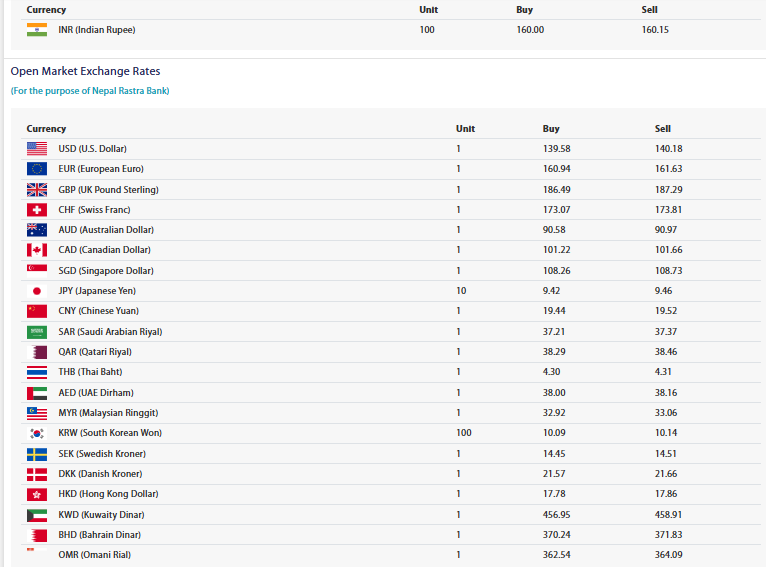
As per the latest bulletin issued by NRB, the buying rate for 1 US dollar (USD) has been fixed at Rs. 139.58, while the selling rate is Rs. 140.18. The Euro (EUR), one of the most widely traded currencies globally, has a buying rate of Rs. 160.94 and a selling rate of Rs. 161.63. Likewise, the British Pound Sterling (GBP) is trading at Rs. 186.49 (buying) and Rs. 187.29 (selling).
In the context of strong trade relations and remittance inflows from Europe and North America, these currencies hold significant weight in Nepal’s forex market. Their values directly impact import-export settlements, overseas education payments, and tourism-related transactions.
Rates for Regional and Major Global Currencies
Among other widely-used currencies, the Swiss Franc (CHF) is being traded at Rs. 173.07 (buying) and Rs. 173.81 (selling). The Australian Dollar (AUD) stands at Rs. 90.58 for buying and Rs. 90.97 for selling, whereas the Canadian Dollar (CAD) is valued at Rs. 101.22 (buying) and Rs. 101.66 (selling). The Singapore Dollar (SGD) also features prominently, with a buying rate of Rs. 108.26 and a selling rate of Rs. 108.73.
From Asia, the Japanese Yen (JPY), valued per 10 units, has a buying rate of Rs. 9.42 and a selling rate of Rs. 9.46. The Chinese Yuan (CNY) is at Rs. 19.44 (buying) and Rs. 19.52 (selling). These two currencies are particularly important due to Nepal’s strong trade, tourism, and diplomatic ties with China and Japan.
Middle East Currencies Reflect Remittance Ties
Remittance being a key pillar of Nepal’s economy, Middle Eastern currencies hold considerable relevance. The Saudi Riyal (SAR) is fixed at Rs. 37.21 (buying) and Rs. 37.37 (selling), while the Qatari Riyal (QAR) stands at Rs. 38.29 and Rs. 38.46 respectively. The UAE Dirham (AED) is currently being traded at Rs. 38.00 (buying) and Rs. 38.16 (selling).
From other Gulf countries, the Kuwaiti Dinar (KWD) has the highest valuation among all listed currencies, with a buying rate of Rs. 456.95 and selling rate of Rs. 458.91. The Bahraini Dinar (BHD) follows closely at Rs. 370.24 (buying) and Rs. 371.83 (selling), while the Omani Riyal (OMR) is listed at Rs. 362.54 (buying) and Rs. 364.09 (selling).
These exchange rates are critical for Nepali workers in the Gulf countries and the businesses that support these remittance channels, as they determine the value of earnings sent back home.
Rates for Asian and European Minor Currencies
NRB has also published rates for other regional currencies such as the Thai Baht (THB), with a buying rate of Rs. 4.30 and a selling rate of Rs. 4.31. The Malaysian Ringgit (MYR) is listed at Rs. 32.92 (buying) and Rs. 33.06 (selling). The South Korean Won (KRW) per 100 units is priced at Rs. 10.09 (buying) and Rs. 10.14 (selling).
For minor European currencies, the Swedish Kroner (SEK) has a buying rate of Rs. 14.45 and a selling rate of Rs. 14.51, while the Danish Kroner (DKK) is trading at Rs. 21.57 (buying) and Rs. 21.66 (selling). The Hong Kong Dollar (HKD) is marked at Rs. 17.78 (buying) and Rs. 17.86 (selling).
INR Remains Stable Amid Trade Ties
In terms of Nepal’s closest economic partner, India, the Indian Rupee (INR) remains pegged under the fixed exchange rate regime. The NRB has set the buying rate for INR 100 at Rs. 160.00, and the selling rate at Rs. 160.15. This fixed rate plays a crucial role in bilateral trade, cross-border transactions, and financial coordination between the two neighbors.
Exchange Rates Subject to Market Adjustments
The Nepal Rastra Bank has emphasized that the rates released today are indicative and may be revised at any time based on demand and supply conditions in the foreign exchange market. The bank has also notified that exchange rates set by commercial banks may vary slightly from the official NRB rates due to operational costs and currency availability.
Furthermore, the NRB has advised the general public, travelers, and businesses to refer to its official website for the most up-to-date and authoritative information on foreign exchange rates.
Today’s foreign exchange rates reflect Nepal’s deepening engagement with international economies, especially those in North America, Europe, the Middle East, and Asia. For importers, exporters, students studying abroad, foreign jobholders, and global tourists, these rates are essential indicators of financial decisions and economic trends.