Nepal’s tourism sector continued its steady growth in 2025, welcoming 11,58,459 international visitors throughout the year, according to official data released by the Nepal Tourism Board (NTB). This represents a slight increase of 0.96% compared to 11,47,548 arrivals in 2024 and marks a 97% recovery relative to pre-pandemic levels, showcasing Nepal’s resilience as a top travel destination in South Asia.
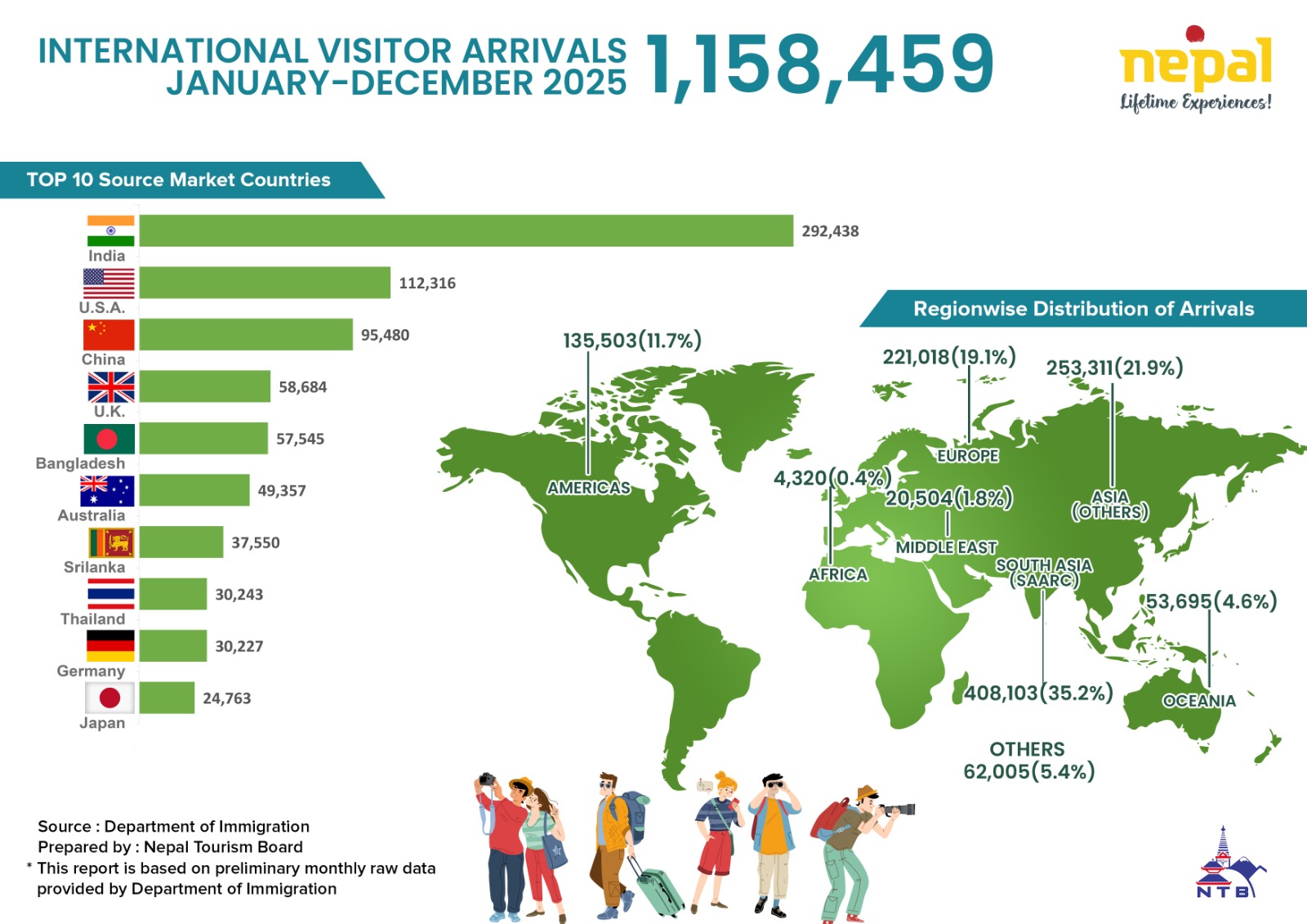
The majority of visitors in 2025 hailed from India, the United States, China, the United Kingdom, and Bangladesh, with India alone contributing 292,438 visitors or 25.2% of total arrivals, solidifying Nepal’s dependency on regional tourism markets.

While the tourism industry demonstrated a strong recovery, it faced challenges during September 2025, when widespread Gen-Z-led protests disrupted transport and public safety, temporarily affecting travel confidence. Tourist arrivals dipped during this period but quickly rebounded in the subsequent months as the government reassured safety and infrastructure improvements restored visitor confidence.
Monthly Trends and Seasonal Peaks
The monthly distribution of tourist arrivals in 2025 indicates strong seasonal trends, with peak months March, April, and October recording the highest influx of visitors:
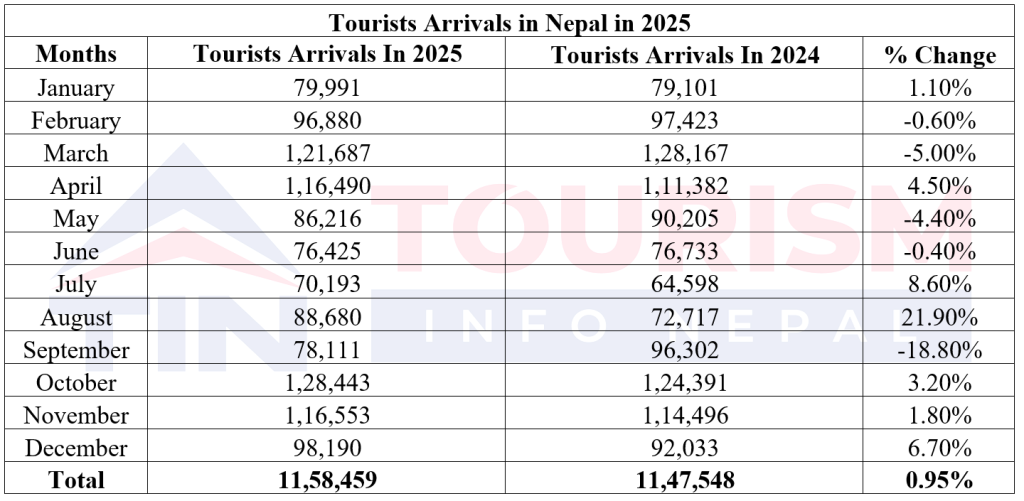
The table shows August 2025 witnessed a sharp rebound of 21.87% compared to 2024, indicating strong pent-up demand following the Gen-Z protest disruption in September, which caused a temporary dip of 18.85% in arrivals compared to the previous year. This demonstrates that while social movements can temporarily affect tourism flows, the sector’s fundamentals and Nepal’s global appeal enable rapid recovery.
Regional and Market Contributions
Nepal’s tourism recovery in 2025 is also reflected in its regional and market-specific arrivals. The top five tourist-generating countries accounted for nearly 53% of all international arrivals:
- India: 292,438 (25.2%)
- USA: 112,316 (9.7%)
- China: 95,480 (8.2%)
- UK: 58,684 (5.1%)
- Bangladesh: 57,545 (5.0%)
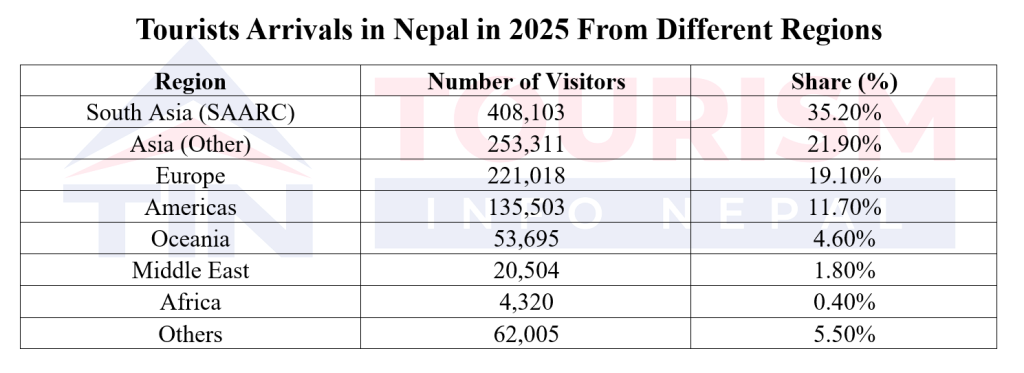
Regionally, SAARC countries led the arrivals with 408,103 visitors (35.2%), followed by Asia (excluding SAARC) with 253,311 (21.9%), and Europe with 221,018 (19.1%). The Americas contributed 135,503 arrivals (11.7%), while Oceania, Middle East, Africa, and other regions together made up the remaining 12.3%.
These statistics highlight that regional tourism, particularly from India and neighboring South Asian nations, remains the backbone of Nepal’s tourism industry, while international arrivals from Europe and the Americas continue to grow steadily.
Financial Impact and Tourism Investment
The resurgence of Nepal’s tourism sector has brought substantial economic benefits to the country. In the fiscal year 2082/83, foreign currency earnings from tourism amounted to NRs. 27,152.55 million during the period from Shrawan to Kartik, reflecting the growing spending power of international visitors. Additionally, Foreign Direct Investment (FDI) in the tourism sector reached NRs. 30,263 million across 476 projects from Shrawan to Mangsir, highlighting strong investor confidence in Nepal’s tourism potential. This significant inflow of capital not only strengthens the sector’s financial foundation but also underscores its capacity to generate long-term economic growth and sustainable development for the nation.
Recovery Amid Challenges
The Gen-Z protest movement in September 2025, focused on employment, governance, and transparency issues, caused a temporary decline in international arrivals, particularly impacting bookings for trekking, cultural tours, and adventure tourism in Kathmandu and Pokhara. However, tourism stakeholders quickly adapted by enhancing safety protocols, promoting alternative destinations, and leveraging digital marketing campaigns.
The months following September saw a strong recovery in October, November, and December, with international arrivals exceeding the previous year by 3.23%, 1.79%, and 6.69%, respectively. This recovery underscores Nepal’s robust tourism management, the appeal of its Himalayan trekking, cultural heritage, and adventure tourism offerings.
As Nepal enters 2026, the tourism sector is poised for further growth and diversification. With international connectivity improving through new flight routes, innovative marketing campaigns, and investments in sustainable tourism infrastructure, Nepal aims to reach pre-pandemic visitor levels by the end of 2026.
Tourism authorities also emphasize strengthening resilience against social disruptions, ensuring that visitor experiences remain safe and enjoyable. The successful bounce-back from September 2025 demonstrates the industry’s capacity to adapt, making Nepal a reliable and attractive destination for international travelers.

Nepal’s tourism sector demonstrated remarkable resilience in 2025, registering 11,58,459 international arrivals, nearly 1% above the previous year and 97% of pre-pandemic levels. Despite temporary disruptions caused by the Gen-Z protest movement, Nepal successfully recovered, driven by strong regional demand, diversified international arrivals, and strategic tourism investments.
With robust government support, increased safety measures, and a focus on sustainable tourism, the industry is well-positioned for continued growth in 2026, reaffirming Nepal’s status as a premier destination for adventure, culture, and Himalayan exploration.