
The Pacific Asia Travel Association (PATA) has released its Annual Tourism Monitor 2026, revealing that international tourism across the Asia Pacific region is nearing full recovery from the COVID 19 pandemic. According to the report released in Bangkok on October 22, 2026, international visitor arrivals across 44 destinations reached 239 million during the early months of 2026, marking a 2.9% increase compared with the corresponding periods in 2025.
Despite the continued recovery, tourism growth is beginning to moderate, and performance varies significantly across destinations. The report highlights a shift in the region’s tourism industry, with greater emphasis on sustainable growth, destination resilience, improved connectivity, and creating long term value for visitors and local communities.

Asia Pacific Tourism Approaches Pre Pandemic Levels
The report shows that Asia Pacific recorded 700.2 million international visitor arrivals across 46 destinations in 2025, equivalent to 99.3% of the region’s 2019 total. Asia accounted for the largest share, with 523.1 million arrivals, while the Pacific recovered to 89.4% and the Americas reached 94.2% of their respective 2019 levels.
The latest figures indicate that the region has made substantial progress in restoring international travel following the pandemic. However, the pace of growth is becoming more moderate as destinations move beyond the initial recovery phase. Differences in visitor demand, travel policies, connectivity, and economic conditions continue to influence tourism performance across individual markets.
Vietnam and South Korea Lead Growth in Key Markets
The Annual Tourism Monitor 2026 highlights contrasting performances among major destinations. The United States recorded 27 million international visitor arrivals in the early reporting period, followed by Hong Kong SAR, Macao, Türkiye, and Mexico among the leading destinations covered. Thailand and Japan also remained significant tourism markets, while Vietnam and South Korea recorded particularly strong growth.
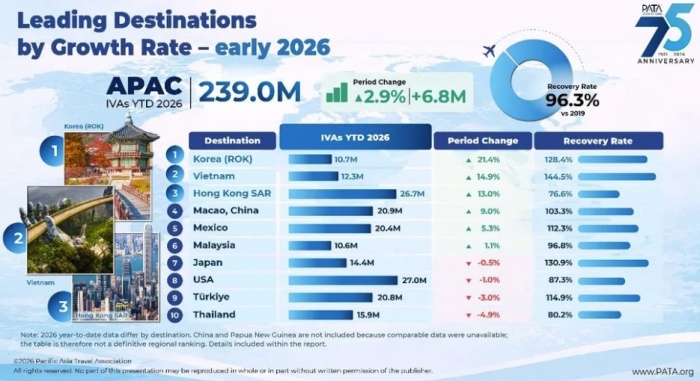
South Korea welcomed 10.7 million international visitors, representing a 21.4% year on year increase and reaching 128.4% of its comparable 2019 level. Vietnam recorded 12.3 million arrivals, up 14.9% year on year and reaching 144.5% of its 2019 volume. These figures demonstrate how some destinations have moved beyond pre pandemic visitor levels while continuing to attract growing international demand.
Tourism Industry Shifts Towards Sustainable Growth
PATA CEO Noor Ahmad Hamid emphasized that the industry’s recovery does not eliminate uncertainty, noting that geopolitical conflicts, natural disasters, economic pressures, and changes in travel policies continue to affect tourism. He stressed the importance of collaboration, adaptability, and responding effectively to changing traveler needs as the region enters its next phase of development.
The report also highlights the importance of travel facilitation, air connectivity, transportation links, and accessible visa policies in supporting future growth. Higher travel costs and complicated travel procedures can influence destination choices, while diversifying source markets and encouraging longer stays can help destinations manage fluctuations in visitor demand. Destinations that have exceeded their pre pandemic levels may also need to manage visitor flows more effectively and encourage travel beyond peak seasons and major gateways.

PATA Report Highlights the Future of Regional Tourism
The PATA Annual Tourism Monitor 2026 provides updated analysis of international visitor arrivals across Asia Pacific and examines the trends shaping the industry as it moves from pandemic recovery towards a new phase of growth. The report suggests that future tourism success should be measured not only by visitor numbers but also by the value created for destinations, businesses, communities, and travelers.
PATA has made the report available for purchase through its official website, with complimentary access offered as a benefit to eligible members. As the region approaches full tourism recovery, the findings underline the need for destinations to balance visitor growth with resilience, sustainability, and long term economic and social benefits.