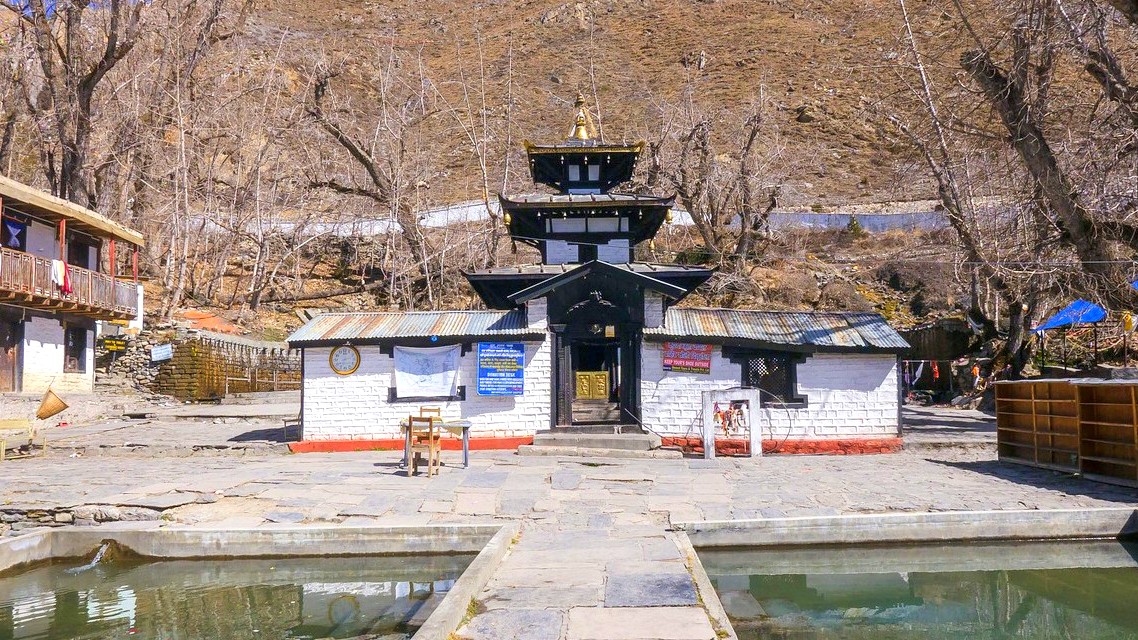
In a significant step toward enhancing the pilgrimage experience, the premises of the revered Muktinath Temple in Baragung Muktikshetra-1, Mustang, have been upgraded to make the area more comfortable and accessible for visitors. Muktinath holds immense spiritual importance for both Hindu and Buddhist devotees, serving as a sacred destination for thousands of pilgrims each year.
Upgradation with Focus on Preservation
The upgradation work was carried out without disturbing the original and historic layout of the temple premises. According to Nirpati Darjee, Head of the Social Development Office of Mustang, the improvement was made possible through a budget allocation of NPR 900,000 under the current fiscal year.
The work primarily involved laying “Chhapani” stones, a traditional and durable form of stone paving, across specific areas within the temple complex. This was done to smoothen pathways and make them safer and more comfortable for pilgrims. The project was awarded through a quotation contract, and Khenga Construction was selected to carry out the stone laying in front of the temple, around the sacred pond (Kund), and near the 108 water spouts.
Partial Completion Due to Budget Constraints
While the temple area has seen visible improvement, budget limitations prevented the full completion of the stone-laying project. According to Lakpatasi Gurung, a representative of the construction firm, only 3,140 square feet of Chhapani stone could be laid this time.
“The available budget allowed us to upgrade a substantial portion of the premises,” Gurung said, “but a complete makeover of the entire perimeter still remains to be done.” Nonetheless, the improvements have already made a noticeable difference in accessibility and aesthetics for visitors.
Smoother and Safer for Pilgrims
The upgraded pathways are already receiving praise from temple staff and pilgrims alike. Rabeen Subedi, an employee of the Muktinath Temple Development Committee, highlighted that earlier, uneven and worn-out stones posed challenges for visitors, especially during rainy or cold seasons.
“The area in front of the temple and around the 108 sacred water taps had become difficult to walk through,” Subedi said. “Now that the surface has been leveled and new Chhapani stones have been installed, pilgrims are finding it easier and safer to move around.”
Provision of Safe Hot Drinking Water
In another pilgrim-friendly move, the Muktinath Temple Development Committee has installed an electrical dispenser that provides clean hot drinking water with a 200-liter capacity. This initiative, led by Committee Chairman and Chief District Officer Bishnu Prasad Bhusal, ensures year-round availability of hot water for pilgrims.
“Hot drinking water at such a high-altitude religious site not only offers comfort but also helps in reducing the chances of altitude sickness,” Subedi explained. Muktinath Temple, situated at an elevation of 3,710 meters (12,172 ft), is often challenging for pilgrims not acclimatized to such heights.
Safety Rails Installed Near 108 Water Spouts
Recognizing the safety concerns for pilgrims who bathe in the 108 holy spouts, safety railings have been constructed around the bathing area. These railings are expected to significantly reduce the risk of accidents, especially during peak pilgrimage seasons when large crowds gather for ritual baths.
Subedi noted, “We receive over 700,000 domestic and international pilgrims annually. Ensuring their safety is a top priority.” The new railing, combined with the leveled pathways, adds to the overall visitor management and spiritual ambiance of the sacred site.
Muktinath: A Growing Pilgrimage Destination
The Muktinath Temple complex has long been a spiritual haven, drawing visitors from across Nepal and abroad. For Hindus, the temple is one of the 108 Divya Desams—sacred abodes of Lord Vishnu—and is believed to offer liberation from the cycle of birth and death. For Buddhists, especially those following the Tibetan tradition, it is a site where the great sage Padmasambhava meditated.
With continuous improvements in infrastructure, Muktinath is evolving from a remote pilgrimage site into a more accessible and comfortable destination for seekers and tourists alike. The recent developments are part of broader efforts to promote religious tourism in Mustang, which also benefits the local economy and community.
Future Prospects
Despite the progress, officials and community leaders acknowledge that much remains to be done. Further improvements in road connectivity, additional paving around the entire temple premises, and enhanced medical and lodging facilities for pilgrims are on the wish list for future development plans.
The Social Development Office and the Temple Development Committee have expressed hope that with additional funding and support from provincial and federal governments, Muktinath will continue to transform into a world-class pilgrimage center without compromising its cultural and spiritual essence.