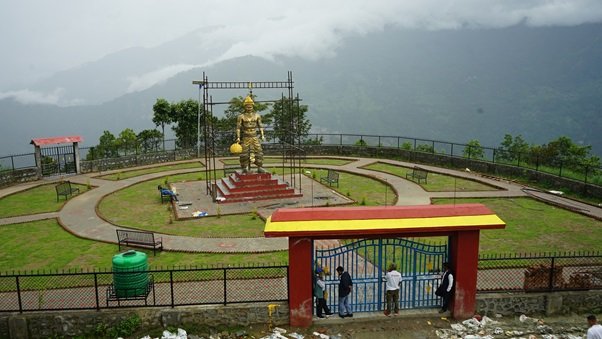
A unique religious and cultural tourism site is nearing completion in Pachaima, Ward No. 5 of Beni Municipality, Myagdi district. The site, known as Ravana Park, is in its final construction phase and is expected to be fully completed by mid-October (Ashoj), according to local officials.
An Ancient Site with Spiritual Significance
Pachaima is located northwest of Beni Bazaar and is historically believed to be a meditation site for ancient sages. The name ‘Pachai’ itself refers to a secluded place where sages used to engage in deep meditation to acquire knowledge and spiritual power. The park is being built on this sacred ground, preserving its historic and mythological value.
Iconic Ravana Statue Nearly Complete
The centerpiece of Ravana Park is an imposing 21-foot-tall bronze statue of Ravana, the mythical king of Lanka from the epic Ramayana. The statue features ten heads, a signature element of Ravana’s depiction in Hindu mythology. Apart from the minor finishing touches like placing the sacred thread (janai) and some cleaning work, the statue is nearly complete.
Municipal and Ministerial Partnership
According to Beni Municipality Mayor Surat KC, around 94 percent of the construction work has been completed, and the deadline has been extended with the goal of finishing the project by Ashoj (October). The park is being developed with shared funding, 70 percent from the Ministry of Culture, Tourism, and Civil Aviation, and 30 percent from the Beni Municipality under the Tourism Infrastructure and Product Development Partnership Program, initiated in the Fiscal Year 2076/77 (2019/20).
The 4-ropani (approximately 0.5 acre) area of the park includes fencing, entry gates, pathways, stone flooring, turf plantation, and various amenities. Notably, the park also features a garden, resting areas, and preservation of mythological landmarks such as the Ravana Navel Site, a temple dedicated to sages, and a Hawan Kund (fire altar).
Delays and Challenges in Execution
Despite an ambitious goal to complete the park within two years, the project faced numerous delays. The initial contract was awarded in Falgun 2077 (March 2021) to Dharma S. Kashyap JV at a cost of NPR 17.6 million. However, a combination of administrative lapses, including the municipality’s failure to submit timely progress reports, led to lack of budget allocation in the FYs 2079/80 and 2080/81, causing the project to stall for 44 months.
Contractors also began withdrawing interest due to uncertainties around financing. It wasn’t until Asar 2078 (July 2021) that work resumed steadily after concerted efforts to resolve the funding issue. As of now, the project is back on track and close to completion.
Mythological and Tourism Potential
According to Ward Chairman Govinda Baniya, the location of Ravana Park holds deep mythological significance. Hindu scriptures state that Pachaima is the birthplace of Ravana, son of the sage Pulatsya, and the spot where his navel is believed to be buried remains preserved as a sacred relic. The Pulaha Ashram, spanning 14 ropanis of land, also adds to the religious allure of the site.
Chairman Baniya expressed confidence that once completed, the park would serve as a major draw for both domestic and international religious tourists. The serene landscape and sacred heritage together make it an ideal destination for those seeking spiritual solace and mythological exploration.
Scenic Beauty and Accessibility
Located at an altitude of 2,000 meters above sea level, Pachaima offers panoramic views of the Dhaulagiri, Nilgiri, and Annapurna Himalayan ranges, as well as the sunrise and vast topography of Myagdi and the confluence of the Myagdi and Kaligandaki rivers.
Visitors can also enjoy the mythological energy of the place, believed to be where sages Pulaha, Kapila, and Jadbharat attained spiritual enlightenment. Chapter Five of the Ramayana mentions that Ravana was born in Pachaima, and it was here that Pulaha, Pulatsya, and Bharata sages meditated.
Long-Standing Vision Becoming Reality
The idea to build a religious garden in Pachaima was initially proposed in 2009 (2066 BS) by Pramod Kumar Shrestha, former president of the Myagdi Chamber of Commerce and Industry, and his team. Despite the allocation of funds in 2017 (2074 BS), the vision faced multiple setbacks due to land disputes and lack of resources.
Eventually, the initiative was revived and integrated into a broader plan to establish a religious corridor linking sites like Galeshwar (Muktinath Gateway), Pula Chaur’s Pachaima, Jagannath, and Todke.
How to Reach Pachaima
Pachaima is about a 30-minute drive from Beni Bazaar. The route passes through Arthunge, Bansbot, and Ekpate to reach Purundi, which is connected by a blacktopped road. From Purundi, a 2-kilometer stretch of unpaved road leads to the Ravana Park site.
Once fully developed, Ravana Park promises to be a landmark destination combining mythology, culture, nature, and panoramic beauty, opening new avenues for religious tourism in Myagdi and contributing to the district’s economic and cultural revitalization.