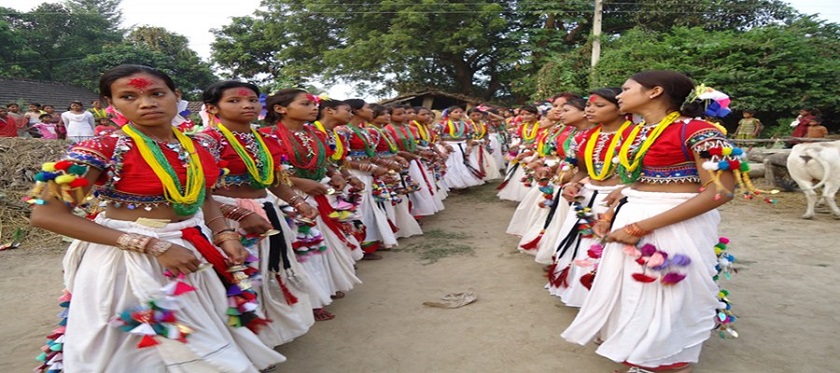
The villages and settlements of Kailali, predominantly inhabited by the Tharu community, are abuzz with preparations for the Atwari festival. This traditional festival is typically celebrated on the second Sunday following Krishna Janmashtami, with the community eagerly preparing a variety of local delicacies and engaging in other cultural activities.
During Atwari, special dishes such as rice made from Andi paddy, roti, dried fish, khariya, sidra, and phulori are prepared. Prabhat Kumar Chaudhary, a central member of the Tharu Kalyankari Sabha, explained that the Tharu community is in the final stages of preparation for the festival. “Various dishes are made using Andi rice, which has become rare and is now sourced from distant Tharu villages. Preparations for the festival’s activities, including cooking these dishes, are in full swing, which is why there is a lot of activity in our settlements,” Chaudhary added.
In addition to the culinary preparations, the community has also completed tasks such as making traditional leaf plates (duna and tapari) for the offering of ‘agrasan,’ a ritual gift, and cleaning homes and courtyards. On the evening before the main festival day, participants partake in a ritual feast. The first day of the festival, which is Sunday, sees devotees fasting without consuming even water, followed by a ritual bath in a nearby river, pond, or lake, and offering prayers.
After the prayers, a portion of the prepared food and fruit is set aside for married daughters of the household, and only then do the fasting participants eat. The set-aside portion, known as ‘agrasan’ or a ritual gift, is then sent to the homes of their married daughters and sisters. On the second day of Atwari, Monday, devotees bathe early in the morning and perform another round of prayers. They light fires using cow dung and offer ghee and pieces of pinewood during the prayer ritual.
Tharu elders explain that the festival is associated with the Mahabharata, where Bhim, the second eldest of the five Pandava brothers, defeated a demon on a Sunday, saving humanity from its terror. As a result, the Tharu community worships Bhim and the Sun God during Atwari. This festival is celebrated across districts with significant Tharu populations, including Kailali, Kanchanpur, Banke, Bardiya, Surkhet, and Dang.The villages and settlements of Kailali, predominantly inhabited by the Tharu community, are abuzz with preparations for the Atwari festival. This traditional festival is typically celebrated on the second Sunday following Krishna Janmashtami, with the community eagerly preparing a variety of local delicacies and engaging in other cultural activities.
During Atwari, special dishes such as rice made from Andi paddy, roti, dried fish, khariya, sidra, and phulori are prepared. Prabhat Kumar Chaudhary, a central member of the Tharu Kalyankari Sabha, explained that the Tharu community is in the final stages of preparation for the festival. “Various dishes are made using Andi rice, which has become rare and is now sourced from distant Tharu villages. Preparations for the festival’s activities, including cooking these dishes, are in full swing, which is why there is a lot of activity in our settlements,” Chaudhary added.
In addition to the culinary preparations, the community has also completed tasks such as making traditional leaf plates (duna and tapari) for the offering of ‘agrasan,’ a ritual gift, and cleaning homes and courtyards. On the evening before the main festival day, participants partake in a ritual feast. The first day of the festival, which is Sunday, sees devotees fasting without consuming even water, followed by a ritual bath in a nearby river, pond, or lake, and offering prayers.
After the prayers, a portion of the prepared food and fruit is set aside for married daughters of the household, and only then do the fasting participants eat. The set-aside portion, known as ‘agrasan’ or a ritual gift, is then sent to the homes of their married daughters and sisters. On the second day of Atwari, Monday, devotees bathe early in the morning and perform another round of prayers. They light fires using cow dung and offer ghee and pieces of pinewood during the prayer ritual.
Tharu elders explain that the festival is associated with the Mahabharata, where Bhim, the second eldest of the five Pandava brothers, defeated a demon on a Sunday, saving humanity from its terror. As a result, the Tharu community worships Bhim and the Sun God during Atwari. This festival is celebrated across districts with significant Tharu populations, including Kailali, Kanchanpur, Banke, Bardiya, Surkhet, and Dang.