The tiger census that began on Poush 3 in Chitwan National Park is currently underway, with Chitwan and Parsa National Parks being treated as a single census block. The first phase of the census has already been completed, while preparations for the second phase are now in progress.
According to Chitwan National Park Information Officer Abhinash Thapa Magar, the process of retrieving camera traps installed during the first phase has begun. “The retrieval of cameras started on Saturday and will be completed by Monday,” he said. A total of 150 enumerators, who were trained on Poush 1 and 2, have been mobilized for the census.

First Phase Completed Across Four Key Zones
The first phase covered Triveni, Amaltari, Kasara, and the Barandabhar corridor. These areas were divided into 286 grid units, each measuring two square kilometers. Camera traps were installed across these grids to capture tiger movements.
Once all cameras from the first phase are retrieved, the team will proceed to the second phase by installing camera traps in the remaining areas of the Chitwan–Parsa block.
Second Phase to Cover a Wider Range
For the second phase, 13 temporary camps will be set up to accommodate census teams. Camera traps will be installed across Sauraha, Khagendramalli, Lothar–Pratappur, Bote Simara, Swameshwar, Bagai, Ambuwa, and up to Shikari Bas.
This phase will be divided into 336 grid units. Each grid will be equipped with a pair of automated camera traps, which will remain in place for two weeks to monitor tiger activity.
Nationwide Census in Progress
Altogether, the Chitwan–Parsa block consists of 958 grid units. In addition to this block, tiger censuses are also being carried out simultaneously in Banke, Bardiya, and Shuklaphanta National Parks. The entire census operation is expected to take around three months.
Conducted every four years, the national tiger census involves park officials, technical experts from the National Trust for Nature Conservation, local volunteers, students, and conservation partners. Temporary technical camps are established in central grid locations to support field operations.

Advanced Monitoring Through Camera Traps
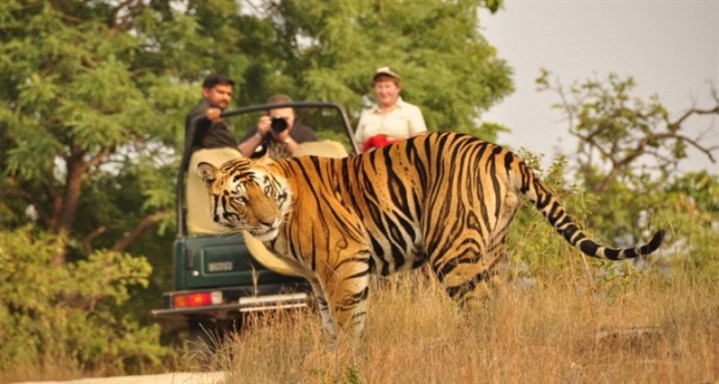
Enumerators monitor camera traps daily, covering between eight to twelve grids depending on terrain. The automated cameras are installed at locations frequently used by tigers, capturing photographs that help identify individual animals. Each tiger is distinguished by its unique stripe patterns, allowing experts to determine population numbers accurately.
Previous Census Results
The last national tiger census conducted in 2022 recorded 355 adult tigers across Nepal. Of these, 128 were found in Chitwan, 125 in Bardiya, 25 in Banke, 41 in Parsa, and 36 in Shuklaphanta National Park. Officials expect the ongoing census to provide updated data that will further strengthen Nepal’s conservation strategies and international commitment to tiger protection.