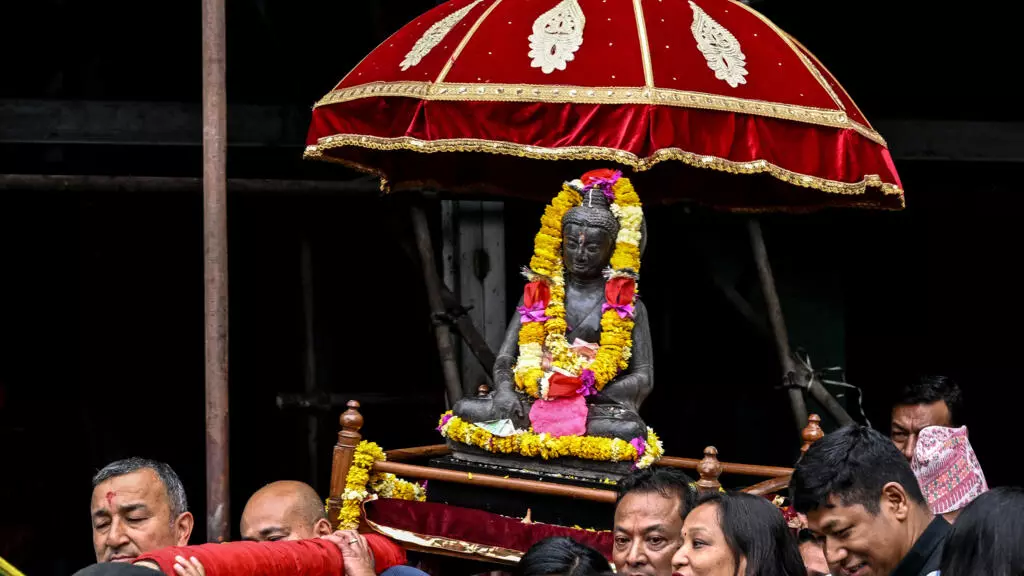
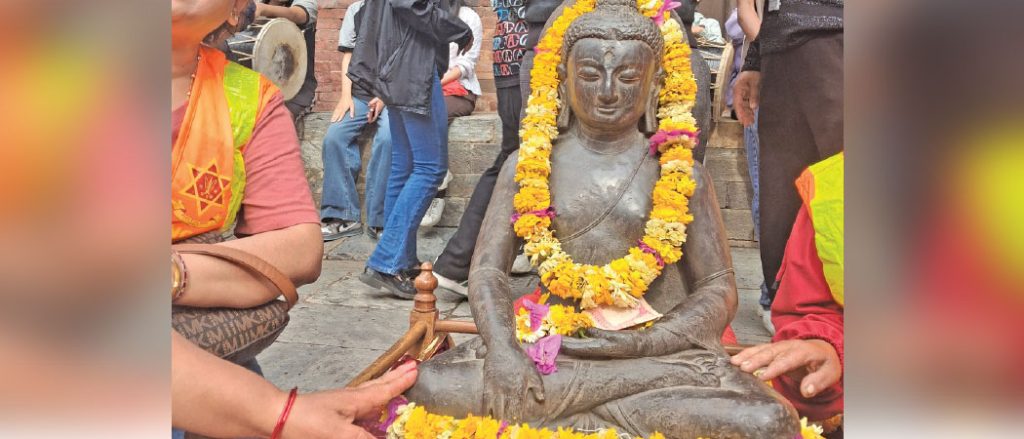
A rare 13th-century idol of Gautam Buddha has been reinstalled at Nhuchhe Baha (Bajradhatu Bihar Monastery), nearly five decades after it was stolen in the 1980s. The monastery, located in Jorganesh Ombahal Tole of Kathmandu Metropolitan City–13, witnessed an emotional and culturally significant ceremony marking the Buddha idol’s return to its original places. The reinstatement took place on May 1, coinciding with the 2570th celebration of Buddha Jayanti, adding spiritual importance to the historic event.
From Theft to Recovery: A Long Journey
The antique idol, believed to have been stolen during the 1980s, a period when many of Nepal’s cultural artifacts were illicitly trafficked abroad, was eventually traced to the Tibet House Collection in New York, United States.

After years of effort, the statue was officially repatriated to Nepal on Falgun 18, 2078 BS (March 2, 2022). Upon its return, it was kept under careful preservation at the Department of Archaeology to ensure its conservation before being restored to its religious and cultural setting.
Grand Reinstallation Ceremony with Cultural Rituals
The reinstatement ceremony drew the presence of key officials and heritage stakeholders, including Officiating Mayor of Kathmandu Sunita Dangol, Ward Chair Macharaja Maharjan, local representatives, Guthi members, and heritage conservation activists.
The event was marked by traditional rituals and the playing of indigenous music, reflecting the deep-rooted cultural practices associated with such religious heritage. Locals gathered to witness the long-awaited return of a sacred object that holds both spiritual and communal significance.
Heritage Beyond Objects: Cultural Identity Emphasized
Addressing the ceremony, Officiating Mayor Sunita Dangol stressed that the idols of Nepal Mandal are not merely artistic objects but integral parts of social and cultural life. “These idols carry deep cultural meaning and are closely connected to the daily lives and traditions of the community,” she said, urging local residents to remain vigilant and proactive in safeguarding heritage assets.
Growing Momentum in Artifact Recovery Efforts of Buddha Idol
Officials and conservation experts noted that the successful return and reinstatement of the Buddha idol reflects growing momentum in Nepal’s efforts to recover stolen cultural artifacts. National Museum Chief Aruna Nakarmi, along with heritage activists Ganapatilal Shrestha and Sanjay Adhikari, highlighted that coordinated initiatives between local authorities and international institutions are yielding positive results. They emphasized that continued vigilance and collaboration are essential to prevent further loss of cultural heritage.
Other Recent Repatriations and Restorations
The Buddha idol is among several important artifacts that have been recently returned and reinstated in Nepal. The ornamental Toran (arch) of Kumari Ghar in Basantapur was reinstalled on Mangsir 5, 2082 BS (November 21, 2025), following its recovery from abroad. Similarly, a 13th-century idol of Goddess Mahagauri (Parbati) from Ga Guthi Suryamukhi Mahadev Temple was reinstalled on Baisakh 5, 2083 BS (April 18, 2026), after being returned from the United Kingdom. Although the Parbati idol had been repatriated earlier in 2052 BS, it remained at the National Museum for decades before finally being restored to its original temple.

Role of Kathmandu Metropolitan City
Kathmandu Metropolitan City has played a crucial role in facilitating the legal and administrative processes required for the recovery of stolen artifacts from international collections. Officials stated that such efforts demonstrate the city’s commitment to preserving its rich cultural and religious heritage while restoring historically significant objects to their rightful place.
A Symbol of Cultural Revival
The reinstatement of the Buddha idol at Nhuchhe Baha stands as a powerful symbol of cultural revival and justice for Nepal’s stolen heritage. It not only restores a sacred object to its spiritual home but also strengthens community identity and historical continuity. Heritage experts believe that such initiatives will inspire further efforts to locate and repatriate other stolen artifacts, ensuring that Nepal’s rich cultural legacy is preserved for future generations.