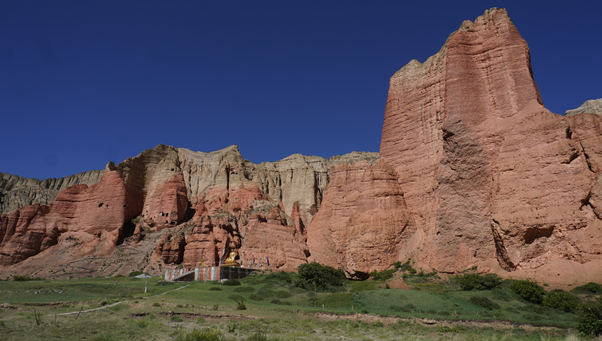
Nestled in the remote northern region of Mustang, near Dhakmar village in Lo-Ghekar Damodarkunda Rural Municipality–2, lies a striking red-hued cliffside that has started drawing attention for both its natural allure and cultural significance. Located along the Jomsom–Korala highway, a nationally recognized pride project that connects northern and southern Nepal, the red mountain can be seen near the village of Ghami. This region in Upper Mustang is slowly emerging as a unique destination for spiritual and adventure tourism.
A Mountain Steeped in Legend
Although the red coloring of the mountain might appear to be a natural geological phenomenon, locals say it is deeply rooted in myth and religious legend. According to Lo-Ghekar Damodarkunda Rural Municipality Chairperson Lopsang Chhomphel, the origins of the red cliffs near Dhakmar are tied to the revered Guru Padmasambhava. “In the 8th century, Guru Padmasambhava is believed to have slain a demon near the Ghami River by tearing open its belly and throwing its entrails into the river. The demon’s blood, according to local belief, stained the mountain red, giving it its unique color,” explained Chhomphel.
This legend has been preserved through the physical representation of a 200-meter-long wall near the Ghami River, constructed to symbolize the demon’s intestines. Locals revere this wall and the red cliffs of Dhakmar as sacred heritage sites.
Rich in Natural and Cultural Attractions
The red mountain near Dhakmar village stretches over two kilometers and is clearly visible to travelers heading toward Upper Mustang and the northern border areas such as Korala. Tourists visiting Mustang’s Ghami region can’t miss the striking crimson cliffs that dominate the landscape.
Unfortunately, due to limited promotion and underdeveloped tourism infrastructure, many travelers remain unaware of the mountain’s cultural and historical significance. “We found that despite the extraordinary beauty and religious history of this site, many tourists remain uninformed due to lack of proper promotion,” Chhomphel added.
The Cave Network of Dhakmar
Adding to the mystery and attraction of the area is a network of over 100 caves that pockmark the cliffside, many of which date back more than two thousand years. These caves, carved by ancient inhabitants, served as shelters long before permanent settlements were established in the region.
Thukten Chiring Gurung, the Ward Chairperson of Lo-Ghekar–2, noted that these caves were man-made and played a crucial role in the early habitation of the area. “Before people built homes here, they used these caves for shelter. Several of them still remain intact, and we aim to develop them into a tourist-friendly zone,” he shared.
Development of the Geo Park
In line with the growing interest in heritage and eco-tourism, local authorities have initiated the development of the Dhakmar cliffs and caves into a geo-park. A pathway complete with railings and stairs is currently under construction, allowing easier and safer access to some of the highest and most significant caves. Chairperson Chhomphel stated that NPR 1.5 million was invested this fiscal year to build half the path, with an additional NPR 2.5 million allocated for the coming year to complete the project.
The park is being designed not just as a meditation center but also as a scenic viewpoint. “From the red caves of the Geo Park, one can enjoy breathtaking views of the Nilgiri Himal and surrounding mountain ranges. The location is being developed for both spiritual retreats and panoramic sightseeing,” said Gurung.
Government and Community Partnership
The Mustang District’s Social Development Office has also partnered with the local rural municipality to promote and protect the Geo Park. Nirpati Darji, the office head, confirmed that NPR 1 million has been spent on constructing protective railings and walls to ensure visitor safety without compromising the cave’s authenticity. “Our goal is to make this site accessible while preserving its sacred and historical character. Local collaboration has been key,” Darji noted.
Darji also emphasized that with local communities gradually transitioning from traditional agriculture and animal husbandry to tourism, the region’s economic potential is growing. “That’s why we’ve already developed a large area of greenery in the park and fenced it off with NPR 3 million from the provincial government. Stone pathways and resting areas have also been added,” he added.
Community-Led Conservation and Tourism
In a rare example of community-driven conservation, locals have raised NPR 6.5 million in donations to install a massive statue of Buddha in the Geo Park. This marks a significant step toward establishing the area as a Buddhist and eco-tourism destination.
Reaching Dhakmar village is relatively straightforward. It lies just two kilometers west of the Jomsom–Korala highway, and can also be accessed via the ancient route through Ghami village. From there, travelers can journey along unpaved mountain roads to reach Lo-Ghekar, home to the world’s oldest monastery, Marang’s “House Monastery,” further enriching the cultural tapestry of the region.
With infrastructure development underway and tourism interest growing, the red cliffs of Dhakmar, once hidden and underappreciated, are now poised to become a cornerstone of spiritual, historical, and eco-tourism in Mustang. As local governments and communities work hand in hand, this unique landscape of legend and beauty may soon gain global recognition.
Source: RSS