Nepal Rastra Bank (NRB), the central monetary authority of Nepal, has released the official foreign exchange rates for today. These rates determine the value of various international currencies against the Nepalese rupee and are crucial for importers, exporters, banks, foreign exchange dealers, and the general public.
Key Currency Rates Set for the Day
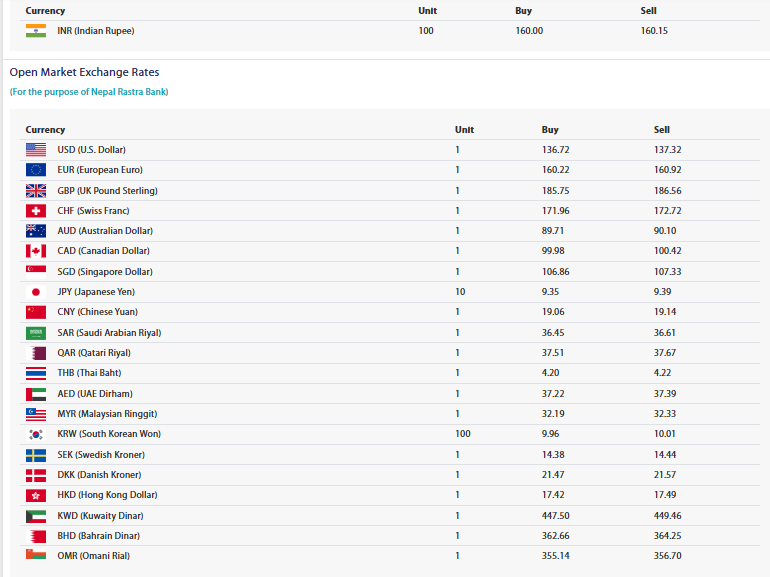
According to NRB, the buying rate of the U.S. Dollar has been fixed at Rs. 136.72, while the selling rate stands at Rs. 137.32. This rate is particularly significant given the high volume of trade and remittances Nepal conducts in U.S. dollars. For the European Euro, the central bank has set the buying rate at Rs. 160.22 and the selling rate at Rs. 160.92. Similarly, the British Pound Sterling has a buying rate of Rs. 185.75 and a selling rate of Rs. 186.56.
Other Major Currencies and Their Rates
The Swiss Franc, a stable global currency, has been valued at Rs. 171.96 for buying and Rs. 172.72 for selling. For the Australian Dollar, the buying rate is Rs. 89.71, and the selling rate is Rs. 90.10. The Canadian Dollar is available at Rs. 99.98 for buying and Rs. 100.42 for selling. Singapore Dollar has also maintained a relatively strong position, with a buying rate of Rs. 106.86 and a selling rate of Rs. 107.33.
Asian Currencies See Varied Valuations
In the Asian region, the Japanese Yen (for 10 units) has been valued at Rs. 9.35 for buying and Rs. 9.39 for selling. The Chinese Yuan is available at Rs. 19.06 (buying) and Rs. 19.14 (selling). Among Gulf currencies, the Saudi Arabian Riyal is fixed at Rs. 36.45 (buying) and Rs. 36.61 (selling), while the Qatari Riyal is being exchanged at Rs. 37.51 (buying) and Rs. 37.67 (selling).
Additional Currency Updates
For travelers and businesspeople transacting in Southeast Asia, the Thai Baht is exchanged at Rs. 4.20 (buying) and Rs. 4.22 (selling). The UAE Dirham, widely used by Nepalese migrant workers, is fixed at Rs. 37.22 for buying and Rs. 37.39 for selling. The Malaysian Ringgit holds a buying rate of Rs. 32.19 and a selling rate of Rs. 32.33, while the South Korean Won (for 100 units) has a buying rate of Rs. 9.96 and a selling rate of Rs. 10.01. In the Scandinavian currency segment, the Swedish Kroner is valued at Rs. 14.38 (buying) and Rs. 14.44 (selling), and the Danish Kroner at Rs. 21.47 (buying) and Rs. 21.57 (selling).
High-Value Currencies Reflect International Trends
The Hong Kong Dollar is exchanged at Rs. 17.42 (buying) and Rs. 17.49 (selling). Among the high-value currencies, the Kuwaiti Dinar holds the highest value in today’s listing, with a buying rate of Rs. 447.50 and a selling rate of Rs. 449.46. Similarly, the Bahraini Dinar is set at Rs. 362.66 (buying) and Rs. 364.25 (selling), and the Omani Riyal at Rs. 355.14 (buying) and Rs. 356.70 (selling).
Indian Rupee – A Key Regional Indicator
Given Nepal’s open border and close economic relationship with India, the Indian Rupee remains highly significant in local markets. The NRB has fixed the rate for INR 100 at Rs. 160 for buying and Rs. 160.15 for selling. This rate is vital for cross-border trade, fuel imports, tourism, and remittance transfers between the two nations.
Exchange Rate Variability and Public Advisory
Nepal Rastra Bank has clarified that these exchange rates are indicative and are subject to modification as per market requirements. The central bank may update the rates at any time depending on changes in international currency markets.
Furthermore, commercial banks may set slightly different rates based on demand, supply, and internal policies. NRB has advised the public and institutions to check with their respective banks or consult the official website (www.nrb.org.np) for real-time updates on foreign exchange rates.
Importance of Daily Exchange Rate Announcements
The daily publication of foreign exchange rates by NRB plays a critical role in economic planning, foreign trade, remittance transactions, travel budgeting, and investment decisions. Businesses dealing with international suppliers or clients, as well as migrant workers sending money home, heavily rely on accurate and timely currency rates to optimize their financial outcomes.
With a rising volume of foreign remittances and imports, currency fluctuations can impact inflation, consumer prices, and government revenues. Hence, maintaining transparency in foreign exchange rates supports financial stability and fosters public confidence in the banking system.
The updated exchange rates from Nepal Rastra Bank offer valuable insight into the country’s interaction with the global financial system. As currency values fluctuate daily, these rates serve as a guide for millions of Nepalese engaged in trade, travel, remittance, and investment. Staying informed on such changes not only ensures smart financial choices but also strengthens Nepal’s resilience in the global economic environment.