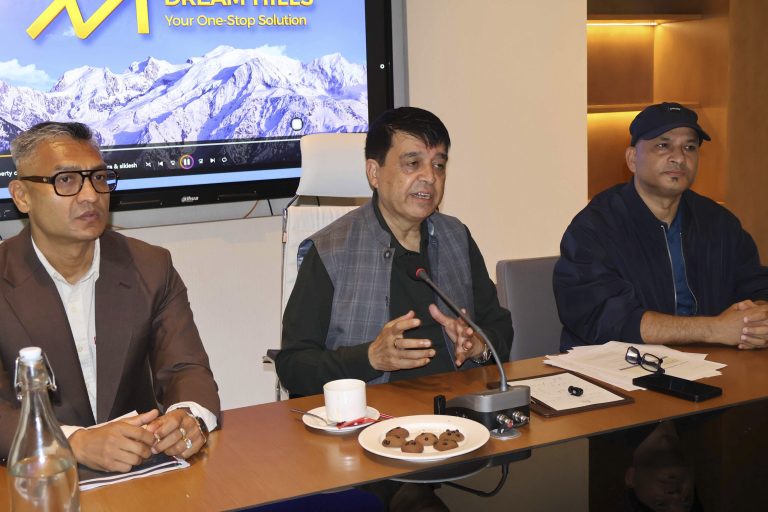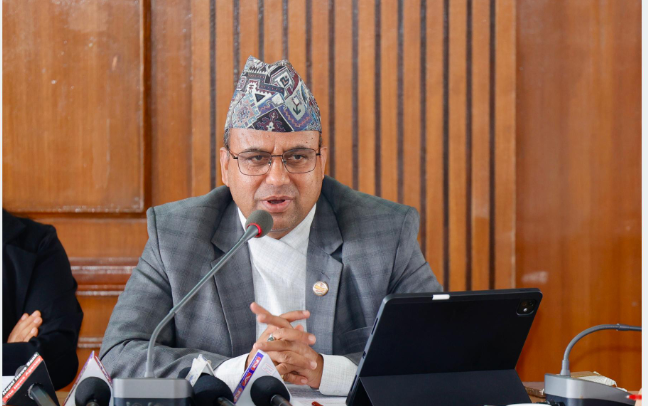
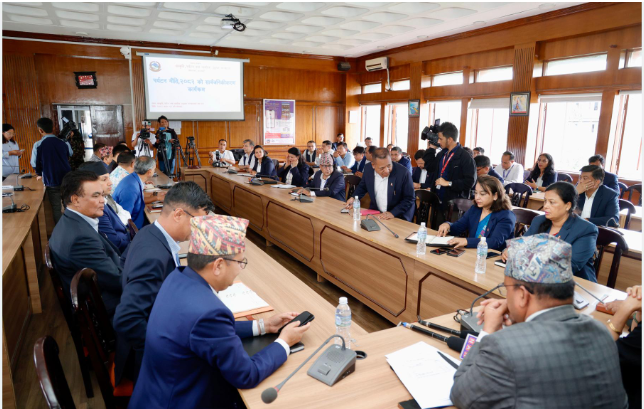
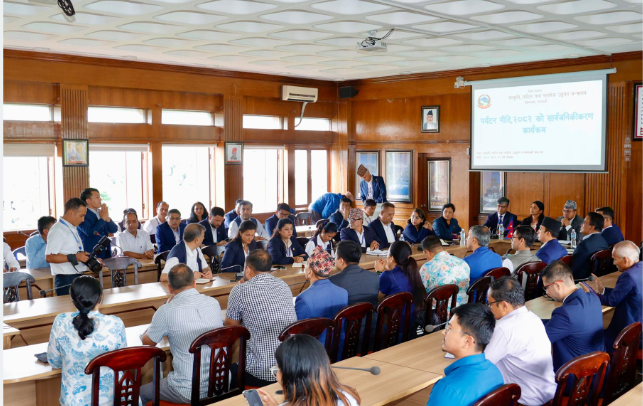
The government of Nepal’s tourism sector, Minister for Culture, Tourism and Civil Aviation, Badri Prasad Pandey, has reaffirmed the government’s commitment to strengthening collaboration with the private sector to realize the country’s tourism potential. Speaking at an event organized at the Ministry today, Minister Pandey officially launched the much-anticipated ‘Tourism Policy 2082’, pledging policy-level support and coordination to drive sustainable growth in the sector.
Stronger Public-Private Partnership on the Horizon
While unveiling the new tourism policy, Minister Pandey emphasized the pivotal role of the private sector in reshaping Nepal’s tourism landscape. “We want to work hand-in-hand with the private sector,” he stated, encouraging private stakeholders to move forward with confidence. “The government is ready to coordinate. Only when the private sector takes initiative can we achieve tangible results.”
Reiterating the government’s readiness for partnership, Minister Pandey underlined the necessity of a shared approach to bring about meaningful change. “Let the private sector lead with self-assurance,” he said, “The government is fully prepared to facilitate and support.”
Policy Realignment in the Federal Context
Minister Pandey highlighted that following the promulgation of the Constitution in 2072 BS, the Ministry had been aligning itself with the principles of federalism. The newly launched tourism policy is a part of the ongoing effort to reform the sector in accordance with the federal structure and emerging needs of the country.
He further informed that the Culture Policy and Civil Aviation Policy are currently under discussion in the Cabinet’s legislative section and will be finalized soon. “A total of 13 legislative acts are already in progress,” the Minister shared, emphasizing that legal reforms are being systematically undertaken to support long-term sectoral growth.
Emphasis on Nepal as a Unique Destination
The new Tourism Policy 2082 replaces the earlier Tourism Policy of 2065 BS and introduces a forward-looking vision that positions Nepal as an “exceptional tourism destination.” According to Minister Pandey, this vision has been embedded as a structural element within the policy framework to promote Nepal globally as a distinctive travel experience.
The policy document outlines strategies for destination diversification, infrastructure improvement, quality service delivery, and the development of sustainable tourism models. It also focuses on strengthening tourism governance through decentralized mechanisms and community-level engagement.
Legal Framework to Ensure Effective Implementation
Minister Pandey assured that the tourism policy would not exist in isolation but will be backed by strong legal instruments. He stated that relevant laws and regulations would be aligned with the provisions of the new policy to ensure effective and timely implementation. This will include harmonizing the Tourism Act, Civil Aviation Act, and other related regulations to support the goals outlined in the new framework.
He also stressed that coordinated institutional efforts will be made to attract investment, build skilled human resources, enhance air connectivity, and ensure the preservation of Nepal’s rich cultural and natural heritage.
Focus on Sustainable and Inclusive Growth
The ministry’s Joint Secretary, Indu Ghimire, presented the key objectives and priorities of the new policy, explaining that it is crafted to respond to the evolving dynamics of the tourism industry and global travel trends. She said that the policy integrates measures for sustainable tourism development, including climate-sensitive planning, rural tourism promotion, and responsible travel practices.
Ghimire stated, “This policy reflects our intent to make tourism a major contributor to the national economy while maintaining balance with nature and local communities. It aims to uplift marginalized regions and engage youth and women in tourism entrepreneurship.”
The policy also sets ambitious goals to increase tourist arrivals, improve tourist experience and safety, expand product offerings beyond traditional destinations, and promote digital transformation in tourism services.
Alignment with National Economic Goals
According to Ghimire, the new policy aligns tourism with Nepal’s broader economic development agenda, positioning the sector as a key driver of employment, investment, and foreign exchange earnings. With a renewed policy focus, the government seeks to create an environment where tourism is resilient to shocks such as pandemics and natural disasters and remains a pillar of national development. She added that a multi-stakeholder approach will be adopted to implement the policy, with clear indicators and periodic reviews to monitor its progress.
A Call for Unity and Vision
The event concluded with a unified call from both the government and private sector representatives for a shared commitment to uplift Nepal’s tourism sector. Minister Pandey’s message was clear: the success of the new tourism policy depends on mutual trust, cooperation, and vision among all stakeholders, government, private entrepreneurs, local bodies, and civil society.
As Nepal prepares to reposition itself in the global tourism market, ‘Tourism Policy 2082’ is expected to be a cornerstone document that reflects the country’s cultural richness, natural diversity, and strategic aspirations for tourism-led growth. With a blend of legal reform, institutional coordination, and public-private synergy, Nepal’s tourism industry now stands at a promising threshold of transformation.
Read More: