Nepal Rastra Bank (NRB), the central monetary authority of the country, has released the official foreign exchange rates for today. The published rates reflect the buying and selling values of major international currencies against the Nepali Rupee, and are based on current global market trends. These rates serve as a reference for banks, financial institutions, foreign exchange traders, importers, and the general public engaged in international transactions.
U.S. Dollar Nears Rs. 141 Mark
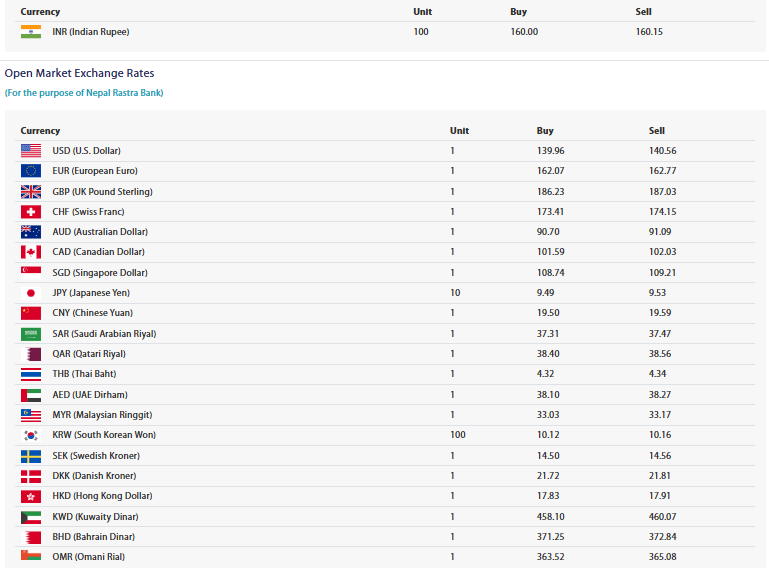
According to NRB, the buying rate for one U.S. dollar is fixed at Rs. 139.96, while the selling rate is Rs. 140.56. The U.S. dollar continues to maintain its strong position against the Nepali Rupee, reflecting global trends of dollar dominance amid international economic uncertainties. The rate is crucial for trade, remittances, and travelers dealing in U.S. dollars.
European Currencies Maintain Strong Value
The Euro, another widely traded currency, has been valued with a buying rate of Rs. 162.07 and a selling rate of Rs. 162.77. Similarly, the British Pound Sterling remains one of the most expensive currencies on the list, with a buying rate of Rs. 186.23 and a selling rate of Rs. 187.03.
These high values reflect the strong economic performance of the Eurozone and the UK relative to Nepal’s domestic currency. The Swiss Franc, known for its financial stability and reserve status, is also trading at a premium, with the buying rate set at Rs. 173.41 and the selling rate at Rs. 174.15.
Dollar Bloc and Regional Currencies
Among the dollar bloc currencies, the Australian Dollar is trading with a buying rate of Rs. 90.70 and a selling rate of Rs. 91.09, while the Canadian Dollar has been pegged at Rs. 101.59 (buying) and Rs. 102.03 (selling). The Singapore Dollar, which is often considered a key currency in Asian trade, is valued at Rs. 108.74 for buying and Rs. 109.21 for selling.
Japan’s currency, the Yen, is being traded in sets of ten, with a buying rate of Rs. 9.49 and a selling rate of Rs. 9.53. Meanwhile, the Chinese Yuan stands at Rs. 19.50 for buying and Rs. 19.59 for selling.
Gulf Currencies: Important for Remittances
Foreign currencies from the Gulf region, where a significant number of Nepali migrant workers are employed, continue to hold importance. The Saudi Arabian Riyal is listed with a buying rate of Rs. 37.31 and a selling rate of Rs. 37.47. The Qatari Riyal is slightly stronger, with rates at Rs. 38.40 (buying) and Rs. 38.56 (selling). Likewise, the UAE Dirham has been valued at Rs. 38.10 for buying and Rs. 38.27 for selling.
The Kuwaiti Dinar remains the highest-valued currency in today’s list, with an impressive buying rate of Rs. 458.10 and a selling rate of Rs. 460.07. Other notable Gulf currencies include the Bahraini Dinar at Rs. 371.25 (buying) and Rs. 372.84 (selling), and the Omani Riyal at Rs. 363.52 and Rs. 365.08, respectively.
Other Asian and European Currencies
Other regional currencies have also been listed with modest values. The Thai Baht is trading at Rs. 4.32 for buying and Rs. 4.34 for selling. The Malaysian Ringgit is marked at Rs. 33.03 and Rs. 33.17, while the South Korean Won (100 units) is set at Rs. 10.12 (buying) and Rs. 10.16 (selling).
Among Scandinavian currencies, the Swedish Krona is priced at Rs. 14.50 and Rs. 14.56, and the Danish Krone at Rs. 21.72 for buying and Rs. 21.81 for selling. The Hong Kong Dollar, an important currency for trade and finance, is trading at Rs. 17.83 (buying) and Rs. 17.91 (selling).
Indian Rupee Steady Against Nepali Rupee
As for Nepal’s most important neighboring currency, the Indian Rupee (INR) is fixed at a standard buying rate of Rs. 160.00 and a selling rate of Rs. 160.15 for every 100 Indian Rupees. This fixed rate continues to facilitate trade and travel between Nepal and India, maintaining the historical pegging system between the two nations.
NRB Reserves the Right to Revise Rates
The Nepal Rastra Bank has clarified that these exchange rates are subject to change as per market fluctuations. The central bank reserves the authority to modify the rates at any time if deemed necessary due to economic, financial, or geopolitical developments.
While these are the official interbank rates, commercial banks may offer slightly different rates based on their own internal assessments and service charges. For the most updated and real-time exchange rates, the central bank advises individuals and institutions to refer to the official NRB website or contact authorized commercial banks.
Today’s foreign exchange rate announcement reflects Nepal’s growing integration into the global financial market, with fluctuations in major world currencies directly impacting domestic trade, tourism, remittances, and investment. With the Nepali Rupee facing pressure due to global economic conditions, continuous monitoring and effective currency management remain critical for economic stability.