The Nepal Rastra Bank (NRB), the central bank of Nepal, has fixed the foreign exchange rates for various international currencies for today. These rates serve as the benchmark for currency exchange transactions across the country and influence trade, remittance inflows, tourism, and other economic activities. According to the latest notification from the NRB, the exchange rates for buying and selling major currencies including the US Dollar, Euro, British Pound Sterling, and others have been updated and will remain effective unless revised.
US Dollar Exchange Rate Set by NRB
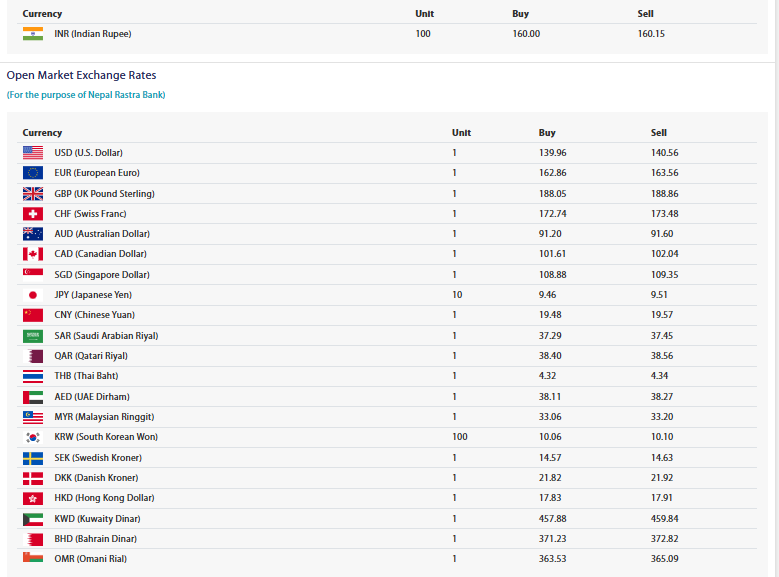
The American Dollar, which is the most commonly traded foreign currency in Nepal, has been fixed at a buying rate of NPR 139.96 and a selling rate of NPR 140.56 per US dollar. This rate plays a significant role in shaping the country’s foreign trade and remittance sectors, considering the volume of USD transactions in Nepal. The buying rate is the price at which banks and authorized dealers purchase dollars from customers, while the selling rate is what they charge to sell dollars to customers.
Rates for European and British Currencies
Alongside the US dollar, the European Euro has been set at a buying rate of NPR 162.86 and a selling rate of NPR 163.56 per euro. The British Pound Sterling commands a higher value with a buying rate of NPR 188.05 and a selling rate of NPR 188.86 per pound. The fluctuation in these currencies reflects ongoing global economic trends and has a direct impact on Nepal’s import costs, especially for goods and services sourced from Europe and the UK.
Exchange Rates for Other Major International Currencies
The Swiss Franc, a strong and stable currency, is set at a buying rate of NPR 172.74 and a selling rate of NPR 173.48. The Australian Dollar’s buying rate stands at NPR 91.20 and selling rate at NPR 91.60, while the Canadian Dollar is priced at NPR 101.61 for buying and NPR 102.04 for selling. The Singapore Dollar’s buying rate is NPR 108.88 and selling rate NPR 109.35. These currencies are particularly important for trade relations and financial transactions involving these countries.
Asian Currencies and Their Rates
Among Asian currencies, the Japanese Yen is quoted at NPR 9.46 for buying and NPR 9.51 for selling per 10 yen. The Chinese Yuan has a buying rate of NPR 19.48 and a selling rate of NPR 19.57. The Saudi Arabian Riyal is priced at NPR 37.29 for buying and NPR 37.45 for selling, while the Qatari Riyal’s rates are NPR 38.40 and NPR 38.56 respectively. These currencies play an essential role in Nepal’s trade and the growing expatriate workforce in Gulf countries.
Exchange Rates for Other Key Regional Currencies
The Thai Baht is set at NPR 4.32 for buying and NPR 4.34 for selling, the UAE Dirham at NPR 38.11 and NPR 38.27, and the Malaysian Ringgit at NPR 33.06 and NPR 33.20 respectively. South Korean Won per 100 units is fixed at NPR 10.08 for buying and NPR 10.10 for selling. Meanwhile, the Swedish Krona’s buying rate is NPR 14.57 and selling rate NPR 14.63, and the Danish Krona is priced at NPR 21.82 for buying and NPR 21.92 for selling. These rates influence Nepal’s regional trade dynamics and remittance flows.
Special Currencies with High Exchange Rates
The Hong Kong Dollar has been set at NPR 17.83 for buying and NPR 17.91 for selling. The Kuwaiti Dinar, known for its high value, commands a buying rate of NPR 457.88 and a selling rate of NPR 459.84. Similarly, the Bahraini Dinar is priced at NPR 371.23 for buying and NPR 372.82 for selling, while the Omani Riyal stands at NPR 363.53 for buying and NPR 365.09 for selling. These currencies are critical for Nepali migrant workers and investors with interests in these Gulf countries.
Indian Rupee Exchange Rate Maintained
Given the close economic ties between Nepal and India, the Indian Rupee remains one of the most important currencies in daily Nepalese transactions. The NRB has fixed the buying rate for the Indian Rupee 100 note at NPR 160.00 and the selling rate at NPR 160.15. This rate is crucial for cross-border trade and influences the pricing of various goods and services along the Nepal-India border.
Flexibility and Updates on Exchange Rates
The Nepal Rastra Bank has clarified that these exchange rates are subject to change and may be revised at any time according to market demand and supply conditions. Commercial banks and authorized dealers may have slightly different rates based on their individual policies and business strategies. To ensure transparency, the updated exchange rates are regularly published on the NRB’s official website for public access.
Importance of Exchange Rate Management
The management of foreign currency exchange rates is vital for maintaining economic stability in Nepal. The rates fixed by the NRB affect inflation, import-export competitiveness, remittance inflows, and foreign investment. A balanced and responsive exchange rate policy helps protect the domestic economy from external shocks and supports sustainable economic growth.
Impact on Businesses and Consumers
Fluctuations in foreign exchange rates can have direct consequences for Nepalese businesses that rely on imported goods or export their products overseas. Likewise, individual consumers engaged in travel, education, or medical treatment abroad closely monitor these rates. The remittance-dependent economy of Nepal, which benefits significantly from overseas workers sending money home, also depends heavily on the stability of these exchange rates.
Public Advisory and Transparency
The Nepal Rastra Bank continues to promote transparency by making all exchange rate information publicly accessible and encourages people to use authorized banking channels for currency exchange. The bank also urges citizens to remain vigilant against unofficial money changers and currency dealers to avoid fraudulent activities.
The Nepal Rastra Bank’s latest foreign exchange rates reflect the central bank’s ongoing efforts to maintain economic balance while accommodating global market movements. The fixed rates for the US Dollar, Euro, British Pound, and other key currencies will guide Nepal’s foreign exchange transactions for the day, influencing trade, investment, and personal finance decisions across the nation. Citizens and businesses are advised to stay informed of any future updates as the NRB continues to monitor and adjust rates in response to market trends.