The Nepal Rastra Bank (NRB), the country’s central bank, has announced the official foreign currency exchange rates for today, covering major international currencies used in trade, remittances, and travel. According to the official release, the exchange rates have been set for the U.S. dollar, European euro, British pound, and several other global currencies.
The rates issued by the NRB provide the benchmark for commercial banks and financial institutions, although minor variations may occur when individual banks apply their own rates for buying and selling foreign currency.
U.S. Dollar Exchange Rate
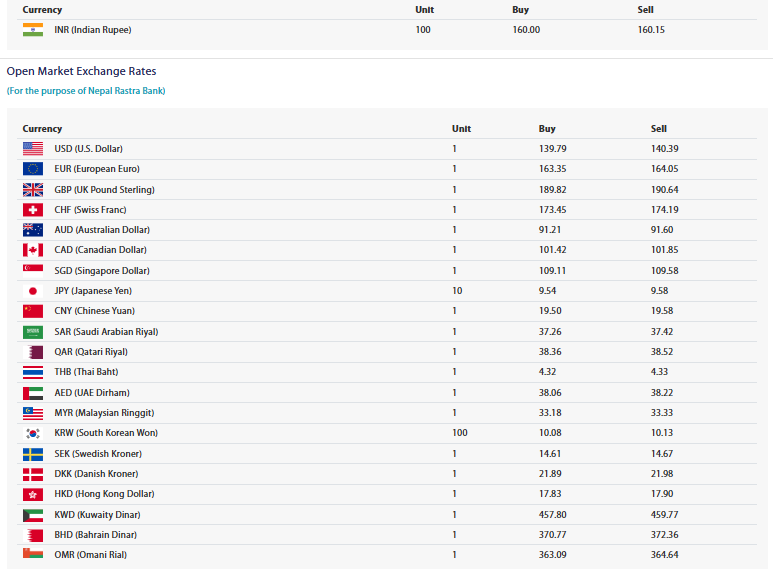
According to NRB’s determination, the U.S. dollar remains one of the most significant currencies for Nepal’s foreign transactions. The official buying rate for one U.S. dollar has been fixed at Rs. 139.79, while the selling rate is set at Rs. 140.39.
This rate plays a crucial role in Nepal’s economy, as the U.S. dollar is widely used in remittances, international trade settlements, and tourism-related transactions. The stability or fluctuation of the dollar rate directly impacts import costs, foreign debt repayments, and the pricing of petroleum products.
European and British Currencies
The exchange rates for major European currencies have also been published. The European euro stands at Rs. 163.35 for buying and Rs. 164.05 for selling. Similarly, the British pound sterling, which is among the highest-valued currencies against the Nepali rupee, has been set at Rs. 189.82 for buying and Rs. 190.64 for selling.
The Swiss franc, another strong global currency, is valued at Rs. 173.45 for buying and Rs. 174.19 for selling. These European currencies are particularly important for Nepali migrant workers living in the UK and EU countries, as well as for international trade and tourism.
Exchange Rates for Dollar Bloc Currencies
Other widely used dollar bloc currencies have also been updated. The Australian dollar is set at Rs. 91.21 (buying) and Rs. 91.60 (selling), while the Canadian dollar stands at Rs. 101.42 (buying) and Rs. 101.85 (selling). Similarly, the Singapore dollar is recorded at Rs. 109.11 for buying and Rs. 109.58 for selling. These rates matter for Nepali students, workers, and businesses that deal with Australia, Canada, and Southeast Asia.
Asian Currency Updates
In Asia, exchange rates for neighboring and regional currencies have also been fixed. The Japanese yen is valued at Rs. 9.54 for buying and Rs. 9.58 for selling per 10 yen. The Chinese yuan, one of Nepal’s most crucial trade currencies, has been fixed at Rs. 19.50 (buying) and Rs. 19.58 (selling).
The Saudi Arabian riyal is pegged at Rs. 37.26 (buying) and Rs. 37.42 (selling), while the Qatari riyal stands at Rs. 38.36 (buying) and Rs. 38.52 (selling). These Gulf currencies are highly significant as they directly affect the income of millions of Nepali migrant workers in the Middle East.
Other International Currencies
Additional exchange rates set by NRB include:
- Thai baht: Rs. 4.32 (buying), Rs. 4.33 (selling)
- UAE dirham: Rs. 38.06 (buying), Rs. 38.22 (selling)
- Malaysian ringgit: Rs. 33.18 (buying), Rs. 33.33 (selling)
- South Korean won (per 100 units): Rs. 10.08 (buying), Rs. 10.13 (selling)
- Swedish krona: Rs. 14.61 (buying), Rs. 14.67 (selling)
- Danish krone: Rs. 21.89 (buying), Rs. 21.98 (selling)
These currencies reflect Nepal’s expanding global trade and labor migration links across Asia and Europe.
Gulf Region and High-Value Currencies
Among the Gulf and Middle Eastern currencies, the Hong Kong dollar has been set at Rs. 17.83 (buying) and Rs. 17.90 (selling). The Kuwaiti dinar, one of the highest-valued currencies globally, is priced at Rs. 457.80 (buying) and Rs. 459.77 (selling).
Similarly, the Bahraini dinar has been fixed at Rs. 370.77 (buying) and Rs. 372.36 (selling), while the Omani riyal stands at Rs. 363.09 (buying) and Rs. 364.64 (selling). These high-value currencies significantly influence the remittance inflows to Nepal, as many Nepalis work in these Gulf nations.
Exchange Rate with the Indian Rupee
The exchange rate with the Indian rupee, Nepal’s closest trading partner, remains fixed. For 100 Indian rupees, the buying rate is Rs. 160, while the selling rate is Rs. 160.15. Given Nepal’s heavy dependence on trade with India and the open border between the two countries, this rate has a direct effect on daily consumer goods pricing, import costs, and cross-border transactions.
Central Bank’s Role and Flexibility
The NRB has clarified that these exchange rates are subject to revision at any time based on market dynamics. While the central bank publishes the official reference rates, commercial banks are allowed to set their own rates within a permissible range.
“The rates issued by Nepal Rastra Bank are updated daily and made available on the central bank’s official website,” the statement said. “Commercial banks may apply slightly different exchange rates, depending on their demand and supply conditions.” This flexibility allows banks to adjust to real-time foreign exchange needs, particularly in the context of remittances, imports, and tourism.
Significance of Daily Exchange Rates
The daily publication of exchange rates serves as an important reference for businesses, traders, migrant workers, and travelers. Importers and exporters use the rates to determine their international transaction costs, while students and workers abroad calculate remittance transfers based on the rates. With Nepal heavily reliant on remittances, one of the largest contributors to its foreign currency reserves, accurate and transparent exchange rates remain vital for maintaining economic stability.
By releasing today’s updated exchange rates, the Nepal Rastra Bank has provided clarity to the market on the value of the Nepali rupee against major global currencies. The rates cover a wide range of currencies, reflecting Nepal’s diverse economic engagements, from trade with China and India to remittances from the Gulf and Europe.
While the U.S. dollar, euro, and Indian rupee remain the most influential in shaping Nepal’s economic trends, the rates for Middle Eastern and Asian currencies play an equally crucial role in sustaining foreign exchange reserves through remittances. As global currency markets fluctuate, the central bank has reaffirmed its commitment to adjusting rates as necessary, ensuring that Nepal’s financial system remains aligned with international monetary movements.