Nepal Rastra Bank (NRB), the central bank of Nepal, has published the official foreign exchange rates for today, setting the benchmark buying and selling rates for various international currencies. The rates, which guide transactions across banks and financial institutions, are applicable for the day but subject to revision depending on market conditions.
US Dollar Leads with NPR 139.01 Buying Rate
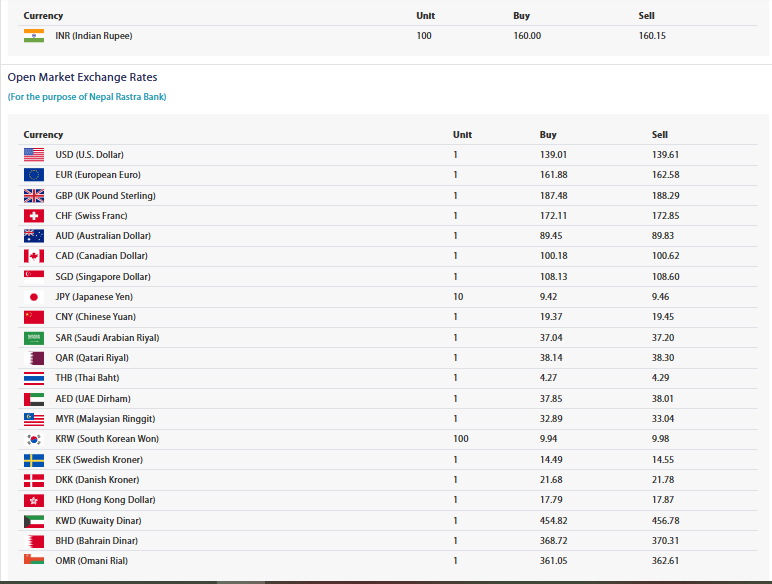
According to NRB’s daily bulletin, the buying rate for one US Dollar has been set at NPR 139.01, while the selling rate stands at NPR 139.61. The US Dollar continues to be one of the most actively traded foreign currencies in Nepal, heavily influencing import-export pricing and remittance flows.
Euro and Pound Sterling Maintain Strong Rates
The European Euro is trading at a buying rate of NPR 161.88 and a selling rate of NPR 162.58, while the UK Pound Sterling remains strong with a buying rate of NPR 187.48 and a selling rate of NPR 188.29. Both currencies have shown resilience in global markets, impacting Nepal’s trade with European nations.
Swiss Franc and Other Major Currencies
The Swiss Franc has been fixed at NPR 172.11 for buying and NPR 172.85 for selling. Among other popular foreign currencies, the Australian Dollar is trading at NPR 89.45 (buying) and NPR 89.83 (selling), while the Canadian Dollar stands at NPR 100.18 and NPR 100.62, respectively.
Asian Currencies and Regional Trade Impact
For Asian trade partners, the Singapore Dollar has been set at NPR 108.13 for buying and NPR 108.60 for selling. The Japanese Yen, calculated for every 10 units, is valued at NPR 9.42 (buying) and NPR 9.46 (selling). The Chinese Yuan is trading at NPR 19.37 (buying) and NPR 19.45 (selling), reflecting ongoing trade relations between Nepal and China. The Saudi Arabian Riyal has been pegged at NPR 37.04 for buying and NPR 37.20 for selling, while the Qatari Riyal stands at NPR 38.14 (buying) and NPR 38.30 (selling).
Other Regional and International Rates
The Thai Baht is being traded at NPR 4.27 for buying and NPR 4.29 for selling. The UAE Dirham is fixed at NPR 37.85 (buying) and NPR 38.01 (selling). The Malaysian Ringgit stands at NPR 32.89 and NPR 33.04, while the South Korean Won, calculated per 100 units, is trading at NPR 9.94 for buying and NPR 9.98 for selling. Among European currencies, the Swedish Kroner is set at NPR 14.49 (buying) and NPR 14.55 (selling), while the Danish Kroner is at NPR 21.68 and NPR 21.76, respectively.
High-Value Middle Eastern Currencies
The Hong Kong Dollar is priced at NPR 17.79 (buying) and NPR 17.87 (selling). High-value Gulf currencies include the Kuwaiti Dinar, set at NPR 454.82 for buying and NPR 456.78 for selling, making it the most valuable currency in today’s exchange list. The Bahraini Dinar stands at NPR 368.72 (buying) and NPR 370.31 (selling), while the Omani Riyal is valued at NPR 361.05 (buying) and NPR 362.61 (selling).
Indian Rupee Fixed at NPR 160 per 100 Units
The Indian Rupee, which plays a significant role in Nepal’s daily economic transactions and cross-border trade, has been fixed at NPR 160.00 for buying and NPR 160.15 for selling per 100 units. This pegged rate system with the Indian Rupee remains a key element of Nepal’s monetary policy.
NRB’s Role in Exchange Rate Determination
Nepal Rastra Bank determines these exchange rates based on global currency market trends, the demand-supply situation in Nepal, and macroeconomic factors. While NRB sets the official reference rates for the day, commercial banks are allowed to set slightly different rates based on their operational needs and customer demand.
The central bank has also clarified that these rates can be revised at any time if there are sudden fluctuations in the global currency market. For real-time updates, the public is advised to check the NRB’s official website or contact their respective commercial banks.
Significance for Trade, Tourism, and Remittance
Exchange rates play a crucial role in Nepal’s economy, influencing the cost of imports, the value of remittance inflows, and the competitiveness of exports. Stronger foreign currencies like the US Dollar, Pound Sterling, and Kuwaiti Dinar benefit remittance receivers, while a weaker domestic currency can make imports costlier. For the tourism industry, currency rates directly impact travel expenses for foreign visitors. Similarly, Nepali students and workers abroad carefully track exchange rates to optimize money transfers.
Public Advisory and Market Impact
NRB has advised individuals and businesses engaged in foreign currency transactions to remain informed about the daily rates and avoid relying on unofficial exchange sources, which may charge higher margins. Economists note that today’s relatively stable rates reflect a balanced supply-demand situation in the market, though upcoming global economic events could cause short-term volatility.