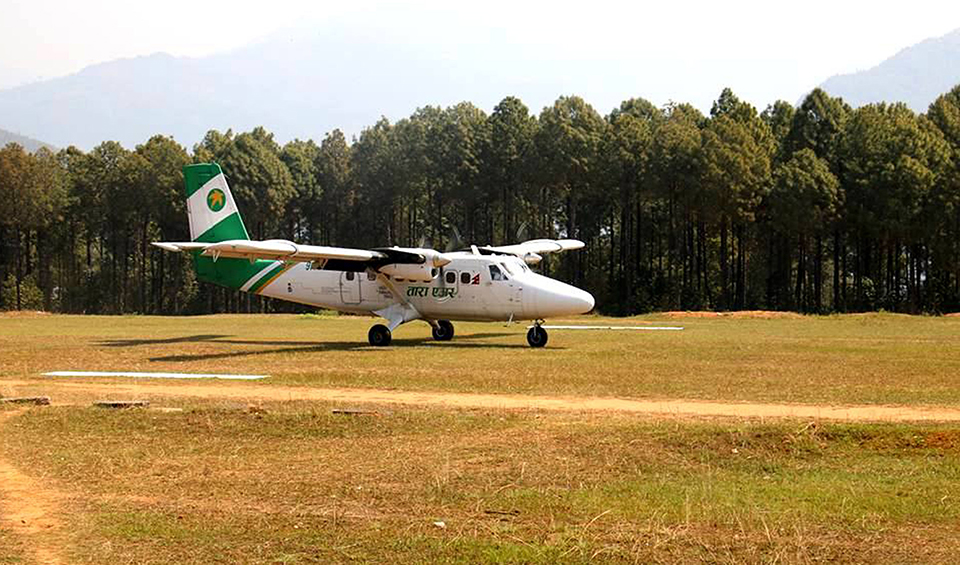
Balewa Airport, located near Kusma Bazaar, the headquarters of Parbat District, has remained closed for 36 years, leaving local residents disappointed and disheartened. Built in 1965 (2022 BS), the airport operated until 1991 (2048 BS) before shutting down entirely.
Despite periodic talks and minor revivals, no consistent flights have resumed, and the community’s hope for regular air connectivity continues to fade. Residents had long awaited the revival of operations, especially after extensive infrastructure upgrades, but complain that no significant initiative has been taken by concerned authorities to resume flights.

Closure Due to Lack of Passengers
After the expansion of the Pokhara–Baglung Highway, passenger demand for flights to and from Balewa sharply declined, leading to the airport’s closure. For nearly three decades, the facility remained dormant until the Baglung Municipality made a fresh attempt to reopen it.
In March 2018 (2074 Chaitra 9), regular flights briefly resumed with aircraft from Nepal Airlines and Tara Air, but operations lasted less than six months due to insufficient passenger traffic. The dusty runway in winter and muddy surface during monsoon made the airport even less appealing for consistent use.
Massive Renovation, No Flights
Over the past few years, more than NPR 80 million has been spent to upgrade the airport’s infrastructure, including the runway, parking area, and terminal building. The 24-meter-wide runway is now fully blacktopped and fenced, while the freshly painted terminal building stands ready for operations.
Sabita Sharma, an administrative assistant at the airport, confirmed that the Civil Aviation Authority of Nepal (CAAN) carried out blacktopping and repairs four years ago at a cost of NPR 80 million. However, despite the investment, no aircraft have landed yet.
“This airport can handle planes with seating capacity of 18 to 24 passengers,” said local resident Ram Sharma. “But without any flights, the investment feels like pouring water into sand.” A single staff member continues to look after the airport facilities, keeping them operationally ready, but with no aircraft in sight.
Potential to Benefit Three Districts
Locals believe that if regular air service resumes, the airport would greatly benefit not just Baglung but also the neighboring districts of Parbat and Myagdi. When elected representatives took office in Baglung Municipality, they attempted to revive operations by guaranteeing two flights a week. The municipality even agreed to cover passenger shortfall costs. For a brief period, this arrangement allowed flights to resume, but once the runway was permanently blacktopped, air services stopped entirely again.
No Test Flight Conducted Yet
Despite the newly renovated runway, no official test flight has been conducted so far. Chakra Bahadur Khatri, Ward Chairperson of Narayansthan (Ward 14) and spokesperson for Baglung Municipality, said, “The people of Balewa are still hopeful about the return of flights. Several initiatives were made, but none have yielded lasting results.”
Khatri added that every tourism and aviation minister visiting the region has been taken to observe the airport, yet no concrete policy-level action has followed. He emphasized that with the completion of the Kaligandaki Corridor, now nearing the blacktopping phase, the number of potential passengers could increase significantly, making flight operations viable. “The municipality is planning to promote Balewa Airport as a pilot training center and for adventure aviation activities such as ultralight flights,” Khatri added.
Private Airlines Reluctant
Former airport manager Surya Bahadur Khatri explained that private airlines have been unwilling to operate from Balewa without a guaranteed number of passengers. “Airlines prioritize routes that ensure profitability. Without passenger assurance, no company wants to take the risk,” he said.
Tourism Potential Untapped
Located in the heart of the North–South Kaligandaki Corridor, Balewa Airport holds strong potential for tourism development. However, despite its strategic location, the facility has failed to operate consistently.
Baglung Mayor Basanta Kumar Shrestha acknowledged the issue, saying, “It’s true that the airport hasn’t functioned regularly, even though it could greatly enhance tourism connectivity. The municipality alone cannot revive it, federal, provincial, and local governments must coordinate to make this happen.”
He further stated that the airport could play a crucial role in promoting domestic tourism, providing easy access to heritage sites, pilgrimage routes, and trekking destinations within the Kaligandaki region.

Hope for the Future
Local resident Kamal Jisi expressed optimism that once key infrastructure projects, such as the completion of the Kaligandaki Corridor, the mechanical bridge, bungee bridge, and new suspension bridge connecting Kusma, are completed, the flow of tourists and passengers will naturally increase.
“These developments will help ensure passenger traffic, and when that happens, airlines will return to Balewa,” Jisi remarked. However, he acknowledged that the community must remain patient for a few more years until these projects are fully operational. For now, Balewa Airport remains a symbol of unfulfilled potential, a blacktopped runway surrounded by mountains, waiting for the sound of aircraft engines to once again echo through the valley.