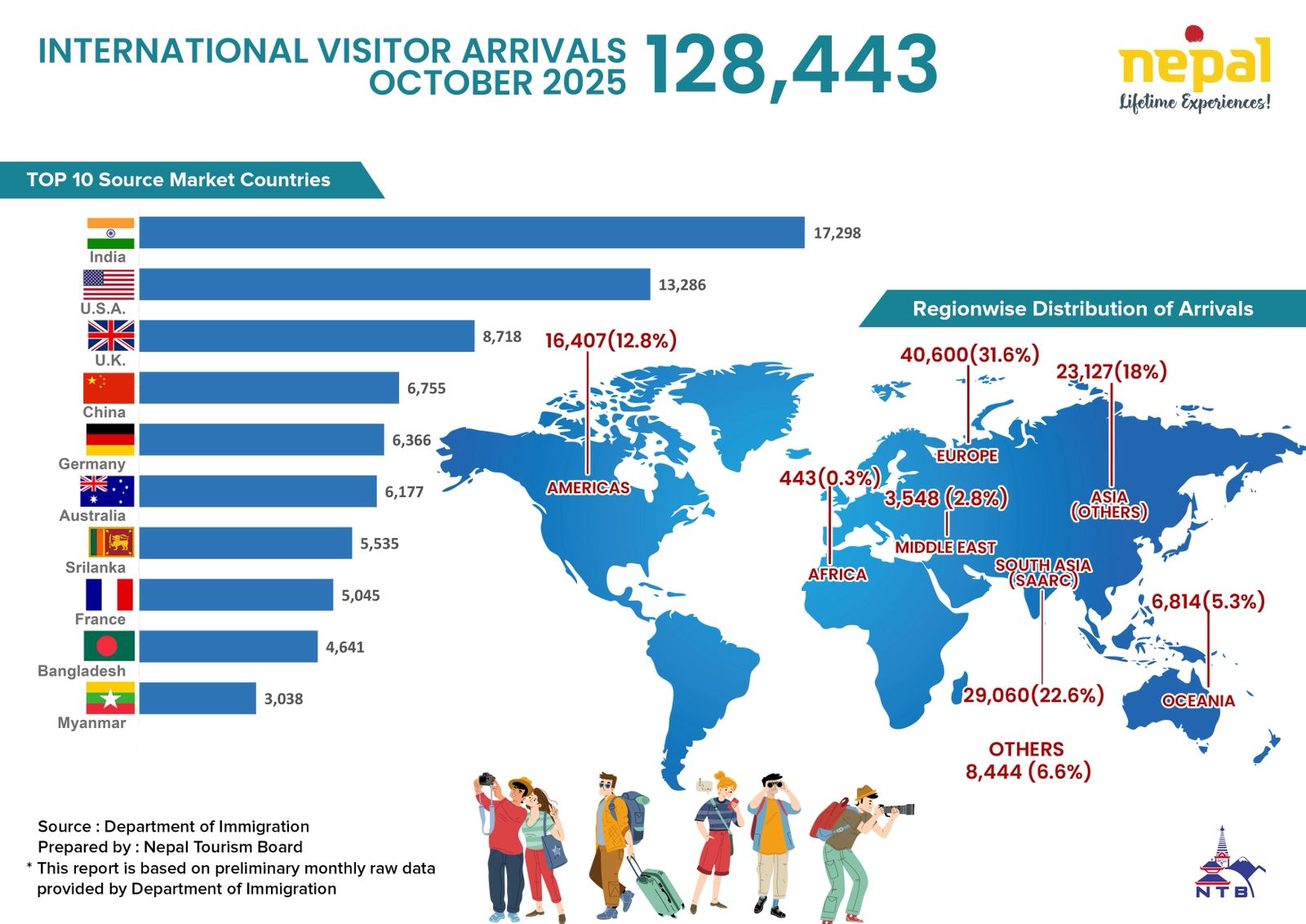
Nepal’s tourism sector continued its steady recovery in October 2025, recording 128,443 international visitor arrivals (IVAs), a 3.3% increase compared to the same month last year. The figure represents a 96% recovery compared to the pre-pandemic level of October 2019, highlighting Nepal’s growing appeal as a safe, accessible, and adventure-rich destination in South Asia.
Cumulatively, from January to October 2025, Nepal welcomed 943,716 foreign visitors, slightly higher than the same period in 2024 and 98% of pre-pandemic figures. The consistent upward trend signals that the country’s tourism industry has nearly regained its former momentum, driven by diversified marketing, improved connectivity, and seasonal trekking and mountaineering attractions.

International Visitor Arrivals (IVAs); October 2025
| Category | Visitor Numbers | Comparison |
| Total Arrivals (October 2025) | 128,443 | +3.3% vs Oct 2024 |
| Recovery vs 2019 (Pre-COVID) | 96% recovered | |
| Cumulative Jan–Oct 2025 | 943,716 | 98% of 2019 level |
Top Five Tourist Markets: India Leads Once Again
India remained Nepal’s largest tourist source in October 2025, contributing 17,298 visitors (13.5%). The United States followed with 13,286 arrivals (10.3%), reflecting the steady flow of adventure travelers and cultural tourists. The United Kingdom retained its third position with 8,718 arrivals (6.8%), while China ranked fourth with 6,755 visitors (5.3%), a positive rebound given the slower pace of outbound travel from China since the pandemic. Germany completed the top five list with 6,366 visitors (5.0%), underscoring Europe’s continued strong engagement with Nepal’s trekking and heritage tourism sectors.
Compared to October 2024, most key markets showed moderate growth, with notable increases from the USA and China, indicating renewed international confidence in Nepal’s travel safety and infrastructure.
| Rank | Country | Visitors | Percentage Share |
|---|---|---|---|
| 1 | India | 17,298 | 13.5% |
| 2 | USA | 13,286 | 10.3% |
| 3 | UK | 8,718 | 6.8% |
| 4 | China | 6,755 | 5.3% |
| 5 | Germany | 6,366 | 5.0% |
Regional Visitor Trends: Europe Remains the Largest Contributor
The regional distribution of IVAs shows that Europe contributed the largest share, accounting for 40,600 arrivals (31.6%). This was followed by South Asia (SAARC countries) with 29,060 visitors (22.6%), and Other Asian countries with 23,127 arrivals (18.0%).
The Americas represented 12.8% of the total arrivals, while Oceania (mainly Australia and New Zealand) contributed 5.3%. The Middle East accounted for 2.8%, Africa for 0.3%, and other regions collectively represented 6.6%. The dominance of Europe reflects the enduring popularity of Nepal’s trekking and mountaineering circuits among European travelers, while the South Asian segment benefited from improved cross-border mobility and shorter-haul travel.
| Region | Arrivals | Share (%) |
|---|---|---|
| Europe | 40,600 | 31.6% |
| South Asia (SAARC) | 29,060 | 22.6% |
| Asia (Other) | 23,127 | 18.0% |
| Americas | 16,407 | 12.8% |
| Oceania | 6,814 | 5.3% |
| Middle East | 3,548 | 2.8% |
| Africa | 443 | 0.3% |
| Others | 8,444 | 6.6% |
Tourism Revenue and Investment Indicators Show Robust Momentum
Beyond arrival statistics, Nepal’s tourism economy also demonstrated encouraging performance across other key indicators. During Bhadra 2082 (August–September 2025), foreign currency earnings from tourism reached NRs. 6,207.15 million, supported by rising hotel occupancy rates, trekking permits, and adventure tourism activities.
Similarly, tourism-related Foreign Direct Investment (FDI) commitments during Ashoj 2082 (September–October 2025) amounted to NRs. 1,460 million, spread across 103 new projects. These investments span hotel development, resort expansion, and tourism infrastructure improvement, signaling growing investor confidence in Nepal’s tourism potential.
Mountaineering Season: Strong Turnout and Royalty Growth
The autumn climbing season of 2025 has been particularly active. A total of 175 expedition teams comprising 1,450 climbers from 83 countries received climbing permits. The government collected NRs. 255.16 million in mountaineering royalties, reflecting strong participation on peaks such as Manaslu, Dhaulagiri, and Ama Dablam.
This figure marks a solid recovery compared to the previous year, when unfavorable weather conditions had limited several climbs. The steady flow of mountaineers, coupled with increased spending on logistics, porters, and guides, continues to benefit local mountain communities and tourism entrepreneurs.

Outlook: Nepal Tourism on Track for Full Recovery by 2026
With nearly one million foreign visitors recorded in the first ten months of 2025, Nepal’s tourism industry stands on the verge of a complete post-pandemic rebound. Improved air connectivity, renewed global confidence, and growing adventure tourism demand are expected to help the country surpass pre-COVID arrival levels by early 2026.
As the nation heads into the winter tourism season, Nepal’s mountains, heritage sites, and hospitality sector are once again drawing travelers from across the world, reaffirming Nepal’s position as one of Asia’s most resilient and inspiring travel destinations.