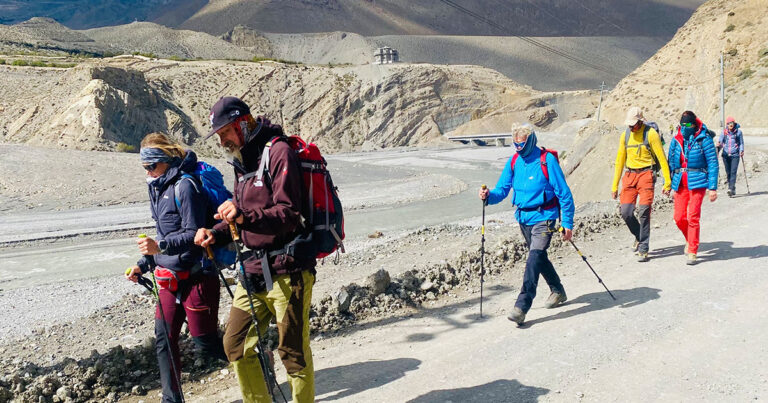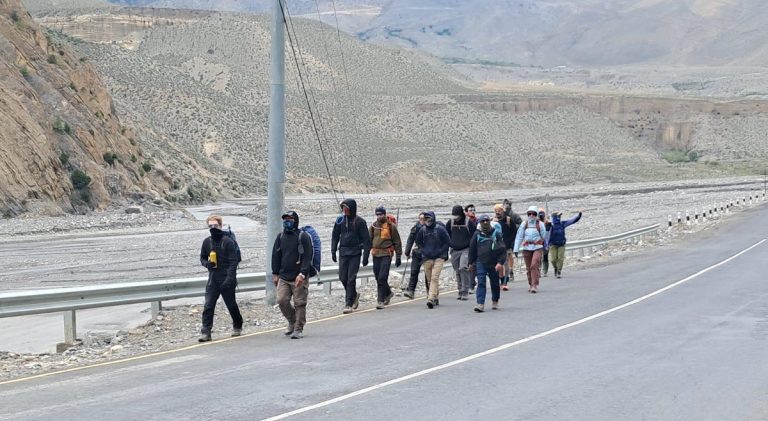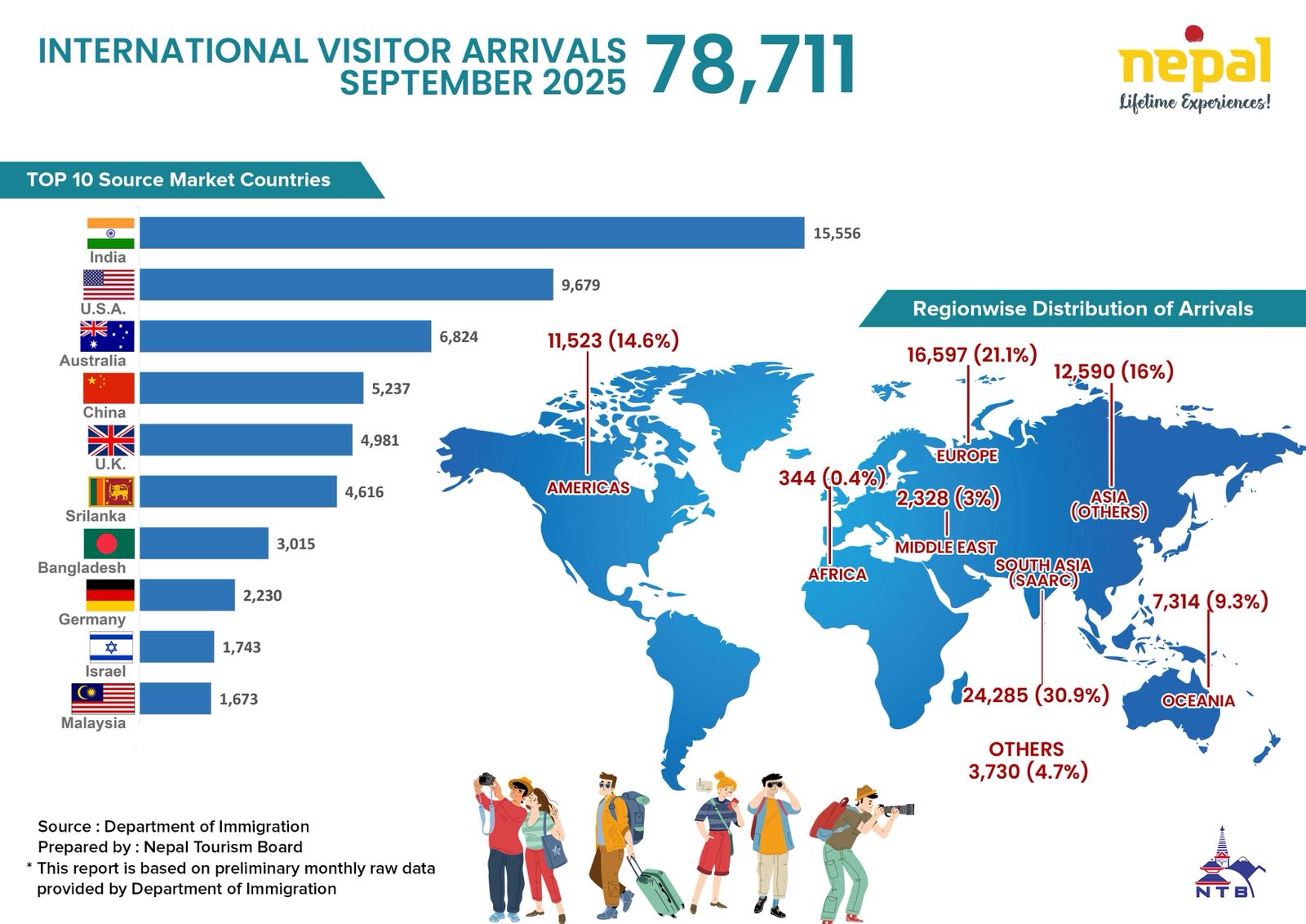
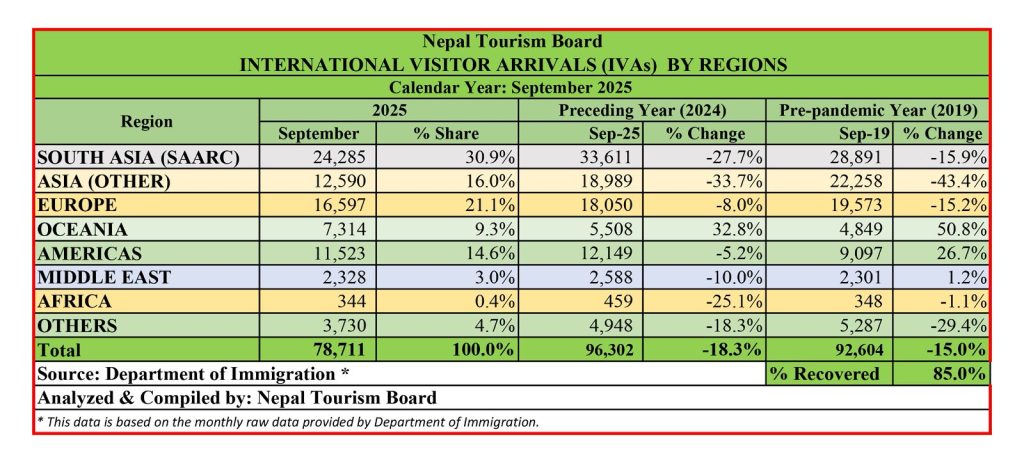
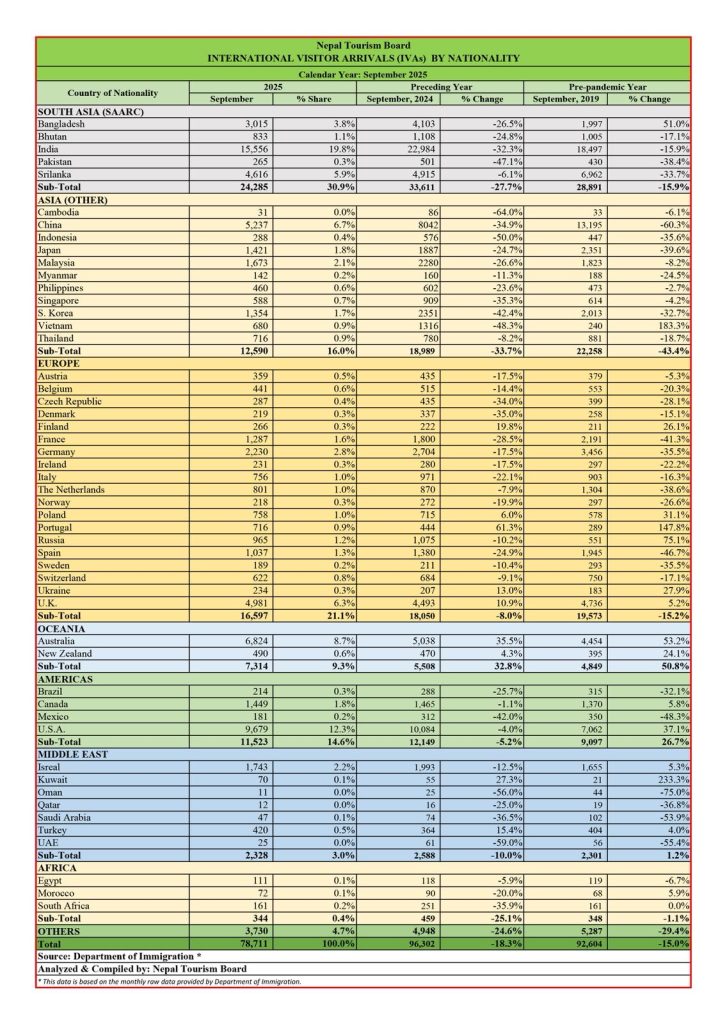
Nepal witnessed a total of 78,711 international visitors in September 2025, marking an 18.3 percent decline compared to the same month last year. Despite the drop, the number still represents an 85 percent recovery compared to pre-pandemic levels of September 2019, signaling a gradual rebound in Nepal’s tourism sector.
Tourism experts believe that the slower pace of recovery this September may be due to weather-related disruptions, particularly heavy monsoon rains and early snowfall in popular trekking routes such as the Everest and Annapurna regions. These conditions are thought to have affected flight operations and visitor mobility across several destinations.

Steady Nine-Month Performance
From January to September 2025, Nepal recorded a cumulative total of 8,15,273 international visitor arrivals (IVAs). The figure demonstrates consistent growth throughout the year, with the tourism industry continuing to recover from the global slowdown caused by the pandemic and subsequent travel challenges.
Industry insiders view the over 8-lakh figure as a positive indicator that Nepal remains a preferred destination for nature, adventure, and culture enthusiasts. The country’s diverse offerings, from trekking and mountaineering to spiritual and eco-tourism, continue to attract visitors from across the globe.
India Tops the Visitor Chart
According to the latest data, India remains Nepal’s top source market, accounting for 19.8 percent of the total visitors in September 2025. A total of 15,556 Indian tourists visited Nepal during the month, reaffirming India’s status as Nepal’s closest and most dependable tourism partner.
The United States followed as the second-largest source market, contributing 9,679 visitors (12.3%), reflecting continued interest from American travelers, particularly those seeking adventure and cultural experiences.
Australia ranked third with 6,824 visitors (8.7%), while China came fourth with 5,237 arrivals (6.7%), indicating a gradual return of Chinese tourists following the resumption of regular flight connections. The United Kingdom secured the fifth position with 4,981 visitors (6.3%), underscoring steady demand from the European market.
Regional Breakdown of Arrivals
In terms of regional distribution, South Asia (SAARC countries) contributed the highest share of international arrivals, totaling 24,285 visitors (30.9%). This is largely driven by cross-border tourism and cultural ties between Nepal and its South Asian neighbors.
Europe followed as the second-largest contributor, with 16,597 visitors (21.1%), reflecting a strong presence from nations such as the UK, Germany, and France. Asia (other than SAARC countries) accounted for 12,590 visitors (16.0%), while the Americas contributed 11,523 visitors (14.6%).
Oceania, mainly driven by Australia and New Zealand, recorded 7,314 arrivals (9.3%), showing sustained interest from long-haul travelers seeking adventure and mountaineering experiences in Nepal. The Middle East accounted for 2,328 visitors (3.0%), while Africa recorded 344 arrivals (0.4%). Other unspecified regions contributed 3,730 visitors (4.17%).
Tourism Industry’s Recovery and Challenges
While the steady flow of visitors signals recovery, tourism entrepreneurs express concern over Nepal’s inability to regain pre-pandemic growth momentum at the desired pace. Several factors, including global economic uncertainties, limited flight connectivity, visa delays, and climate-related disruptions, have impacted arrivals this year.
Despite these challenges, tourism operators remain optimistic. The ongoing autumn trekking and mountaineering season, which runs from October to December, is expected to bring a surge in tourist numbers, particularly to major destinations such as Everest, Annapurna, Langtang, and Mustang.
Government’s Focus on Tourism Promotion
The Nepal Tourism Board (NTB) has intensified its promotional campaigns in key international markets, focusing on cultural tourism, wellness travel, and adventure experiences. Efforts such as digital campaigns, participation in global travel fairs, and regional collaborations are aimed at attracting high-value tourists.
The NTB has also been coordinating with airlines to improve connectivity, particularly with China, Thailand, and Middle Eastern hubs. Industry stakeholders have urged the government to focus on infrastructure upgrades, simplified visa processes, and sustainable tourism practices to ensure steady growth.

Nepal’s Tourism Resilience Continues
Despite seasonal fluctuations and global challenges, Nepal’s tourism industry continues to show resilience. The country’s reputation as a safe, diverse, and welcoming destination has contributed to sustained visitor interest. With growing international recognition for its mountain landscapes, spiritual sanctuaries, and cultural heritage, Nepal remains firmly positioned as one of South Asia’s most sought-after destinations. Industry leaders hope that improved air connectivity and stable weather in the coming months will help close 2025 with strong overall performance.
Looking Ahead
Tourism experts anticipate that by the end of 2025, Nepal could surpass 1 million international arrivals, marking a full post-pandemic recovery if positive trends continue. The ongoing autumn and winter seasons are expected to play a crucial role in determining this year’s final performance. While September saw a dip compared to last year, the consistent upward trajectory across earlier months indicates a steady and sustainable rebound for Nepal’s tourism sector.