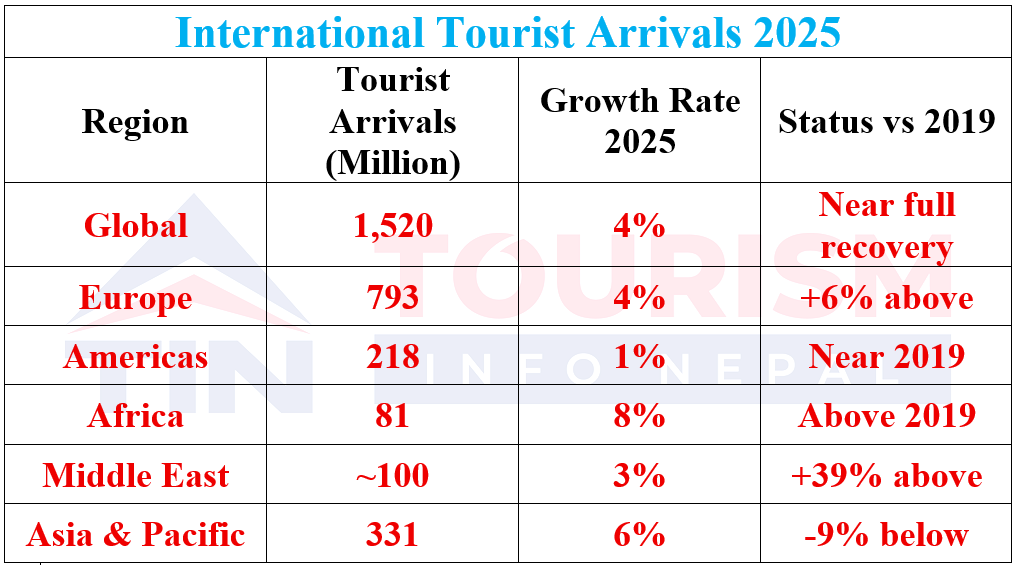
Global tourism continued its steady recovery in 2025, with international tourist arrivals increasing by 4% year-on-year, reflecting sustained travel demand despite economic and geopolitical challenges. According to the first World Tourism Barometer of the year released by UN Tourism, an estimated 1.52 billion international tourists traveled globally in 2025, nearly 60 million more visitors than in 2024. The figures indicate a return to pre-pandemic growth patterns, aligning closely with the average annual growth rate of 5% recorded between 2009 and 2019.
The growth was supported by strong outbound demand from major source markets, improved air connectivity, enhanced visa facilitation, and the continued recovery of destinations in Asia and the Pacific. Despite inflationary pressures affecting tourism services and lingering geopolitical tensions, global travel demand remained resilient throughout the year.

UN Tourism Secretary-General Shaikha Alnuwais noted that travel demand stayed robust across regions in 2025 and expressed optimism for the year ahead. She stated that the positive momentum is expected to continue into 2026, provided global economic conditions remain stable and destinations still lagging behind pre-pandemic levels complete their recovery.
Africa Leads Growth as Asia-Pacific Continues Rebound
Regional data from the World Tourism Barometer highlights uneven but broadly positive growth across destinations. Africa recorded the strongest performance in 2025, welcoming 81 million international tourists, an increase of 8% compared to 2024. North Africa stood out with an 11% surge, driven by strong recovery in key destinations.
Europe, the world’s most visited region, received 793 million international tourists, marking a 4% increase over 2024 and 6% growth compared to 2019. Western Europe (+5%) and Southern Mediterranean Europe (+3%) posted solid results, while Central and Eastern Europe rebounded strongly with 6% growth, although arrivals remained 9% below pre-pandemic levels.
The Middle East recorded 3% growth, reaching nearly 100 million international visitors in 2025. The region continued to outperform pre-pandemic benchmarks, with arrivals standing 39% above 2019 levels, making it the strongest-performing region relative to pre-COVID figures.
The Americas saw modest growth of 1%, totaling 218 million arrivals. While South America (+7%) and Central America (+5%) led regional performance, weaker results in the United States and weather-related disruptions, including Hurricane Melissa affecting parts of the Caribbean, dampened overall growth.
Asia and the Pacific welcomed 331 million international tourists, growing 6% year-on-year, though arrivals remained 9% below 2019 levels. North-East Asia recorded a strong 13% increase, while South Asia fully recovered to pre-pandemic levels, signaling continued regional momentum.
Destinations Record Strong Double-Digit Growth
Most destinations worldwide reported positive results in 2025. Among countries with full-year data, several recorded double-digit growth in international arrivals, including Brazil (+37%), Egypt (+20%), Morocco (+14%), and Seychelles (+13%). Destinations reporting data through November also showed impressive performance, with Bhutan (+30%), Iceland (+29%), Guyana (+24%), South Africa (+19%), and Japan (+17%) registering strong gains.
Other tourism indicators mirrored this growth. International air capacity and passenger traffic increased by 7% through October 2025, according to IATA. Global accommodation occupancy reached 66% in November 2025, matching levels recorded a year earlier.
Tourism Export Revenues Reach Record USD 2.2 Trillion
Strong travel demand translated into record financial performance for the tourism sector. International tourism receipts reached an estimated USD 1.9 trillion in 2025, up 5% from 2024, while total export revenues from tourism, including passenger transport, climbed to a record USD 2.2 trillion.
Several destinations reported revenue growth outpacing arrival growth, highlighting increased visitor spending. Countries posting strong gains in tourism receipts included Morocco (+19%), Republic of Korea (+18%), Egypt (+17%), Japan (+14%), and Mauritius (+10%). Among top global tourism earners, the United Kingdom and France (both +9%), Spain (+7%), and Türkiye (+6%) also recorded solid revenue growth.
Outlook for 2026: Growth Continues Amid Uncertainty
UN Tourism forecasts international tourism growth of 3% to 4% in 2026, reflecting a normalization after strong rebounds in 2023 and 2024. The outlook assumes continued recovery in Asia and the Pacific, stable global economic conditions, and no major escalation in geopolitical conflicts.

A majority of tourism experts remain optimistic, with 58% expecting better performance in 2026, while 31% foresee similar results. However, challenges such as high travel costs, geopolitical risks, trade tensions, and extreme weather events could affect traveler confidence.
Enhanced air connectivity, growing outbound travel from emerging markets, and major global events, including the Milano Cortina 2026 Winter Olympics and the FIFA World Cup 2026, are expected to further stimulate international travel in the year ahead.