The International Air Transport Association (IATA) has released the latest edition of its World Air Transport Statistics (WATS), offering a comprehensive overview of the global airline industry through 2025.
Updated annually, WATS provides data on passenger demand, airline capacity, operational performance, fleet composition, busiest routes, employment, and airline financial performance. The latest edition incorporates data from 1,315 airlines included in IATA’s Annual Statistics collection, including more than 250 international airlines that provided specific data for the WATS report.
Premium-Class Air Travel Continues to Grow
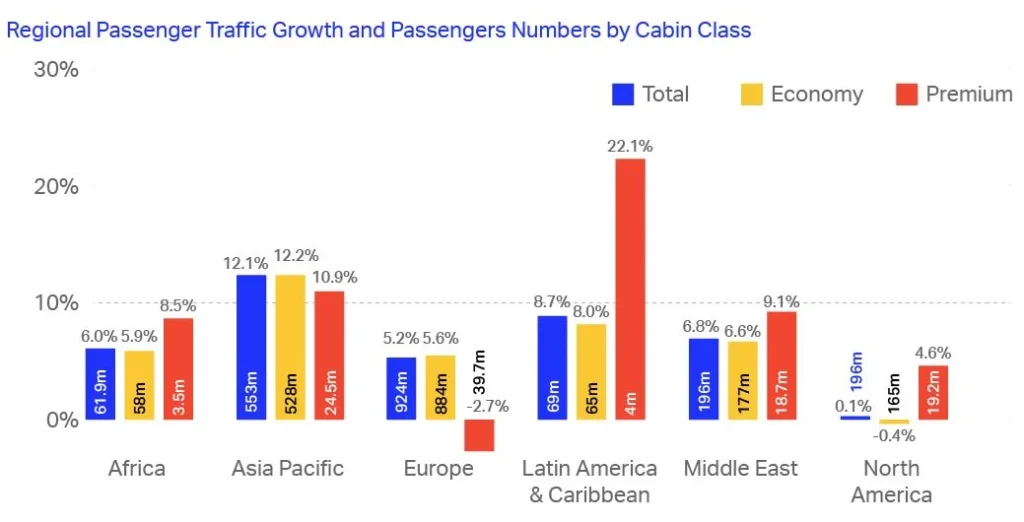
International premium-class travel recorded strong growth in 2025, with the number of business- and first-class passengers reaching 109.7 million, an increase of 4.5% compared to the previous year. Premium passengers accounted for 5.5% of all international travellers during the year.

Latin America recorded the strongest growth, with premium-class passenger numbers increasing by 22.1% to 4 million. Meanwhile, Europe remained the largest premium travel market, recording 39.7 million premium-class passengers in 2025. In terms of the share of premium travellers within total passenger numbers, North America led with 10.4%, followed by the Middle East with 9.5% according to the recent data of IATA.
Asia Pacific Dominates the World’s Busiest Airport Routes According to IATA
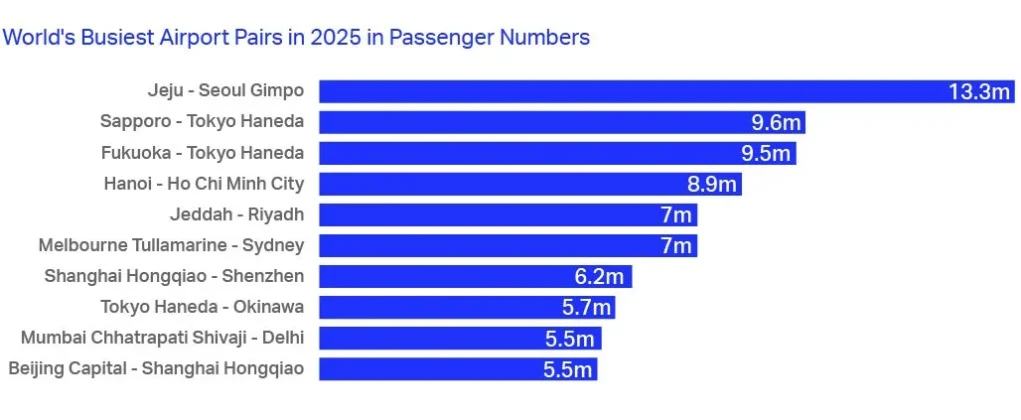
Asia Pacific continued to dominate the ranking of the world’s busiest airport pairs in 2025; according to the recent data of IATA. The route between Jeju International Airport and Seoul Gimpo International Airport (CJU-GMP) remained the busiest airport pair globally, carrying 13.3 million passengers.
All of the world’s top 10 busiest airport pairs were domestic routes, with nine located in the Asia Pacific region. The only route outside the region was the connection between King Abdulaziz International Airport in Jeddah and King Khalid International Airport in Riyadh (JED-RUH).
Busiest Airport Pairs by Region
In Africa, the route between Cape Town International Airport and Johannesburg’s OR Tambo International Airport (CPT-JNB) was the busiest, with 3.4 million passengers; according to the recent data of IATA.. In Latin America, Bogotá’s El Dorado International Airport–Medellín’s José María Córdova International Airport (BOG-MDE) ranked first, carrying 3.5 million passengers.
Europe’s busiest airport pair remained Barcelona–Palma de Mallorca (BCN-PMI), with 2.1 million passengers. The Stockholm Arlanda–Malmö route (ARN-MMX) recorded the fastest growth in Europe, with passenger numbers rising 85% to 271,031. In North America, New York’s John F. Kennedy International Airport–Los Angeles International Airport (JFK-LAX) was the busiest domestic route, carrying 2.2 million passengers. The busiest international airport pair from North America was JFK–London Heathrow (JFK-LHR), with 2.1 million passengers.
United States Remains World’s Largest Passenger Market According to IATA
The recent data revealed by IATA shows that the United States remained the world’s largest passenger market in 2025, recording 890.1 million passengers, including arrivals and departures. However, passenger numbers grew by only 1.6% year-on-year, the slowest growth among the world’s top 10 markets.
China ranked second with 776.1 million passengers, representing a 4.8% increase from 2024. The other leading passenger markets according to the recent data of IATA were:
- United Kingdom: 269.7 million passengers, up 3.4%
- Spain: 252.7 million, up 5.0%
- Japan: 223.5 million, up 9.2%
- India: 218.2 million, up 3.3%
- Italy: 187.3 million, up 5.8%
- Germany: 163.8 million, up 3.4%
- France: 152.6 million, up 2.2%
- Türkiye: 129.3 million, up 2.9%
The report also highlighted strong growth in several emerging markets. Kazakhstan recorded a 40% year-on-year increase to 18.1 million passengers, while Uzbekistan handled 12.5 million passengers, up 16.9%. Outside Central Asia, Vietnam also recorded significant growth, with 80.9 million passengers, representing a 14.8% increase from the previous year.
Airbus A220 and A350 Record Major Growth in Fleet Usage
The global aircraft fleet continued to evolve as airlines increasingly operated newer and more fuel-efficient aircraft. The Airbus A220 recorded the most dramatic increase in flight activity compared with 2019, with the number of flights rising 770.4% to 530,000 in 2025.
The Airbus A350 also recorded substantial growth, operating 434,000 flights, an increase of 117.4% compared to 2019. The Boeing 787 recorded a 40.8% increase, operating 795,000 flights in 2025.

Most Used Aircraft Types in 2025
Narrow-body aircraft continued to dominate global airline operations. Boeing 737 aircraft, including all variants, operated 10.8 million flights in 2025, making it the most widely used aircraft family. This was followed by the Airbus A320 with 8.7 million flights and the Airbus A321 with 4.2 million flights.
The Airbus A321 recorded a significant 61.6% increase in flights compared with 2019, reflecting the growing popularity of larger narrow-body aircraft for medium-haul operations. By contrast, the Airbus A380 continued to see reduced use. The aircraft operated 90,000 flights in 2025, down 24.4% from 2019.
Global Aviation Industry Continues to Transform
The latest WATS data highlights the continued transformation of the global aviation industry, marked by growing passenger demand, expanding premium travel, strong growth in emerging markets, and the increasing use of fuel-efficient aircraft. The figures also show the continued dominance of Asia Pacific in high-volume domestic air travel, while newer aircraft such as the Airbus A220, A321, A350, and Boeing 787 are increasingly shaping the future of global airline operations.