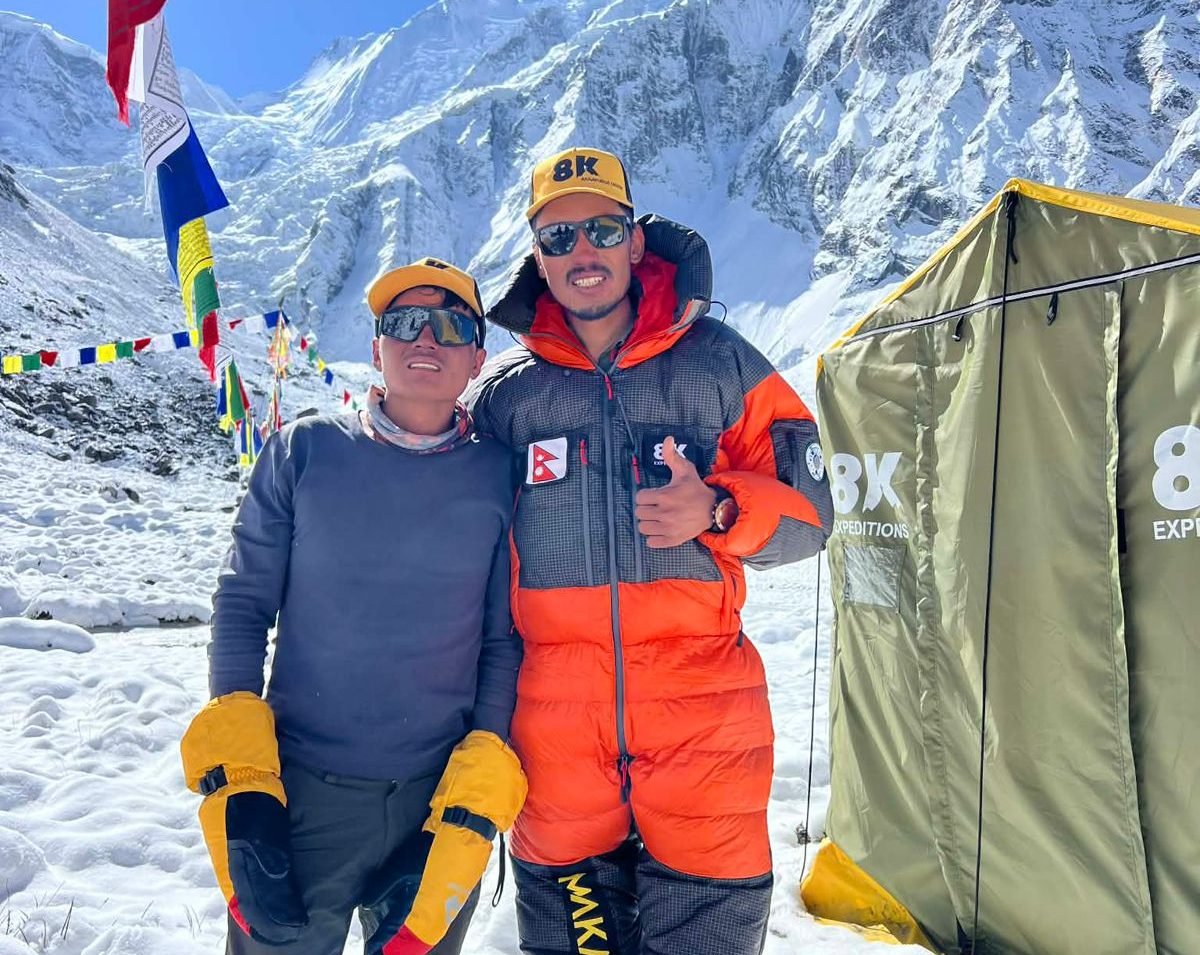
A Sherpa climber who had been missing for more than 48 hours above Camp IV on Mount Annapurna has been successfully rescued and is now receiving medical treatment, according to expedition officials.
Climber Went Missing During Descent from Summit
The missing climber, identified as Dawa Nurbu Sherpa from Makalu region in Sankhuwasabha, disappeared while descending from above 7,700 meters after summiting Annapurna on April 19 at around 9:00 am. He had reached the summit alongside Swiss IFMGA guide Richard Markus Bolt as part of an organized expedition. Expedition officials confirmed that contact with him was lost above the couloir near Camp IV, triggering an immediate emergency response.

Intensive Multi-Stage Search and Rescue Operation
Lakpa Sherpa, expedition director of 8K Expeditions, said an air search mission was launched without delay after Dawa went missing. “8K Expeditions immediately mobilized an air search mission after Dawa went out of contact from the couloir above Camp IV during his descent,” Lakpa said.
However, due to insurance restrictions, a long-line rescue above Camp III was not authorized. As a result, the company carried out the operation independently, deploying experienced guide Ashok Lama to assist in the rescue effort. During the aerial search, Lama successfully located Dawa near Camp IV. Despite extreme altitude challenges, he managed to ascend from Camp III and reach the stranded climber.
Dramatic High-Altitude Rescue from 7,000m Zone
From the location below Camp IV, Dawa was carefully brought down to Camp III. A helicopter operated by Heli Everest, piloted by Priya Adhikari, was then deployed to evacuate him to base camp. He was subsequently transported to Kathmandu for further medical treatment. Officials confirmed that Dawa is “safe and sound,” though he suffered minor frostbite during the ordeal.
Multi-Stage Coordination in Extreme Conditions
8K Expeditions Chairman Pemba Sherpa described the rescue as a complex, multi-phase operation involving coordinated aerial and ground efforts. He explained that the first helicopter mission conducted an aerial search but failed to locate the climber. A second search successfully identified his position. In the third phase, Ashok Lama was air-dropped at Camp III, located between 6,000 and 7,000 meters, an operation described as highly challenging due to altitude and weather conditions.
Lama then ascended to Dawa’s location below Camp IV and escorted him back to Camp III. In the fourth phase, a helicopter evacuated Dawa, followed by the extraction of Lama in the fifth stage. Both were flown to Pokhara, where Dawa received initial treatment at CIWEC.
Insurance Limits and Cost Concerns Raised
Pemba Sherpa also raised concerns over the financial limitations of high-altitude rescue operations, stating that insurance coverage of $10,000 was insufficient. “Insurance will cover a maximum of $10,000. The remaining cost has been borne by our agency,” he said, calling for a revision of coverage limits to at least $30,000 to better reflect the realities of Himalayan rescues. He further questioned whether current insurance frameworks truly understand the risks involved in Nepal’s high-altitude mountaineering environment.

Call for Stronger Safety Systems in the Himalayas
Pemba emphasized that only well-resourced companies can currently manage such complex rescues, warning that smaller operators may lack the financial capacity to save climbers in similar situations. “If this had been a small-scale expedition company, they would have no option but to leave the Sherpa up there to his fate,” he said, highlighting the urgent need for stronger safety systems and better insurance structures in high-altitude expeditions.
The successful rescue of Dawa Nurbu Sherpa has once again underscored both the extreme risks of Himalayan climbing and the critical importance of coordinated rescue capabilities in Nepal’s mountaineering sector.