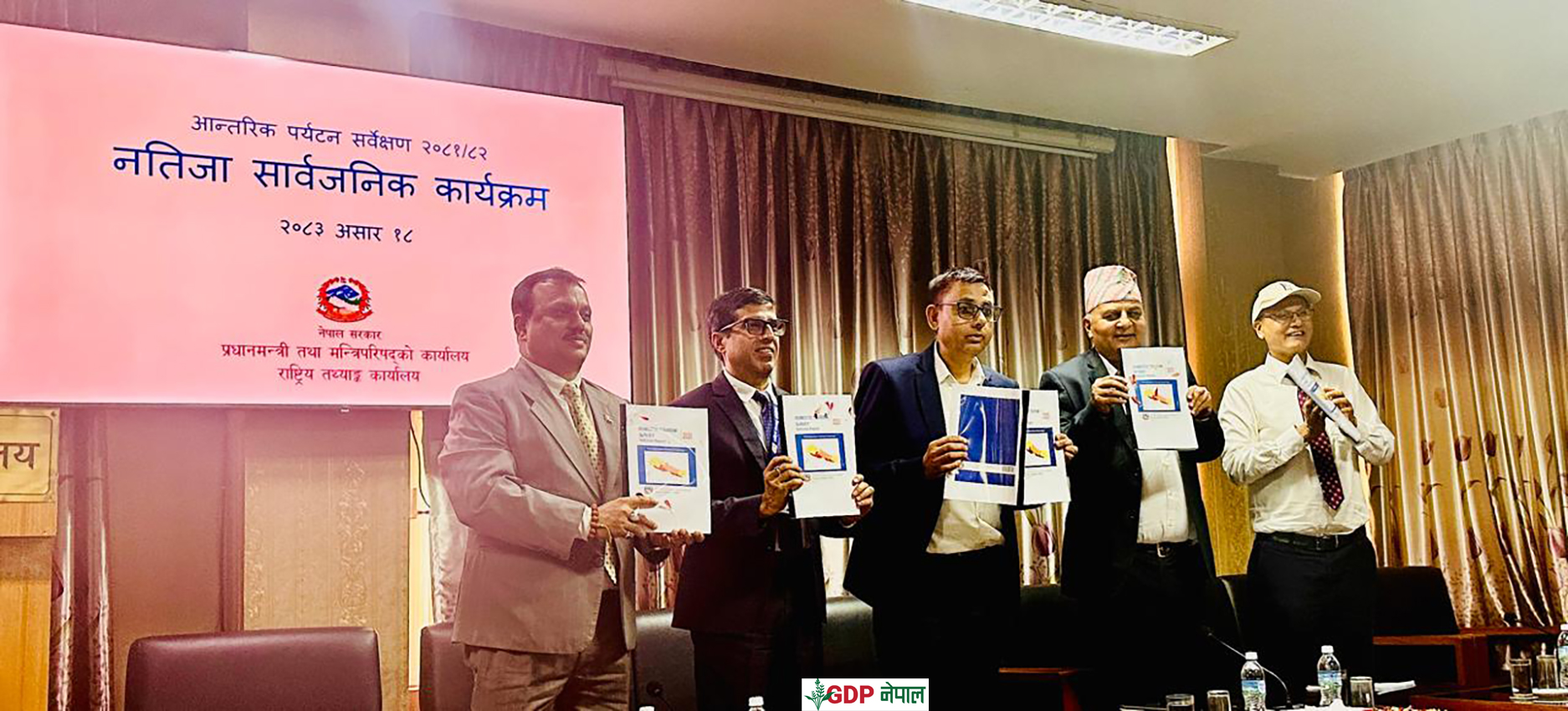
A newly released national survey by the National Statistics Office Nepal has revealed that Nepali households are spending an estimated Rs 4 Kharba 59 Arba 5 Crores annually on tourism-related activities, highlighting the growing economic significance of travel and tourism within Nepal.
According to the country’s first-ever nationwide “Domestic Tourism Survey 2081/82”, a major share of this expenditure comes from domestic tourism alone, where Nepalis spend approximately Rs 3 Kharba 95 Arba 42 Crores annually, underlining the expanding role of internal tourism as a major contributor to the national economy.
The survey, based on international Tourism Satellite Account standards, presents the most comprehensive picture yet of Nepal’s internal tourism patterns and is expected to serve as an important reference for future tourism planning and policy formulation.

More Than Half of Nepali Households Participate in Domestic Tourism
The survey found that 52.4 percent of Nepal’s total 6.91 million households, equivalent to around 3.62 million households, participated in at least one tourism-related trip during the survey period.
This indicates that more than half of Nepali families are now actively involved in tourism activities, reflecting increasing mobility, stronger travel culture, and the growing economic role of domestic tourism across the country.
The survey was conducted using a two-stage stratified sampling method, covering 5,328 households across 444 enumeration areas nationwide, making it Nepal’s most detailed tourism consumption study to date.
Domestic Tourism Spending Nears Rs 4 Trillion
Among domestic tourism expenditure, Nepalis spent Rs 3 Arba 4 Kharba 44 Crores on overnight domestic trips, while same-day return domestic travel accounted for Rs 90 Arba 98 Crores.
In comparison, spending on international travel remained significantly smaller, with overnight outbound travel accounting for Rs 47 Arba 97 Crores and same-day foreign trips totaling Rs 15 Arba 67 Crores.
The data clearly shows that domestic tourism remains the dominant component of household tourism spending, suggesting that internal travel demand has become a major pillar supporting Nepal’s tourism economy.
Health-Related Travel Records Highest Spending Share
One of the survey’s most notable findings shows that health and medical treatment-related travel accounted for 31.78 percent of total tourism expenditure, making it the single largest reason behind tourism-related spending by Nepali households.
Meanwhile, travel linked to volunteer work, migration-related movement, and other miscellaneous purposes accounted for only 0.8 percent of total expenditure, representing the smallest segment.
The survey suggests that healthcare access continues to drive significant domestic travel movement across Nepal, particularly among households traveling between districts and urban medical centers.
Shopping Emerges as Largest Spending Category
In terms of spending categories, shopping accounted for 26 percent of total tourism expenditure, making it the largest spending area among travelers.
By contrast, spending on adventure tourism activities accounted for just 0.04 percent, reflecting the relatively limited share of adventure-related spending among domestic travelers despite Nepal’s global adventure tourism reputation.
The survey also showed that 68.7 percent of transportation spending occurs through public transportation, confirming that buses and other public vehicles remain the primary mode of travel for domestic tourists across the country.
Average Spending Per Trip Reaches Nearly Rs 12,000
The study found that the average expenditure per trip stands at Rs 11,922 per journey.
Among different travel purposes, health-related travel recorded the highest average spending, with households spending Rs 23,516 per trip, significantly higher than other travel categories.
Tourism economists say this reflects the financial burden associated with traveling for specialized healthcare services, particularly for residents of rural and remote districts traveling to urban hospitals.
Family Visits and Social Connections Drive Domestic Tourism
The survey also examined travel motivation patterns among Nepali travelers.
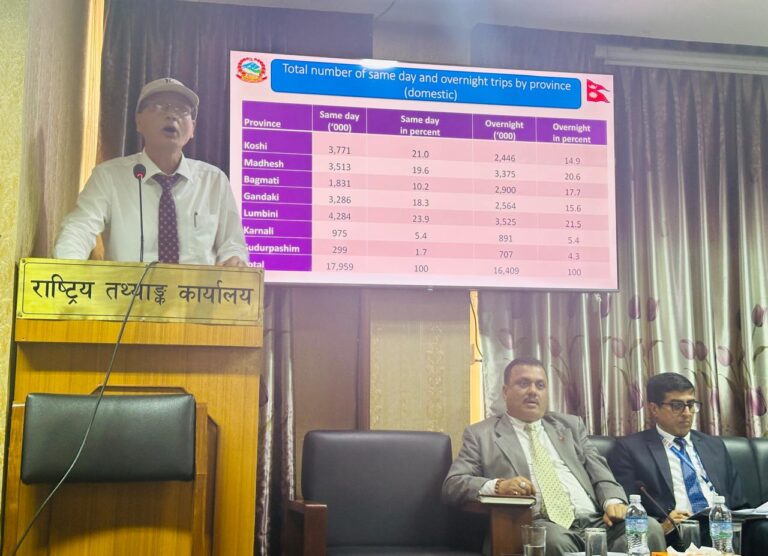
For same-day domestic trips, shopping emerged as the primary purpose, accounting for 32.6 percent, followed by health treatment and visiting friends and relatives, both accounting for 20.1 percent each.
For overnight domestic travel, the biggest motivation was visiting friends and relatives, accounting for 65.5 percent of all trips, indicating that social and family relationships remain the strongest driver of internal travel behavior in Nepal.
Experts say this highlights how domestic tourism in Nepal remains deeply connected to cultural and family-based mobility rather than purely leisure-focused travel.
Kathmandu, Chitwan and Kaski Lead as Major Tourism Destinations
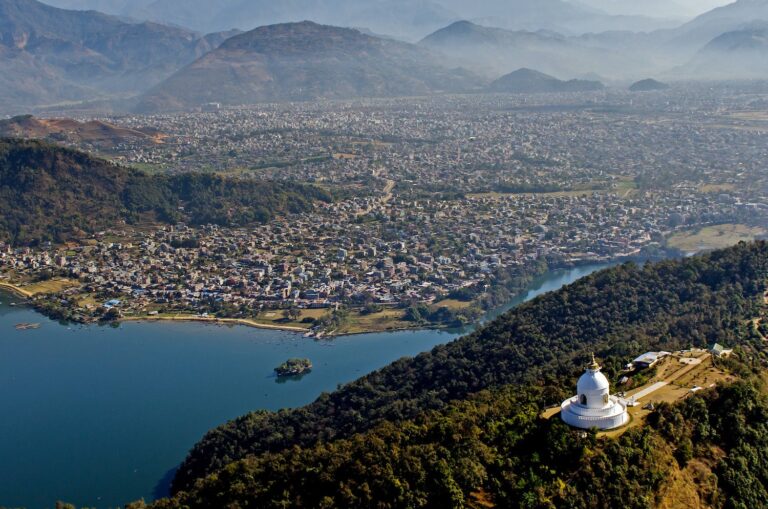
Among overnight domestic tourism destinations, Kathmandu, Chitwan District, and Kaski District emerged as the top destinations visited by domestic travelers.
The survey showed that Kaski District is particularly popular among travelers seeking recreation and holiday experiences, making it the country’s leading leisure destination for domestic tourists.
The average duration for overnight domestic travel stands at 5.33 days, while Nepali travelers make an average of 4.81 such trips annually.
Regionally, Sudurpashchim Province and Madhesh Province recorded the longest average stay duration of 8.18 days, while Gandaki Province recorded the highest annual travel frequency, with residents making 6.26 trips per year on average.
Young Population Driving Nepal’s Tourism Movement
The survey found that Nepal’s tourism-active households are dominated by younger age groups.
Generation Z (13–28 years) accounted for 26.6 percent of tourist households, followed by Generation Alpha and Beta (0–12 years) at 22.6 percent, and Generation Y (29–44 years) accounting for 22 percent.

The average household size among tourism-participating families stood at 3.94 members nationally, with rural households averaging 4.02 members, slightly larger than urban households, which averaged 3.87 members.
Survey Provides Crucial Data for Future Tourism Policy
Tourism experts say the survey provides the first real statistical picture of Nepal’s domestic tourism economy and offers valuable insights for future policy-making, infrastructure planning, destination development, and tourism investment strategies.
Officials believe the findings can help Nepal diversify tourism planning beyond international arrivals by recognizing domestic tourism as a major economic engine capable of sustaining year-round tourism growth.