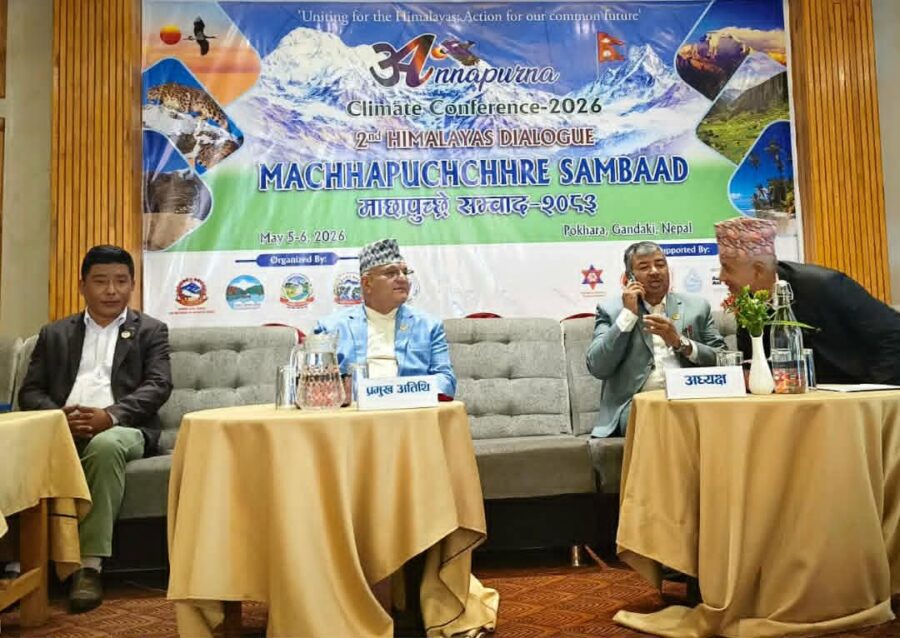
A major regional dialogue on climate change has commenced in Pokhara with the launch of the Annapurna Climate Conference and Machhapuchhre Dialogue, initiated by Save Our Himalaya First Nepal in collaboration with provincial and local government bodies. The conference, which began on Tuesday, aims to discuss the growing impacts of climate change in the Himalayan region through research presentations, expert discussions, and policy recommendations.
The program is jointly organized by the Save Our Himalaya First Nepal, the Ministry of Forests and Environment of Gandaki Province, Pokhara Metropolitan City, Machhapuchhre Rural Municipality, and Annapurna Rural Municipality.

Climate Change Emerges as a Critical Regional Concern
Speaking at the event, organizer and Chairperson of Save Our Himalaya First Nepal, D.B. Nepali, said the Gandaki region is globally recognized for its ecological sensitivity and environmental importance. He stressed that weather change must be treated as a top-priority issue in the region due to its direct impact on livelihoods, biodiversity, and natural ecosystems. He added that the conference was designed to bring together experts and policymakers to develop collective solutions for climate resilience in the Himalayas.
Chief Minister Highlights Rising Climate Risks
The conference was officially inaugurated by the Chief Minister of Gandaki Province, Surendra Raj Pandey, who highlighted the increasing frequency of climate-induced disasters in the region. He pointed out that communities across the province have repeatedly suffered from floods, landslides, excessive rainfall, and drought-like conditions in recent years.
He emphasized that addressing the needs of disaster-affected communities is a government priority. He also warned that globally recognized environmentally rich areas like Gandaki are increasingly vulnerable to climate change, calling for stronger cooperation, awareness, and collective action from all stakeholders.
Research Papers Highlight Environmental Challenges
The conference features the presentation of more than 30 research papers focusing on the impacts of climate change on weather patterns, ecosystems, livelihoods, and biodiversity in the Himalayan region. Experts from Nepal and abroad shared their findings on various dimensions of weather change. Professor Dr. Myrile Ballard from the University of Calgary, Canada, presented a paper on the future of Indigenous communities in the context of climate change. Dr. Basanta Raj Adhikari discussed disaster risk in the Himalayan region, while Khagendra Raj Paudel presented a case study on the Nepal Himalaya.

From the provincial perspective, Purneshwor Subedi of the Gandaki Province Ministry of Forests and Environment presented an analysis of past and present climate conditions. Assistant Professor Dipendra Raj Pahari of Janapriya Multiple Campus shared insights on the untold stories of Machhapuchhre.
Focus on Health, Water, Wildlife, and Ecosystems
Additional research presentations explored how climate change is affecting public health, local communities, forests, water resources, and wildlife. Speakers included Dr. Ranjan Datta from the University of Calgary, Zebunisa Chapola, Namindra Dahal of the Nepal Water Conservation Foundation, and Dr. Rajan Paudel from ACAP. Their studies highlighted the interconnected impacts of environmental degradation and climate stress on Himalayan ecosystems.
Policy, Tourism, and Agriculture Under Climate Stress
Further sessions focused on policy responses and sectoral impacts, including tourism, agriculture, and ecology in the Gandaki Province. Presenters such as Dr. Ripu Kunar, Shrikanth Khatiwada, Anupam Upreti, and Prem Dawadi discussed how weather change is influencing regional development strategies, tourism sustainability, agricultural productivity, and ecological balance.
Participation from Government and Academic Leaders
The opening session was chaired by D.B. Nepali and attended by senior officials and experts, including Dr. Maheshwar Dhakal, Joint Secretary at the Ministry of Forests and Environment’s Climate Change Management Division, Secretary of the Gandaki Province Ministry of Forests and Environment, Kaski District Coordination Committee Chief Liladhar Paudel, and Dr. Narayan Prasad Gautam, Chief of the Institute of Forestry, Pokhara. Machhapuchhre Rural Municipality Chairperson Min Bahadur Gurung and representatives from civil society organizations also participated in the program.

Field Visit and Declaration Planned for Conclusion
Organizers have announced that the conference will conclude on Wednesday with a field visit to Khara Pani in Machhapuchhre Rural Municipality. A formal declaration outlining key findings and recommendations will also be issued at the end of the program. The event is expected to strengthen regional cooperation and policy dialogue on weather change adaptation and environmental conservation in the Himalayan region.
Strengthening Himalayan Climate Action
The Annapurna Climate Conference and Machhapuchhre Dialogue are being seen as an important platform to bridge scientific research, policy formulation, and community action. By bringing together experts, government representatives, and civil society, the initiative aims to enhance resilience and promote sustainable development in one of the world’s most climate-sensitive regions.