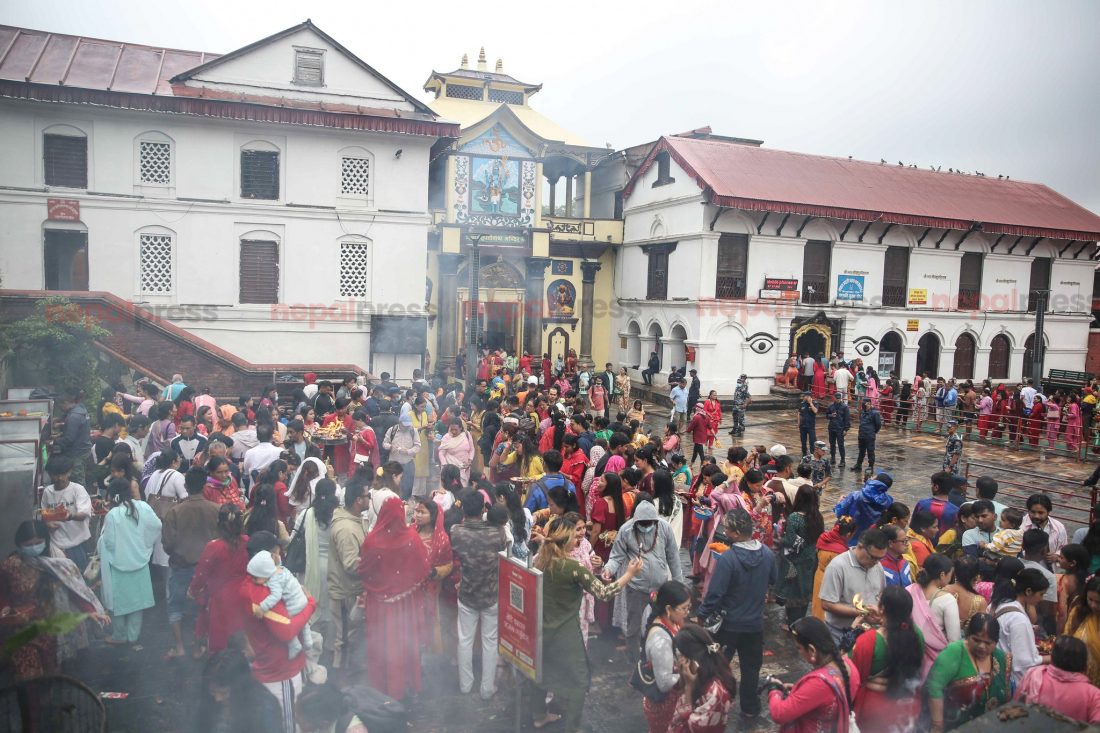
On the last Monday of the sacred month of Shrawan, devotees began gathering at Pashupatinath Temple from as early as 3 AM. The day holds special religious significance as Mondays in Shrawan are dedicated to Lord Shiva, attracting thousands of worshippers across the country to Shiva temples for prayers, rituals, and darshan (holy viewing). This year, the crowd at Pashupatinath has been particularly large, with devotees lining up well before dawn to offer their respects.
Four Entrances Open Early to Manage Devotee Flow
According to Subash Chandra Joshi, Member Secretary of the Pashupati Area Development Trust (PADT), all four gates of the Pashupatinath temple complex were opened from 3 AM to accommodate the influx of devotees. As with other major festivals, the PADT arranged four main queues for entrance to streamline the movement of worshippers.
The first queue begins at Gaurighat and passes through Umakund and Rudragadeshwar before entering through the western gate. The second line starts at Mitrapark and Dakshinamurti leading to the western main gate, while the third queue forms via Jayabageshwari, Bhuvaneshwari, and Shankaracharya Math, also entering from the western main gate. The fourth line comes from Pingalasthan through the four Shiva temples and Panchdeval before entering from the southern gate.
Religious Significance of Shrawan Mondays
Shrawan is considered the month of Lord Shiva, and Mondays during this period are especially auspicious. It is believed that bathing early in the morning and performing puja (worship) at Shiva temples on these days fulfills devotees’ wishes and grants eternal blessings. In line with this belief, the Trust has also arranged additional facilities, including extra shoe racks to accommodate the large number of visitors.
Since the beginning of Shrawan, four special buses have been running along the Ring Road to ferry devotees to Pashupatinath and other key Shiva shrines, helping ease traffic and crowd management.
Observance of the Shrawan Monday Fast
Among devotees, there is a popular belief related to the Shrawan Monday vrat (fast). Married women observe the fast praying for the long life of their husbands, while unmarried women fast hoping for a suitable life partner. Ramchandra Gautam, a religious scholar and former chairman of the Nepal Panchang Nirnayak Bikash Samiti, stated that ancient scriptures emphasize worship of Shiva throughout the month of Shrawan and especially on Mondays for peace, prosperity, and happiness.
Traditionally, those beginning the Shrawan Monday fast for the first time are advised to start in a year when there are five Mondays in Shrawan. The fast concludes on the last Monday with rituals such as godaan (cow donation) and puranapatra (offering of a sacred leaf), marking the fulfillment of devotees’ wishes.
Devotees Flock to Gokarneshwar Mahadev Temple
Similar scenes of devotion were witnessed at Gokarneshwar Mahadev Temple located in the northeastern part of Kathmandu. The temple opened its gates at 3 AM as well, welcoming a large number of worshippers. Jai Ram Mahat, Chairperson of the Gokarneshwar Municipality Ward No. 4 and also the head of the temple’s management committee, confirmed the heavy influx of devotees.
An ancient tradition connects worship at Pashupatinath and Gokarneshwar, where worshippers perform puja of the Shriyantra at Pashupatinath and Balayantra at Gokarneshwar. Hence, devotees visiting one temple also make it a point to visit the other, adding to the crowds at both sites.
Pilgrims Bring Sacred Water from Sundarijal for Offering
Another significant custom observed during this period is the collection of holy water from the source of the Bagmati River at Sundarijal, which is then brought to Pashupatinath for ritual offering. Devotees associated with the Bol Bam Kanwariya Sangh had camped at Sundarijal from the previous night to perform early morning ablutions and collect pure water.
Known as the Bol Bam tradition, pilgrims dressed in yellow cloth carry water-filled pots attached to bamboo poles, chanting “Bol Bam” as they journey from Sundarijal to Pashupatinath. Along the way, they also offer the sacred water to smaller Shiva shrines, including Gokarneshwar Mahadev, thus sustaining an ancient devotional practice.
Rituals of Offering Pure Water and Milk to Lord Shiva
Lord Shiva is revered as the lord who loves the continuous flow of water and milk. Devotees perform special offerings during Shrawan by pouring river water, cow’s milk, and other sacred substances on Shiva’s lingam to invoke blessings.
In Nepalese society, it is customary to perform the Vedic Rudrabhishek (ritualistic bathing of the Shiva lingam) once a year, often in Shrawan. It is believed that performing this ritual protects homes from negative energies, and brings peace, prosperity, and spiritual merit.
Other Shiva Temples Also Witness Heavy Devotee Turnout
Besides Pashupatinath and Gokarneshwar, other Shiva temples in Kathmandu, such as Makhan Mahadev in Basantapur (often called the “Small Pashupatinath”), also saw significant crowds. The devotion to Lord Shiva during this month is marked by fervent worship, large gatherings, and the renewal of faith across the city.