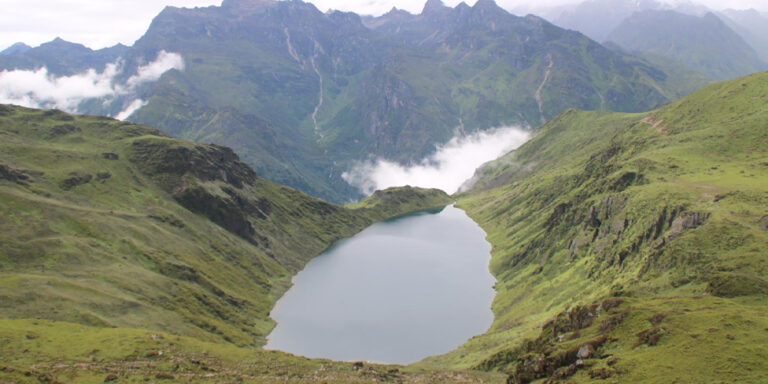
In the heart of Mikwakhola Rural Municipality-5, within the enchanting Loden region of Taplejung, lies a pristine natural treasure: Lampo Pokhari, a serene, oval-shaped lake nestled amidst lush green hills. Despite its breathtaking beauty and deep cultural significance, Lampo Pokhari remains largely unexplored and is quietly awaiting the footsteps of curious travelers and nature lovers.
Lampo Pokhari stands out as one of the main attractions of the Loden meadows, a region known for its spectacular highland landscapes and unspoiled ecosystems. The lake, surrounded by grassy fields and shrouded in mystique, holds deep cultural value for the local Sherpa community, who refer to it as Chhonasing Pokhari. With its tranquil waters reflecting the surrounding greenery and the high Himalayas, it offers a soul-soothing experience for visitors who brave the rugged journey to reach it.
Taplejung’s Rich Array of Tourist Destinations
Taplejung district is widely recognized for its wealth of tourist destinations, catering to a wide range of interests. From Kanchenjunga, the world’s third-highest mountain, that draws global adventurers, to sacred religious sites like Pathibhara Devi Temple, the district offers something for everyone. Moreover, Taplejung’s highland meadows, vibrant buki flower fields, and crystal-clear alpine lakes, like Lampo Pokhari, further enrich its appeal, especially for eco-tourism and cultural exploration.
According to Milan Limbu, a local who collects medicinal herbs in the area each year, Lampo Pokhari is the largest lake in the Loden region. Yet, despite its size and natural appeal, it has received little academic or institutional attention. No official body has conducted a detailed study or research on the lake’s ecological significance or hydrology, a fact that underscores the lack of promotion and scientific interest in this hidden jewel.
Sacred Significance and Local Belief
Local ward member and resident Topla Sherpa shares that Lampo Pokhari is not just a picturesque site, but a lake steeped in legends and cultural narratives. For the local Sherpa community, the lake is revered as a spiritual site, believed to be blessed and sacred. They frequently organize rituals and pay homage, believing the waters possess natural energy and healing power.
Surrounded by undulating green ridges, the lake’s stunning location enhances its charm. The silence, disturbed only by the sound of the wind and occasional animal calls, creates an ambiance of peace and reflection. Pande Sherpa, a resident of Mikwakhola-5 Simbuk, explains that visitors often sit quietly beside the lake to experience inner calm and often capture its scenic beauty through photography before descending back.
Challenges to Accessibility and Lack of Infrastructure
Despite its immense potential, Lampo Pokhari has not seen substantial development efforts or strategic promotion from authorities. Being a high-altitude destination, travelers often suffer from altitude sickness, including headaches and nausea. The journey to the lake typically takes a week, requiring physical endurance and logistical preparedness.
Accommodation is a major challenge. With no permanent human settlement nearby, visitors must rely on yak or sheep herders’ shelters or temporary huts (dharmashalas) built by local communities in memory of their ancestors. Gyalzen Sherpa, Chairperson of Ward-5, notes that travelers must bring their own food and supplies, as no shops or services exist in the region. The rugged terrain and lack of basic infrastructure have made it difficult for tourism to flourish in a sustainable way.
Hope on the Horizon: Local Government Taking Initiative
Encouragingly, the local government is starting to take notice. In the current fiscal year, the Mikwakhola Rural Municipality has allocated a budget for the promotion of Loden and Lampo Pokhari, marking a significant step toward mainstreaming this off-the-beaten-path destination. Gyalzen Sherpa mentions that efforts are now underway to highlight the lake’s natural and cultural importance, targeting internal and eventually international tourists.
With the gradual increase in domestic tourism, more Nepalis are venturing into remote destinations like Loden. Social media has played a pivotal role in bringing attention to the lake, with photos and stories shared by trekkers slowly catching the eyes of adventure seekers.
A Call for Sustainable Eco-Tourism
Lampo Pokhari stands at a unique intersection of ecological richness, cultural heritage, and spiritual reverence. For Nepal’s tourism planners, it presents a golden opportunity to develop a low-impact, community-driven eco-tourism model that could uplift local livelihoods while preserving the natural environment.
However, this will require proper planning, including trail management, safety measures, local guide training, and the construction of minimal yet essential infrastructure such as toilets, emergency shelters, and designated camping spots. Encouraging community participation and respecting the cultural beliefs tied to the lake are also crucial steps toward ethical tourism development.
If promoted with vision and care, Lampo Pokhari could become the next iconic destination in Eastern Nepal, offering travelers a blend of natural serenity, spiritual insight, and highland adventure, all while empowering one of the country’s most remote communities.
As Taplejung continues to rise as a multi-faceted tourist destination, Lampo Pokhari in Loden holds untapped potential to become a symbol of natural beauty, cultural richness, and sustainable tourism. With the right mix of promotion, preservation, and participation, this tranquil lake could soon witness the footsteps of curious travelers who seek more than just sightseeing—an immersive experience in nature and tradition.