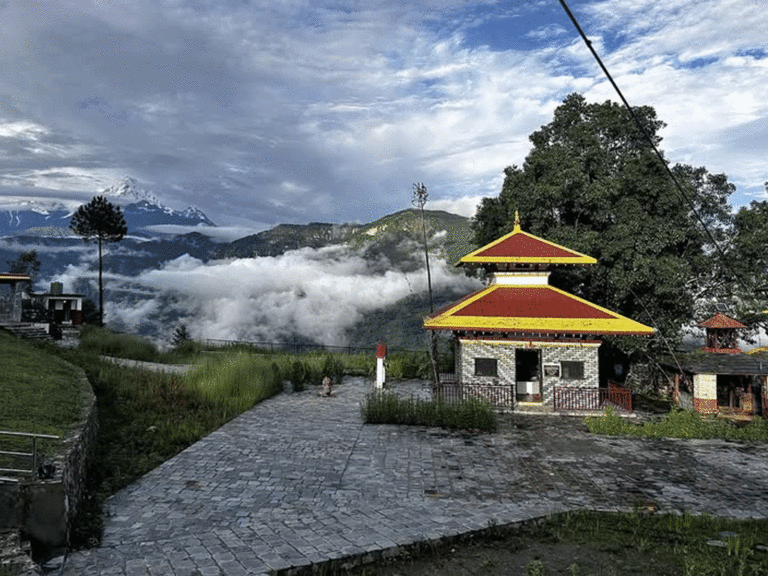
Located in ward number 5 of Beni Municipality, Myagdi, Pulashram, also locally known as Pachhai, remains an overlooked yet spiritually significant site awaiting pilgrims and tourists. According to Hindu mythology, the area is believed to be the sacred land where sages Pulastya and Pulaha performed penance and where the legendary demon king Ravana of the Ramayana was born.
Despite its rich religious and historical legacy, the serene Pulashram area lies quiet and under-visited. As per Tej Prakash Baniya, Vice-Chairperson of the Paultsya Area Development Fund, the site has immense spiritual value but has yet to receive the recognition it deserves.
Mythological References and Ancient Significance
Pulashram finds its mention in both the Shrimad Bhagwat Mahapurana and the Ramayana. The eighth chapter of the fifth section of the Bhagwat details the location as the confluence of goddesses Jayanti, Mangala, and Kali, where sages Pulastya and Pulaha meditated. It is also believed that Ravana’s navel was buried here, and the fire pits (hawan kunds) used by the sages still exist at the temple premises today.
“Various religious texts and research validate that sages Pulastya and Pulaha performed spiritual rituals in this area, which is why it is named Pulashram,” said Baniya. The site also includes ancient charu (sacrificial remnants) believed to be left behind from the sages’ offerings.
On the Route to Muktinath, But Left Behind
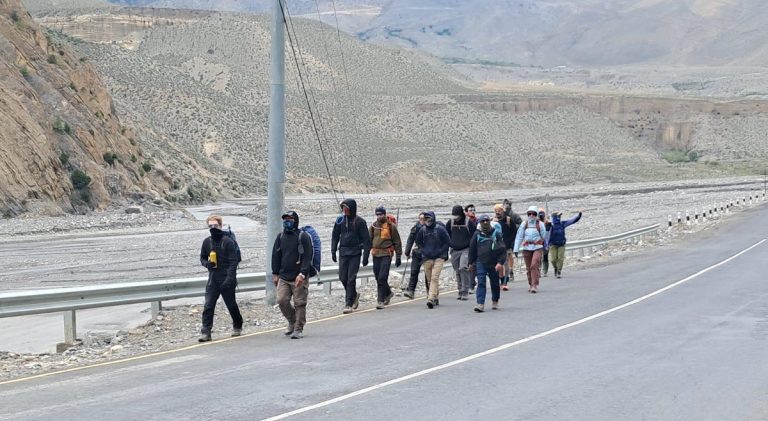
Each year, more than 700,000 domestic and international tourists pass through Beni en route to the sacred Hindu-Buddhist pilgrimage site Muktinath, located along the Beni–Jomsom route. However, Pulashram, situated just nine kilometers north of Beni, remains largely unnoticed.
Lack of road infrastructure, poor promotion, and insufficient accessibility are major hurdles. “Very few people know about the significance of Pulashram. Even those who are aware are often forced to turn back from Pulachaur or Tinmane due to poor road conditions,” said Baniya.
Natural Beauty and Peaceful Ambience
At an altitude of 1,700 meters above sea level, Pulashram offers mesmerizing views of the Annapurna and Dhaulagiri ranges. One can also witness the flowing Kali Gandaki and Myagdi Rivers and observe rural settlements of Myagdi, Parbat, and Baglung districts.
With no immediate human settlements nearby, the area offers a peaceful retreat for visitors. The solitude and serenity of Pulashram make it ideal for spiritual reflection, meditation, and nature appreciation.
Challenges in Accessibility and Infrastructure
Pulashram is about two hours on foot or 30 minutes by vehicle from Beni. However, lack of a well-maintained road and proper pedestrian pathways has discouraged many visitors. Local resident Shanti Sharma pointed out that absence of a proper route has been a major issue preventing pilgrims from reaching the sacred site.
A decade ago, the Paultsya Area Development Fund had constructed a temple at Pulashram using funds raised from a religious Mahayagya. Despite this, the broader area still lacks basic tourism infrastructure.
Ongoing Development: Ravan Park Nearing Completion
Recent efforts by Beni Municipality, in collaboration with the Ministry of Tourism, are showing progress. According to Govinda Baniya, Ward Chairperson of Beni-5, the construction of Ravan Park within the Pulashram complex is in its final stages.
A towering 21-foot-high Ravana statue, complete with ten heads and traditional ornaments, has been erected using bronze alloy. The surrounding four-ropani park includes fencing, gates, slate-paved paths, lawns, and rest areas. Only minor works like ritual thread (janai) placement and cleaning remain.
Preserving History While Promoting Tourism
The park, built under a contract worth NPR 17.6 million, preserves historically significant locations such as the Ravana’s navel site, the rishi temple, and the hawan kund. Infrastructure includes landscaped gardens, resting spaces, fencing, and land conservation facilities.
Mayor Surat KC of Beni Municipality confirmed that 6 kilometers of road from Beni to Purundi have already been blacktopped. A proposal has been submitted to upgrade the road from Chanoute to Pulashram with support from the provincial and federal governments.
Targeting South Indian and Sri Lankan Religious Tourists
Highlighting the religious link between Pulashram, Ravana, and the Ramayana, Mayor KC stated that the site could attract religious tourists from South India and Sri Lanka. A road linking Galeshwar in Beni-9 to Pulashram and Jagannath is also being upgraded under the Gandaki Provincial Government’s support.
The Vision of a Religious Tourism Corridor
With an ambitious plan in place, the local government aims to develop a “Religious Corridor” connecting Beni, Pulashram, Ghatanakot, Dholthan, Jagannath, and Galeshwar. According to Mayor KC, this development strategy will help extend the stay of pilgrims heading to Muktinath and promote local tourism-based livelihoods. “By developing this corridor, we aim to create a reason for Muktinath-bound pilgrims to stop and explore the spiritual richness of Beni,” he said.