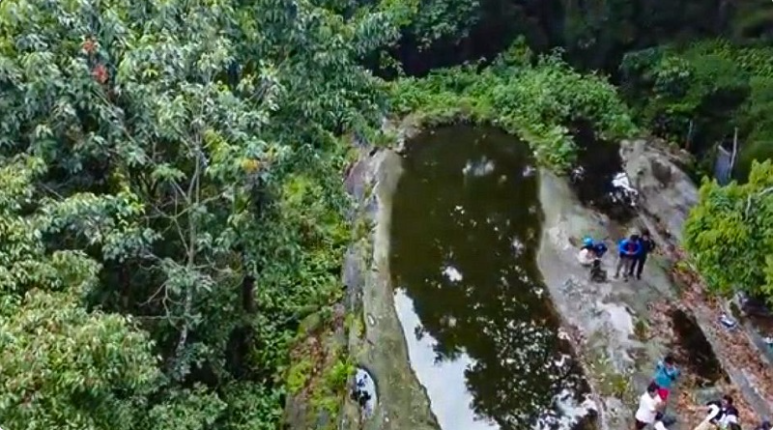
Tucked away in the dense forests above Baasthala village in Makalu Rural Municipality-6, Mangma Pond remains largely unnoticed despite its rich cultural, religious, and natural significance. Located atop a massive rock about three to four kilometers uphill from the settlement, this tranquil pond spans approximately 11 meters in length, 6 meters in width, and 3 meters in depth, and remarkably, it never dries up throughout the year.
Locals regard Mangma Pond as a sacred site and believe it is the abode of a powerful deity. Surrounded by unspoiled nature and steeped in ancient spiritual beliefs, the pond holds a special place in the hearts of the indigenous communities, yet it remains hidden from the wider public due to a lack of promotion and infrastructural development.
A Sacred Site with Ancient Beliefs
According to Kuber Rai, a local resident, the people of this region, predominantly from the Rai, Kulung, and Mewahang communities, believe that Mangma Pond is inhabited by a divine presence. This spiritual belief has been passed down from generation to generation, making the pond an integral part of local traditions and festivals.
One such important cultural event is Mabahan Parba, during which villagers climb up to the pond to perform rituals, offer incense and light butter lamps. “We offer prayers, burn incense, and share prasad in devotion,” said Bajraman Rai, a local elder. The area has been strictly protected by customary rules, sacrifices and any violent activities are strictly prohibited, as the site is believed to be linked with the Nagdevata (serpent deity).
The pond’s pristine condition and the spiritual discipline surrounding it are seen as key factors preserving its sanctity. This unique combination of natural beauty, religious importance, and community guardianship makes Mangma Pond a potential gem in Nepal’s growing eco-spiritual tourism sector.
Local Initiatives Toward Preservation and Access
Efforts to enhance the site’s accessibility and infrastructure have begun at the local level. According to Dhanraj Rai, another local resident and community leader, the villagers are working hard to promote the pond’s significance and preserve its cultural heritage.
“The trail leading to the pond has been repaired through local volunteer labor and with support from the Prime Minister Employment Program (PMEP),” Rai shared. The pathway, once rugged and overgrown, is now in a much better condition, allowing visitors and pilgrims to reach the site more easily.
In addition to the trail renovation, a small waiting shelter (pratikshalaya) has been constructed near the pond for devotees and visitors. There are also plans to build a temple near the pond to enhance its religious infrastructure. “We want to develop the pond area in a way that respects its spiritual importance while welcoming pilgrims and tourists,” Dhanraj Rai emphasized.
Need for Wider Promotion and Government Support
Despite these community-led initiatives, the site remains largely unknown beyond the local region. The lack of promotional campaigns, government attention, and inclusion in tourism maps has prevented Mangma Pond from receiving the recognition it deserves. While many sacred and natural sites across Nepal have been transformed into popular tourism destinations, Mangma Pond remains overlooked and underdeveloped.
The villagers hope that relevant authorities, including the Ministry of Culture, Tourism and Civil Aviation, the provincial government, and the local municipality, will step in to support infrastructure development, preserve the natural habitat, and create sustainable tourism strategies.
“There is immense potential here,” said Kuber Rai. “Not just as a pilgrimage destination, but also as a site for nature lovers, trekkers, and cultural researchers. We just need the right kind of promotion and support.”
A Model for Eco-Spiritual Tourism
Mangma Pond is not just a body of water, it is a living symbol of faith, ecological harmony, and community spirit. Its isolation within the dense forest offers visitors a serene escape from modern life, while its spiritual aura invites inner reflection and devotion.
Experts in heritage tourism suggest that such places should be developed under eco-spiritual tourism models, ensuring that tourism does not disturb the local ecology or traditions but instead enhances them. Proper signage, information centers, community homestays, and environmental education can be introduced gradually to build a tourism-friendly ecosystem around the site.
Moreover, involving local communities in every stage of the development, from management to benefit-sharing, ensures that the project remains culturally sensitive, economically empowering, and environmentally sustainable.
Preserving the Sacred and Revealing the Hidden
The story of Mangma Pond in Sankhuwasabha is a powerful reminder of Nepal’s untapped spiritual and natural treasures. At a time when the country is striving to diversify its tourism offerings, such hidden gems offer unique opportunities to promote sustainable, culturally respectful, and community-driven tourism.
With increased attention, strategic investment, and continued local stewardship, Mangma Pond can rise from obscurity to become a cherished destination that honors both divinity and nature, a true testament to Nepal’s rich spiritual and ecological heritage.