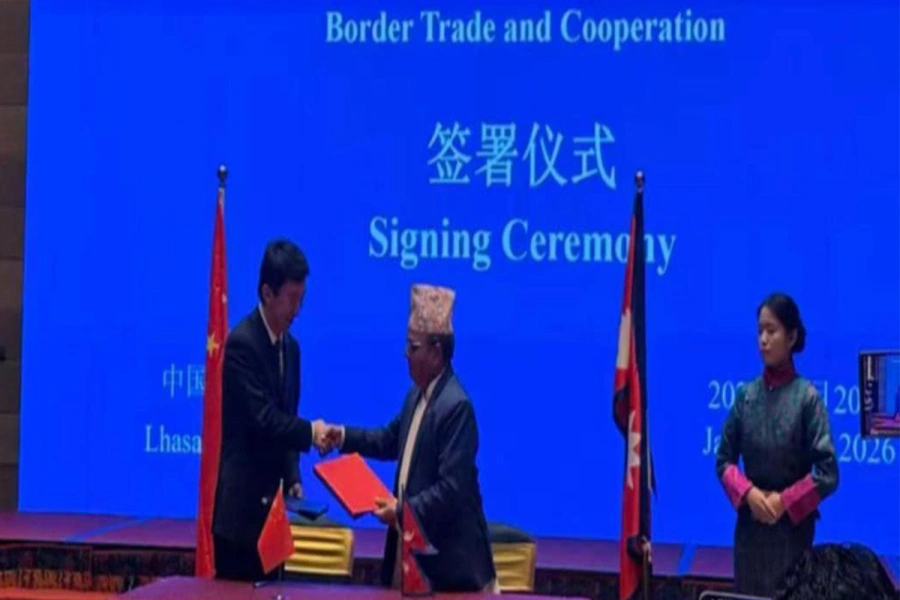
Nepal and China have agreed to restart the direct Kathmandu–Lhasa bus service, nearly 20 years after it was suspended, marking a significant step toward strengthening cross-border connectivity, tourism, and trade between the two countries. The decision was taken during the Nepal–China Joint Meeting of Commerce Secretaries, held in Lhasa on January 20 and 21, according to Nepal’s Ministry of Industry, Commerce and Supplies.
The long-distance bus service will operate via Tatopani, covering a distance of approximately 1,000 kilometers, with an estimated travel time of 20 to 22 hours. The exact commencement date of the service will be finalized through diplomatic channels.

Decision Taken at High-Level Bilateral Meeting
Nepali Consul General in Lhasa, Laxmi Prasad Niraula, confirmed that both sides have formally agreed to resume the service, which had briefly operated nearly two decades ago before being discontinued within two months.
“The Kathmandu–Lhasa bus service had been launched earlier but was shut down due to various challenges,” Niraula said. “Now, there is a fresh agreement to restart it, along with efforts to simplify visa procedures.”
The earlier service was operated by Sajha Yatayat, but it faced operational difficulties due to poor road conditions and complex visa requirements for travelers.
Route, Travel Time, and Infrastructure Challenges
According to officials, buses departing from Kathmandu are expected to reach Lhasa within 20 to 22 hours, traveling through Tatopani, one of the major border points between Nepal and China. The journey from Kathmandu to Tatopani typically takes about four hours, while the Tatopani–Lhasa stretch can take up to 20 hours.
“There are no major issues on the road from Tatopani to Lhasa,” Niraula said. “However, the main concern lies in the Kathmandu–Tatopani section. It remains uncertain whether large buses can operate smoothly on that stretch.” Officials noted that improving road conditions on the Nepali side will be critical to ensuring the successful operation of the service.
Visa Simplification and Trade Expectations
One of the key reasons for the suspension of the earlier service was complicated visa procedures. This time, both countries have agreed to pursue diplomatic efforts to simplify the visa process, making cross-border travel more convenient for passengers.
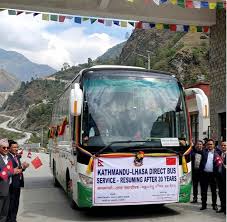
Once operational, the Kathmandu–Lhasa bus service is expected to boost tourism and bilateral trade, providing a cost-effective and direct transport option for travelers, traders, and business communities from both countries.
Broader Trade and Infrastructure Discussions
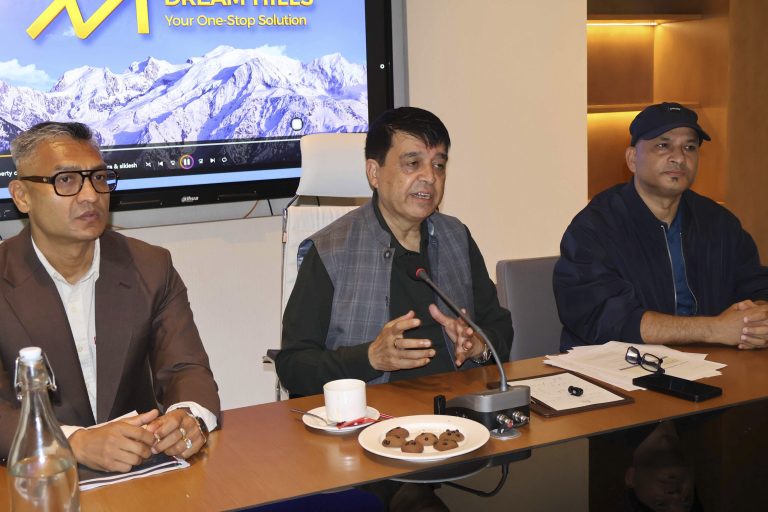
The meeting was led by Commerce Secretary Dr. Ram Prasad Ghimire from Nepal and Chatro Peh, Vice Chairman of the People’s Government of China’s Xizang Autonomous Region, from the Chinese side. The discussions reviewed progress on decisions taken during the second meeting held in Kathmandu in November 2024.
According to ministry spokesperson Netra Subedi, talks covered a wide range of issues, including bilateral trade, investment, transit facilitation, technical cooperation, and trade infrastructure development.
Both sides discussed updating the 1981 Trade and Payment Agreement, simplifying border entry passes for traders and drivers, expediting the Tokha–Chhahare tunnel project, fixing fertilizer quotas, and continuing China’s zero-tariff policy for Nepal even after Nepal graduates from the least developed country category.
Border Facilitation and Connectivity Projects
The two countries agreed to strengthen customs facilitation and border management by effectively implementing the Nepal–China Border Transport Agreement. Measures include reducing trade time and costs, promoting green channels with risk-based inspections, strengthening laboratory testing, exchanging bilateral trade data, easing vehicle movement, and facilitating jute exports from Nepal.
Agreements were also reached on constructing roads, a friendship bridge, and connecting roads between Kimathanka in Sankhuwasabha and Chen Tang in China’s Xizang Autonomous Region. Both sides committed to continuing construction of the Inland Container Depot (ICD) at Timure in Rasuwa, simplifying customs procedures at the Korala border point in Mustang, and accelerating ICD construction at Korala.

Future Cooperation and Next Meeting
Discussions were held on disaster-related vehicle rerouting facilities, the Hilsa–Simikot road, the Rasuwa–Syaphrubesi road, and a proposal to establish a sister city relationship between Gyirong in China and a municipality in Rasuwa district. Talks also progressed on the Nepal–China high-technology agriculture park project.
Both sides described the meeting as positive and productive and agreed to hold the fourth Nepal–China Joint Meeting of Commerce Secretaries in Nepal in 2027, on a mutually agreed date.