The Nepal Rastra Bank (NRB), the central monetary authority of Nepal, has released the official foreign exchange rates applicable for Tuesday, July 8, 2025. These rates, which guide commercial banks and financial institutions across the country, provide the benchmark for the purchase and sale of various international currencies against the Nepalese Rupee (NPR).
According to NRB, the buying rate for one US Dollar has been set at NPR 137.07, while the selling rate is NPR 137.67. The US Dollar continues to serve as the dominant currency in global trade and finance, and its daily exchange rate remains a key economic indicator for Nepal’s importers, exporters, and remittance sector.
Euro, Pound Sterling, and Other Major Currencies
Among other leading global currencies, the Euro (EUR) stands at a buying rate of NPR 160.73 and a selling rate of NPR 161.43. The British Pound Sterling (GBP), which remains one of the strongest currencies in the global market, is being traded at NPR 186.58 for buying and NPR 187.40 for selling.
Similarly, the Swiss Franc (CHF) has been valued at NPR 171.92 for buying and NPR 172.67 for selling, reflecting its steady performance as a safe-haven currency often preferred by international investors during periods of global financial uncertainty.

Rates for Australian, Canadian, and Asian Currencies
For currencies from other developed economies, the Australian Dollar (AUD) is being traded at NPR 89.10 (buying) and NPR 89.49 (selling). Meanwhile, the Canadian Dollar (CAD) is set at NPR 100.31 (buying) and NPR 100.75 (selling). The Singapore Dollar (SGD) has been fixed at NPR 107.17 for buying and NPR 107.64 for selling.
From East Asia, the Japanese Yen (JPY), specifically for a unit of 10 Yen, has been assigned a buying rate of NPR 9.43 and a selling rate of NPR 9.47. The Chinese Yuan (CNY) is listed at NPR 19.11 (buying) and NPR 19.19 (selling). These currencies are particularly important given Nepal’s growing trade relations with China and Japan.
Middle Eastern Currencies: Important for Remittance Inflows
Middle Eastern currencies, which hold significance due to Nepal’s large number of migrant workers in the Gulf region, also feature prominently in today’s exchange list. The Saudi Arabian Riyal (SAR) is pegged at NPR 36.55 for buying and NPR 36.71 for selling, while the Qatari Riyal (QAR) is valued at NPR 37.61 (buying) and NPR 37.77 (selling).
Additionally, the UAE Dirham (AED) is traded at NPR 37.32 for buying and NPR 37.48 for selling, a relevant figure for hundreds of thousands of Nepalis working in the United Arab Emirates. These remittances represent a vital part of the Nepalese economy.
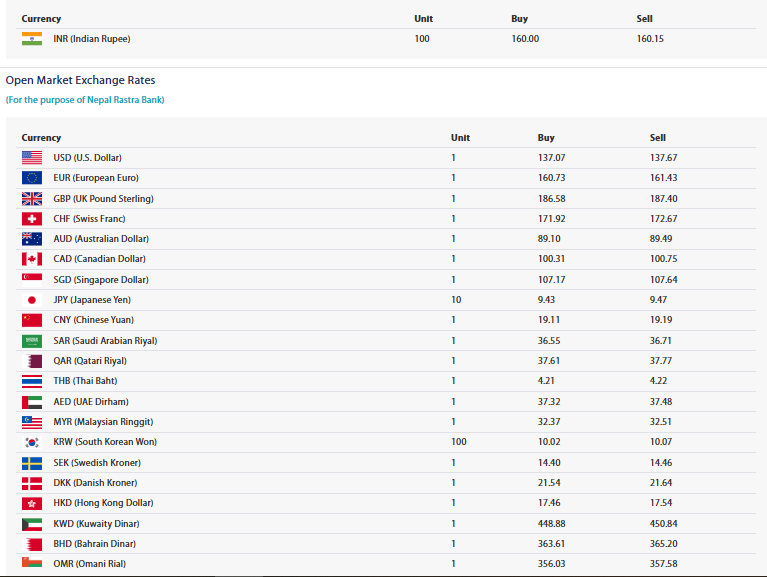
The Kuwaiti Dinar (KWD), one of the world’s highest-valued currencies, is fixed at NPR 448.88 (buying) and NPR 450.84 (selling). Similarly, the Bahraini Dinar (BHD) is marked at NPR 363.61 (buying) and NPR 365.20 (selling), while the Omani Riyal (OMR) stands at NPR 356.03 for buying and NPR 357.58 for selling.
Other Currencies: Thai Baht, Malaysian Ringgit, and Korean Won
The Thai Baht (THB) is priced at NPR 4.21 (buying) and NPR 4.22 (selling). The Malaysian Ringgit (MYR) is listed at NPR 32.37 (buying) and NPR 32.51 (selling). The South Korean Won (KRW), for a unit of 100, is set at NPR 10.02 (buying) and NPR 10.07 (selling).
Other Scandinavian currencies also made the list. The Swedish Krona (SEK) is listed at NPR 14.40 for buying and NPR 14.46 for selling, while the Danish Krone (DKK) is being exchanged at NPR 21.54 (buying) and NPR 21.64 (selling).
South Asian Region and Indian Rupee
In South Asia, the Indian Rupee (INR), which remains Nepal’s most frequently used foreign currency due to open border and strong bilateral trade ties, has been set at NPR 160 for buying and NPR 160.15 for selling per 100 units.

NRB’s Advisory on Exchange Rate Flexibility
The Nepal Rastra Bank has clearly stated that these rates are indicative and subject to change based on evolving market dynamics and foreign exchange market fluctuations. The central bank also noted that commercial banks in Nepal may apply slightly different rates, depending on their internal pricing strategies and the volume of foreign exchange transactions.
Furthermore, NRB has reminded the public that updated and real-time exchange rates are available on its official website, and stakeholders are advised to consult the site for the most accurate information before engaging in any currency exchange or international financial transaction.
In light of global economic trends, including inflationary pressures, interest rate adjustments by major central banks, and ongoing geopolitical tensions, foreign exchange rates remain volatile. As such, daily fluctuations in buying and selling prices of foreign currencies are expected, especially during the monsoon season when Nepal’s imports surge and travel increases.
The exchange rate announcement by NRB plays a crucial role not only for businesses involved in international trade but also for remittance recipients, tourists, students studying abroad, and foreign investors, all of whom are influenced by shifts in the foreign exchange market.