The Nepal Rastra Bank (NRB) has published the official foreign exchange rates for Monday, Shrawan 5, 2082 (July 21, 2025). The rates reflect updated buying and selling values for a wide range of foreign currencies used in trade, travel, and remittance. These rates are based on the latest global currency market trends and are revised daily.
U.S. Dollar Buying at Rs 137.54
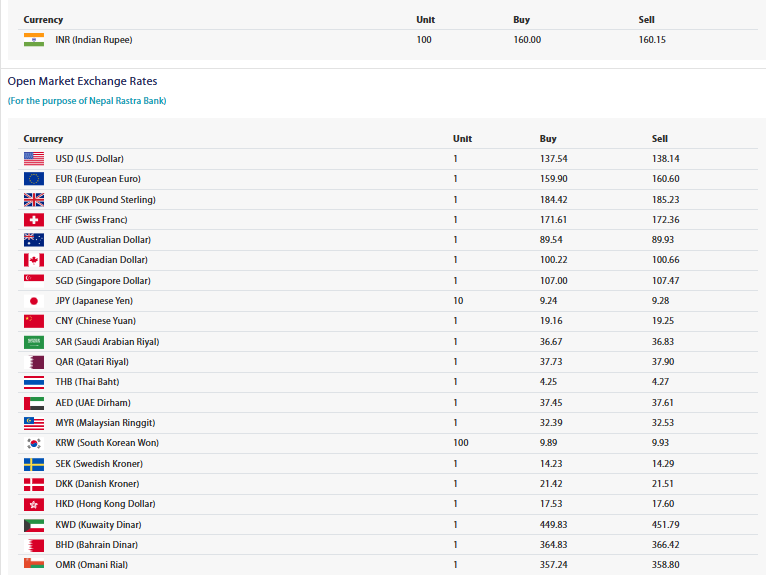
According to the central bank, the buying rate for one U.S. dollar has been fixed at Rs 137.54, while the selling rate stands at Rs 138.14. The U.S. dollar continues to hold a dominant position as the most traded foreign currency in Nepal, and its rate serves as a reference for multiple financial activities, especially in international trade and remittance.
Major Global Currencies: Euro, Pound, Franc
Among other major global currencies, the European Euro is being bought at Rs 159.90 and sold at Rs 160.60. Similarly, the UK Pound Sterling has a buying rate of Rs 184.42 and a selling rate of Rs 185.23. The Swiss Franc, a stable currency often used in international transactions, is being bought at Rs 171.61 and sold at Rs 172.36, reflecting a marginal increase over previous weeks.
Dollar Bloc Currencies: Australia, Canada, Singapore
The Australian Dollar is valued at Rs 89.54 (buying) and Rs 89.93 (selling), whereas the Canadian Dollar is slightly higher at Rs 100.22 for buying and Rs 100.66 for selling. The Singapore Dollar, another key currency in Asian trade, is being bought at Rs 107.00 and sold at Rs 107.47, reflecting stability in the Southeast Asian financial corridor.
Asian Currencies: Yen, Yuan, Riyals
The Japanese Yen (per 10 units) is set at Rs 9.24 (buying) and Rs 9.28 (selling). The Chinese Yuan stands at Rs 19.16 and Rs 19.25 for buying and selling, respectively. Currencies from the Gulf nations, which are important due to Nepal’s large migrant labor population, have also been updated. The Saudi Arabian Riyal is being bought at Rs 36.67 and sold at Rs 36.83, while the Qatari Riyal is priced at Rs 37.73 (buying) and Rs 37.90 (selling).
Regional Neighbors: Indian Rupee Fixed at Rs 160.15 per 100
The Indian Rupee (INR), the most widely circulated foreign currency in Nepal due to geographical proximity and open-border trade, is pegged by NRB at Rs 160.00 for buying and Rs 160.15 for selling per 100 INR.
This controlled exchange rate with the Indian Rupee remains crucial for retail transactions and border trade with India. However, rates may vary slightly among commercial banks and money exchanges.
Other Notable Currencies: Dirham, Ringgit, Won
The UAE Dirham is priced at Rs 37.45 (buying) and Rs 37.61 (selling). Similarly, the Malaysian Ringgit stands at Rs 32.39 for buying and Rs 32.53 for selling. The South Korean Won (per 100) is quoted at Rs 9.89 (buying) and Rs 9.93 (selling), a small but important currency due to Nepal-Korea labor ties and tourism.
Other minor yet significant currencies include the Thai Baht at Rs 4.25 (buying) and Rs 4.27 (selling); the Swedish Kroner at Rs 14.23 (buying) and Rs 14.29 (selling); and the Danish Kroner at Rs 21.42 (buying) and Rs 21.51 (selling).
High-Value Currencies: Kuwaiti Dinar, Bahraini Dinar, Omani Riyal
Among the highest-valued currencies, the Kuwaiti Dinar is being bought at Rs 449.83 and sold at Rs 451.79, maintaining its status as the most valuable currency in the global market. Similarly, the Bahraini Dinar stands at Rs 364.83 (buying) and Rs 366.42 (selling), while the Omani Riyal is exchanged at Rs 357.24 (buying) and Rs 358.80 (selling).
These currencies are of significant relevance due to the high volume of Nepali migrant workers in the Gulf Cooperation Council (GCC) countries, who remit funds regularly back to Nepal.
Rates Subject to Revision
The NRB has stated that the published rates are subject to change based on fluctuations in international markets. The central bank reserves the right to revise the rates at any time as required.
Moreover, commercial banks in Nepal may publish slightly different exchange rates based on their internal policies and service charges. The NRB advised users, travelers, and businesses to consult the updated official rates on the central bank’s website for accurate financial planning and transactions.
Central Bank’s Role in Currency Stability
As the regulatory authority, Nepal Rastra Bank plays a critical role in stabilizing currency values, curbing inflation, and maintaining balance in the foreign exchange reserves. The exchange rate regime adopted by Nepal is a mix of fixed and floating systems, where some currencies (like INR) are pegged, while others fluctuate according to global markets. By issuing daily exchange rates, NRB aims to provide transparency, reduce speculation, and ensure informed decision-making by individuals, businesses, and financial institutions.