Nepal Rastra Bank (NRB), the country’s central monetary authority, has published the official exchange rates for foreign currencies applicable on Sunday. The new rates cover a wide range of major global currencies including the US dollar, euro, pound sterling, Chinese yuan, Japanese yen, and other regional as well as international currencies.
According to the bank, the exchange rates are determined based on global currency market trends and domestic monetary needs. The announcement serves as an important reference for commercial banks, businesses, investors, and individuals involved in international trade, remittance, and travel.
US Dollar, Euro, and Pound Sterling
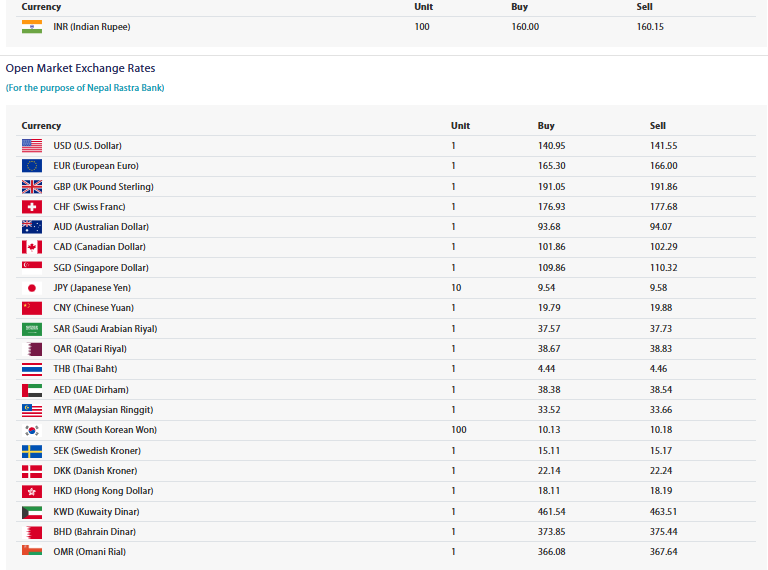
As per the rates set for Sunday, the buying rate of one US dollar stands at Rs. 140.95, while the selling rate is Rs. 141.55. The American dollar continues to hold a dominant position in Nepal’s foreign exchange market, primarily due to its widespread use in international trade and remittances.
For the European euro, the buying rate is Rs. 165.30, and the selling rate is Rs. 166.00. Similarly, the UK pound sterling has been fixed at a buying rate of Rs. 191.05 and a selling rate of Rs. 191.86. These currencies are widely used in Nepal’s tourism sector, with visitors from Europe contributing significantly to the inflow of foreign currency. The Swiss franc is another key global currency included in the NRB’s daily bulletin. For Sunday, the franc is priced at a buying rate of Rs. 176.93 and a selling rate of Rs. 177.68.
Australian, Canadian, and Singapore Dollars
In the case of other global currencies, the Australian dollar has been fixed at Rs. 93.68 for buying and Rs. 94.07 for selling. The Canadian dollar stands at a buying rate of Rs. 101.86 and a selling rate of Rs. 102.29.
Similarly, the Singapore dollar has been set at Rs. 109.86 for buying and Rs. 110.32 for selling. These currencies are of growing importance to Nepal as thousands of Nepali migrant workers are based in Australia, Canada, and Singapore, sending home valuable remittances that support the national economy.
Asian Currencies: Yen, Yuan, and Riyals
The Japanese yen is traded at Rs. 9.54 per 10 units for buying and Rs. 9.58 for selling. Meanwhile, the Chinese yuan, another crucial regional currency given Nepal’s trade ties with China, is valued at a buying rate of Rs. 19.79 and a selling rate of Rs. 19.88.
Among Middle Eastern currencies, the Saudi Arabian riyal is fixed at Rs. 37.57 for buying and Rs. 37.73 for selling, while the Qatari riyal is valued at Rs. 38.67 (buying) and Rs. 38.83 (selling). With a large number of Nepali workers employed in Gulf countries, the demand for riyals remains consistently high.
Other Regional Currencies
According to NRB, the Thai baht stands at Rs. 4.44 for buying and Rs. 4.46 for selling. The UAE dirham is set at Rs. 38.38 and Rs. 38.54 respectively. Similarly, the Malaysian ringgit is priced at Rs. 33.52 for buying and Rs. 33.66 for selling.
The South Korean won per 100 units is valued at Rs. 10.13 for buying and Rs. 10.18 for selling. The Swedish krona is fixed at Rs. 15.11 (buying) and Rs. 15.17 (selling), while the Danish krone is set at Rs. 22.14 (buying) and Rs. 22.24 (selling).
Gulf and Other International Currencies
Among other key currencies, the Hong Kong dollar is set at Rs. 18.11 for buying and Rs. 18.19 for selling. The Kuwaiti dinar, known for being one of the strongest currencies in the world, is priced at Rs. 461.54 for buying and Rs. 463.51 for selling.
The Bahraini dinar has been fixed at Rs. 373.85 (buying) and Rs. 375.44 (selling). Similarly, the Omani rial is valued at Rs. 366.08 for buying and Rs. 367.64 for selling. These Gulf currencies are vital due to Nepal’s reliance on remittances from Nepali workers in the Middle East.
Finally, the Indian rupee has been maintained at Rs. 160.00 for buying and Rs. 160.15 for selling per 100 units. Since the Nepali rupee is pegged to the Indian rupee, this exchange rate plays a central role in Nepal’s overall monetary stability.
Flexibility and Revisions in Rates
The central bank has clarified that the published exchange rates may be revised at any time depending on market fluctuations. While NRB publishes the official rates, commercial banks may set slightly different rates within the central bank’s guidelines, reflecting real-time trading conditions. The official updated rates are made available daily on the NRB website, ensuring transparency for the public and institutions.
Importance of Daily Exchange Rates
Foreign exchange rates play a critical role in shaping Nepal’s economy. From import and export businesses to remittances and tourism, the value of the Nepali rupee against foreign currencies impacts multiple sectors.
For ordinary citizens, the rates influence travel expenses, overseas education fees, and the value of remittances received from family members abroad. For businesses, the rates determine import costs and export competitiveness in international markets. By updating exchange rates daily, NRB seeks to stabilize the currency market, manage inflation, and ensure smooth foreign trade and financial transactions.
Nepal Rastra Bank’s announcement of exchange rates for Sunday reflects the country’s continued reliance on foreign currency inflows through remittances, trade, and tourism. With the US dollar, euro, and pound sterling maintaining strong positions, and Gulf currencies playing a crucial role due to migrant labor, the updated rates serve as a vital guide for financial institutions and the public alike.
The central bank has emphasized that while the published rates are official, they remain subject to change as per global currency market movements. Therefore, stakeholders are encouraged to consult the latest updates on NRB’s website before conducting international transactions.