Nepal Rastra Bank (NRB), the country’s central monetary authority, has published the latest open market foreign exchange rates applicable for Wednesday. These rates, crucial for determining remittance value, import-export cost assessments, and foreign transaction pricing, reflect global currency fluctuations and their local implications.
The published rates cover a wide range of international currencies, including major global players like the U.S. Dollar, Euro, and Pound Sterling, as well as currencies of countries with strong Nepali migrant worker populations such as the UAE, Qatar, Saudi Arabia, and Malaysia.
Strength of the U.S. Dollar and Other Major Currencies
The U.S. Dollar (USD), considered the global reserve currency and the most traded in Nepal’s remittance-driven economy, has continued to remain steady. According to the central bank’s report, the buying rate of the dollar stands at Rs. 133.85, while the selling rate is slightly higher at Rs. 134.45. The dollar’s robust performance is reflective of its international demand and the U.S. Federal Reserve’s recent monetary policy stance.
The European Euro (EUR), another major global currency, is being traded at Rs. 137.90 for buying and Rs. 138.50 for selling. This slight premium on the selling rate is typical, reflecting the transactional buffer allowed in currency exchange markets.
The UK Pound Sterling (GBP) continues to be one of the strongest currencies on the NRB chart. It is being bought at Rs. 161.30 and sold at Rs. 162.00, maintaining its historically high value due to the UK’s monetary resilience and investor confidence in the pound.
Among other key global currencies, the Swiss Franc (CHF) has been listed at a buying rate of Rs. 185.85 and a selling rate of Rs. 186.66, reflecting the Swiss economy’s stable and low-risk appeal to international investors.
Surge in Commonwealth and Asian Currencies
The Australian Dollar (AUD) has maintained notable strength, trading at Rs. 172.98 for buying and Rs. 173.73 for selling. Similarly, the Canadian Dollar (CAD) stands at Rs. 89.81 buying and Rs. 90.21 selling, which indicates consistent trade flow between Nepal and these commonwealth nations, often bolstered by student migration and tourism.
Asian currencies also showed stable movement. The Singapore Dollar (SGD) is being exchanged at Rs. 100.81 (buying) and Rs. 101.25 (selling), a figure that reflects Singapore’s economic recovery and steady trade relations. The Japanese Yen (JPY), traded per 10 units, is being bought at Rs. 107.59 and sold at Rs. 108.06, indicating continued demand for the Yen, possibly influenced by international investors seeking safer assets amid fluctuating markets.
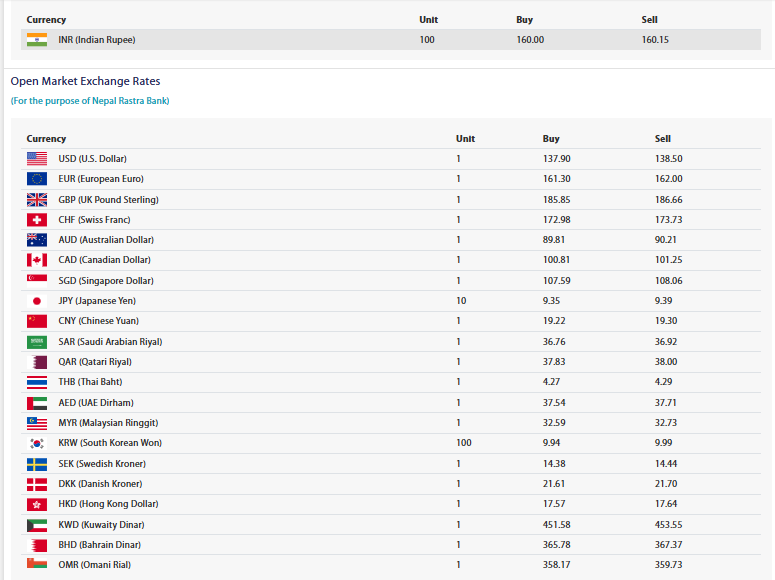
China’s Yuan (CNY) is currently trading at Rs. 9.35 for buying and Rs. 9.39 for selling, underscoring Nepal’s growing import dependency and infrastructure partnership with China. The South Korean Won (KRW) is traded at Rs. 32.59 (buying) and Rs. 32.73 (selling) per 100 units, reflecting stable rates amidst balanced demand.
Gulf Currencies Steady as Remittance Inflows Continue
Gulf currencies, which are highly relevant to Nepal due to the large number of Nepali migrant workers in Middle Eastern countries, remain firm. The Saudi Arabian Riyal (SAR) is being bought at Rs. 19.22 and sold at Rs. 19.30, while the Qatari Riyal (QAR) is exchanged at Rs. 36.76 (buying) and Rs. 36.92 (selling).
Similarly, the UAE Dirham (AED) continues to show strong demand, with a buying rate of Rs. 4.27 and a selling rate of Rs. 4.29. The Omani Rial (OMR) is among the highest-valued currencies in the market, trading at a hefty Rs. 358.17 (buying) and Rs. 359.73 (selling). Likewise, the Kuwaiti Dinar (KWD) is maintaining its dominance as the strongest foreign currency on the chart, with a buying rate of Rs. 451.58 and a selling rate of Rs. 453.55.
The Bahraini Dinar (BHD) is also performing well, being bought at Rs. 365.78 and sold at Rs. 367.37. These values show the continued importance of Gulf remittances for Nepal’s foreign currency reserves, making them a key pillar of Nepal’s macroeconomic stability.
Miscellaneous Currencies and Market Irregularities
The Thai Baht (THB) is trading at Rs. 37.83 (buying) and Rs. 38.00 (selling), a moderate value reflecting regional tourism and trade movements. The Malaysian Ringgit (MYR) is valued at Rs. 37.54 for buying and Rs. 37.71 for selling, consistent with steady labor migration and commodity trade.
There appears to be inconsistency in rates of some currencies, such as the Swedish Kroner (SEK) and Danish Kroner (DKK). The Swedish Kroner is listed at Rs. 9.94 (buying) but with a significantly higher selling rate of Rs. 14.44, while the Danish Kroner shows Rs. 14.38 (buying) and Rs. 21.70 (selling), which may point to low liquidity or limited demand/supply in the local market.
A similar irregularity is noticed in the Hong Kong Dollar (HKD) and Kuwaiti Dinar (KWD) data, where dual entries or typographical inconsistencies may exist. While one line shows HKD as Rs. 21.61 (buying) and Rs. 17.64 (selling), which seems inverted, another line lists KWD buy and sell values again with inconsistent presentation. These should be verified for clarity, but they don’t necessarily undermine the general trend of strength in premium currencies.
Nepal Rastra Bank’s daily currency exchange rates offer vital insights into global economic trends, bilateral trade dynamics, and the economic pulse of Nepali households dependent on remittance flows. As international markets continue to react to geopolitical events, inflation pressures, and central bank decisions, these fluctuations in exchange rates will remain critical for importers, exporters, financial institutions, and everyday citizens alike. Staying updated with these rates ensures informed economic decision-making at both macro and micro levels.