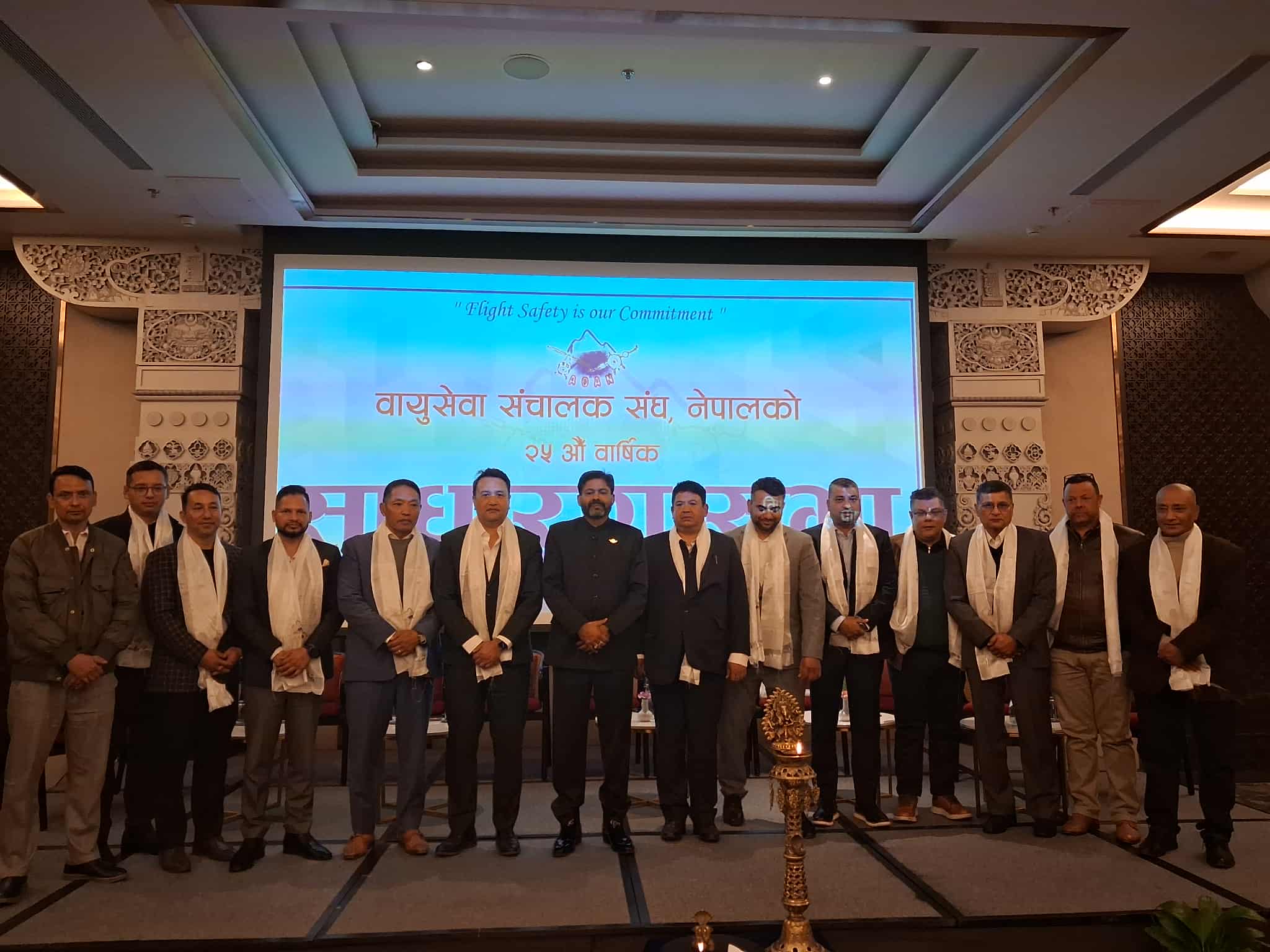
Pratap Jung Pandey has been unanimously elected as the new President of the Airlines Operators Association of Nepal (AOAN), marking a significant leadership transition for Nepal’s aviation sector. The election took place during the association’s 25th Annual General Meeting (AGM) held today, where representatives from domestic airlines and aviation stakeholders gathered to outline the future direction of the industry.
Along with Pandey, a new working committee was also elected to steer the association for the upcoming term. Nima Nuru Sherpa has been appointed First Vice-President, Subash Sapkota as Bilateral Vice-President, and Umesh Paneru as Third Vice-President. Murlidhar Joshi will serve as General Secretary, Bal Krishna Pandit as Secretary, and Rupesh Joshi has taken over the role of Treasurer.

The newly formed committee represents a wide spectrum of Nepal’s aviation fraternity, bringing together leadership from some of the country’s most prominent airlines and helicopter service providers.
Representation from Leading Airlines
Several key figures from Nepal’s aviation industry are part of the new executive body. Nimauru Sherpa is the proprietor of Altitude Air, Subash Sapkota is the Chief Executive Officer of Sapkota Airlines, and Umesh Paneru serves as the CEO of Paneru Tara Air.
General Secretary Murlidhar Joshi is the Managing Director of Simrik Air, while Secretary Bal Krishna Pandit holds managerial responsibilities at Air Dynasty. Treasurer Rupesh Joshi is also associated with Air Dynasty in a managerial and financial leadership role.
The executive committee further includes Shrom Harsha Shrestha from Base Camp Helicopter, Dhanashyam Raj Acharya from Sita Air, Umesh Acharya from Saurya Airlines, Binod Thapa from Fishtail Air, Prajwal Thapa from Guna Airlines, Milan Maharjan from Himalaya Airlines, Novel Kumar Rajlawat from Prabhu Helicopters, and Phurba Tsering Sherpa from Heli Everest. Their inclusion ensures broad representation of both fixed-wing and rotary-wing operators in AAA’s policymaking process.
Focus on Sustainability and Operational Challenges
Addressing the AGM, newly elected President Pandey emphasized the urgent need for sustainability in Nepal’s aviation sector. He noted that globally, more airlines have closed down than those currently operating, highlighting the fragile nature of the aviation business.
Pandey stressed that Nepal must give serious attention to building a sustainable aviation ecosystem. He drew attention to rising aviation fuel costs, increasing flight delays, and limited infrastructure utilization. Despite the country’s hotel capacity reaching nearly 3.5 million beds, Nepal receives only around 1.1 million tourists annually, he pointed out.
“Airports must be utilized efficiently. Without improving connectivity and operational reliability, tourism growth will remain limited,” Pandey stated. He added that cooperation with the Civil Aviation Authority of Nepal (CAAN) has made regulatory and operational processes relatively smoother, but long-term planning remains crucial.
Regulator Urges Long-Term Planning
Acting Director General of CAAN, Devchandra Lal Karna, also addressed the gathering and urged airline operators to develop strong long-term strategies to survive and grow in the competitive aviation sector.
Karna highlighted the challenges of operating expensive Twin Otter aircraft and stressed the need for suitable aircraft that can operate in Nepal’s remote and mountainous regions while remaining economically viable. He said that regulators have been compelled to tighten rules for airlines operating only on short-haul and “Sugam” routes.
He further revealed that the ATR 72-500 aircraft, which previously operated in Nepal, are now being phased out. In the current scenario, he urged airlines to make concrete plans to introduce ATR 72-600 series aircraft to enhance safety, efficiency, and service coverage.

Balancing Regulation and Safety
Karna emphasized that while regulation may sometimes feel restrictive, it plays a critical role in ensuring aviation safety. “The regulator’s job is to regulate, and regulation will always be challenging, but safety must never be compromised,” he said.
The AGM concluded with a collective commitment from AOAN members to work closely with regulatory bodies, strengthen airline operations, and support Nepal’s tourism-driven aviation growth. With a new leadership team in place, the Airlines Operators Association of Nepal is expected to play a vital role in shaping a more resilient, efficient, and sustainable aviation future for the country.