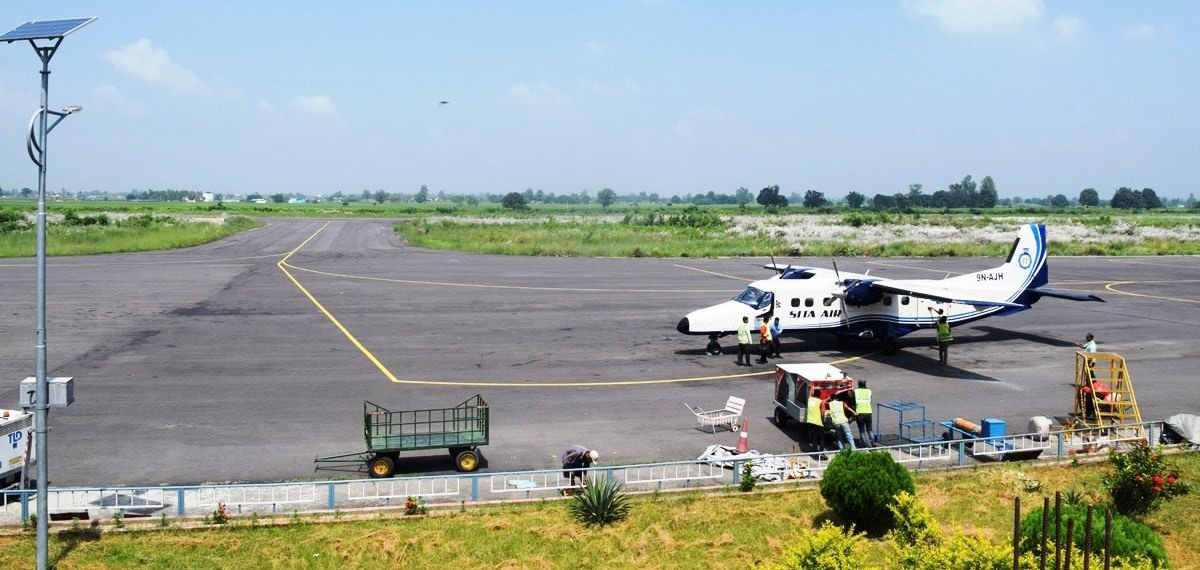
A state-of-the-art terminal building has been successfully completed at Nepalgunj Airport in western Nepal, marking a significant milestone in enhancing the country’s aviation infrastructure. The terminal was completed ahead of its scheduled deadline and is set to be handed over to the Nepalgunj Airport Terminal Building Project within a few days.
The Director General of the Civil Aviation Authority of Nepal (CAAN), Pradeep Adhikari, inspected the newly completed facility on Thursday, stating that preparations are underway to bring the terminal into operation as soon as possible.

He expressed confidence that the new terminal building, constructed with superior quality compared to the terminals of Pokhara, Bhairahawa, and Tribhuvan International Airport, would significantly contribute to regional development and create employment opportunities.
Aiming for Cross-Border Flights to India
Nepalgunj Airport, regarded as the second-largest airport after Kathmandu, has long been envisioned as a hub for cross-border flights. Director General Adhikari shared that discussions between Nepal and India are ongoing regarding launching direct flights to major Indian cities, including Delhi and Lucknow.
“With the completion of this new terminal building, operating international flights from Nepalgunj Airport will now be much more feasible,” Adhikari noted. He emphasized that the new facility reflects Nepal’s commitment to improving its aviation infrastructure to meet international standards. “When tourists from wealthy nations arrive and see poor infrastructure, it affects the sustainability of aviation and tourism business,” he said, adding that this modern terminal building has been constructed to match global standards and future demands.
Completed Ahead of Deadline with Quality Assurance
According to Nal Bikram Thapa, Project Manager of the Nepalgunj Airport Terminal Building Project, the construction company completed the project about one and a half months ahead of schedule.
“The total cost of the project amounts to NPR 2.98 billion, and we are very satisfied with the work,” Thapa said. “All construction activities were carried out under the direct supervision of our engineers, ensuring the highest quality standards.”
Ramesh Sharma, Chairman and Managing Director of Sharma & Company, the contractor responsible for the project, stated that the construction was completed nearly two months ago. He highlighted that the building was developed in compliance with international flight operation requirements. “In Nepal, it’s often said that contractors cannot complete projects on time. We’ve proven otherwise by completing this project before the deadline,” Sharma remarked proudly.
Designed to Serve 1,600 Passengers Per Hour
The newly completed terminal building incorporates advanced technology and modern facilities, making it one of Nepal’s most sophisticated domestic airport terminals. It is capable of serving up to 1,600 passengers per hour during peak hours, ensuring smoother passenger flow and better travel experiences.
Construction of the terminal began in December 2022 (Poush 2079), with an initial three-year completion target. The three-story structure, including a semi-basement, has been efficiently completed well in advance. The semi-basement floor has been designed for commercial use, adding long-term economic value to the airport’s operation.
Modern Facilities and Infrastructure
Spanning an area of 5,075 square meters, the terminal includes:
- 14 passenger check-in counters
- 3 VIP lounges
- 1 children’s play area
- Separate customs and quarantine inspection rooms
In addition, the terminal premises feature green landscaping, and roads ranging from 5 to 14 meters wide have been constructed around the facility to manage traffic flow efficiently.
Adequate drainage and water management systems have also been installed to prevent flooding during heavy rainfall, ensuring the building remains resilient and functional year-round.

Symbol of Progress in Regional Aviation
The completion of the Nepalgunj Airport terminal marks a major advancement in western Nepal’s aviation sector, reflecting the government’s and CAAN’s broader vision to expand domestic and international air connectivity.
Once operational, the modern terminal is expected to strengthen tourism, trade, and cross-border connectivity with India, helping Nepalgunj emerge as a key regional aviation hub. This milestone project stands as a symbol of Nepal’s growing technical capacity and commitment to building world-class infrastructure that aligns with both present and future demands of the aviation industry.