The Nepal Rastra Bank (NRB), the country’s central monetary authority, has announced the foreign exchange rates for July 10, 2025. These rates apply to all foreign currency transactions carried out by commercial banks in Nepal and are subject to change as per market fluctuations.
USD, Euro, and Pound Sterling Exchange Rates
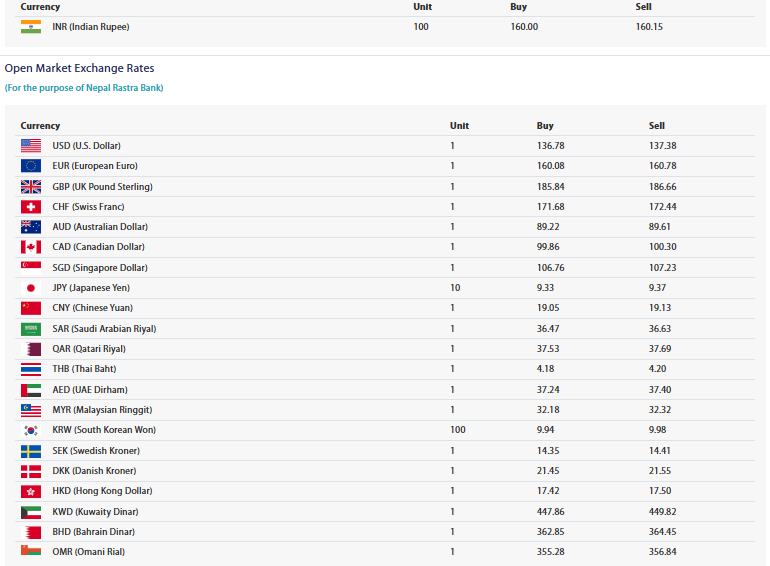
As per the official figures released by the NRB, the buying rate for one U.S. Dollar (USD) is fixed at NPR 136.78, while the selling rate stands at NPR 137.43. The U.S. Dollar continues to remain the benchmark currency in international trade and finance, and its daily fluctuations are closely monitored by businesses, travelers, and importers alike.

The Euro (EUR) has been set at NPR 160.08 for buying and NPR 160.78 for selling, reflecting slight movement in the European currency amid changing global market conditions. Meanwhile, the British Pound Sterling (GBP), known for its high value, is being traded at NPR 185.84 for buying and NPR 186.66 for selling.
Exchange Rates for Other Major Currencies
Among other widely-used international currencies, the Swiss Franc (CHF) has been fixed at NPR 171.68 for buying and NPR 172.44 for selling. The Australian Dollar (AUD) stands at NPR 89.22 buying and NPR 89.61 selling, whereas the Canadian Dollar (CAD) has been fixed at NPR 99.86 for buying and NPR 100.30 for selling. Similarly, the Singapore Dollar (SGD) is listed at NPR 107.76 buying and NPR 108.23 selling.
Regional and Asian Currency Updates
From Asia, the Japanese Yen (JPY), calculated per 10 units, has a buying rate of NPR 9.33 and a selling rate of NPR 9.37. The Chinese Yuan (CNY), a significant trading currency for Nepal, is set at NPR 19.05 for buying and NPR 19.13 for selling. The Thai Baht (THB) is quoted at NPR 4.18 buying and NPR 4.20 selling, and the South Korean Won (KRW), per 100 units, is valued at NPR 9.54 for buying and NPR 9.58 for selling.
Gulf Currencies: Essential for Remittance Market
In the context of Nepal’s large migrant workforce in the Middle East, Gulf currencies remain highly relevant. The Saudi Arabian Riyal (SAR) has a buying rate of NPR 36.47 and a selling rate of NPR 36.63, while the Qatari Riyal (QAR) stands at NPR 37.53 buying and NPR 37.69 selling.
The UAE Dirham (AED) is being exchanged at NPR 37.24 for buying and NPR 37.40 for selling. The Kuwaiti Dinar (KWD), one of the strongest currencies in the world, is trading at a buying rate of NPR 447.86 and a selling rate of NPR 449.82. Additionally, the Bahraini Dinar (BHD) is valued at NPR 362.85 buying and NPR 364.45 selling, while the Omani Riyal (OMR) stands at NPR 355.28 for buying and NPR 356.84 for selling.
Other Currencies
Among other international currencies listed by the NRB:
- The Malaysian Ringgit (MYR) is priced at NPR 32.18 for buying and NPR 32.32 for selling.
- The Swedish Krona (SEK) is set at NPR 14.35 for buying and NPR 14.41 for selling.
- The Danish Krone (DKK) is listed at NPR 21.45 for buying and NPR 21.55 for selling.
- The Hong Kong Dollar (HKD) is being traded at NPR 17.42 for buying and NPR 17.50 for selling.

Indian Rupee Remains Fixed
The Indian Rupee (INR), which is Nepal’s closest economic counterpart due to open-border trade and travel, remains pegged at NPR 160 for buying and NPR 160.15 for selling per 100 Indian Rupees. This fixed exchange rate system has been in place for years, helping stabilize economic transactions between the two nations.
Exchange Rates Subject to Change
Nepal Rastra Bank has clarified that these rates are indicative for the day and may be subject to revision as per economic requirements. The bank emphasized that commercial banks may offer slightly different rates, depending on their internal demand and supply metrics. NRB also reminded the public that updated exchange rates are always available on its official website and that anyone engaging in foreign currency transactions should check for the latest data before proceeding.
The daily exchange rate published by Nepal Rastra Bank plays a critical role in Nepal’s financial and commercial sectors. From importers and exporters to remittance recipients, international travelers, and currency traders, these rates affect a wide range of stakeholders. As global currencies fluctuate amid economic changes, Nepal’s central bank continues to update its rates to reflect real-time market trends and safeguard the national economy.