Nepal Rastra Bank (NRB), the central bank of Nepal, has published the official foreign exchange rates for today, outlining the buying and selling rates for various international currencies. These rates are essential benchmarks for financial institutions, businesses, and individuals involved in foreign trade, travel, and remittance transactions.
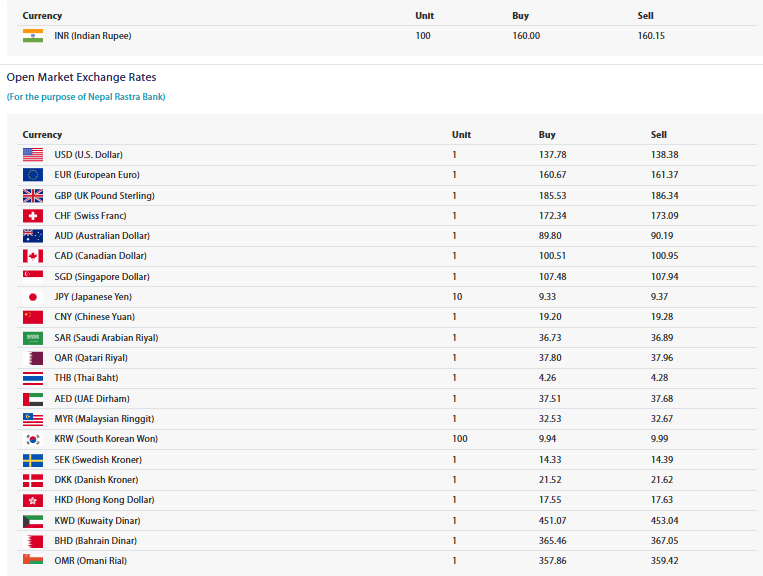
According to NRB, the buying rate for the US Dollar has been fixed at Rs. 137.78, while the selling rate stands at Rs. 138.38. The American currency continues to play a dominant role in international transactions and remittances, which form a significant part of Nepal’s foreign reserves.
European and British Currency Rates Updated
The Euro, which is widely used in European Union nations, is trading at a buying rate of Rs. 160.67 and a selling rate of Rs. 161.37. Similarly, the British Pound Sterling, another major global currency, has been set at Rs. 185.53 for buying and Rs. 186.34 for selling. These figures reflect subtle market movements and the relative strength of the Nepali Rupee against these major currencies.
The Swiss Franc, known for its stability, has a buying rate of Rs. 172.34 and a selling rate of Rs. 173.09, while the Australian Dollar has been set at Rs. 89.80 (buying) and Rs. 90.19 (selling). The Canadian Dollar, another currency with growing relevance in global trade, has been fixed at Rs. 100.51 (buying) and Rs. 100.95 (selling).
Asian Currencies and Regional Trade Impact
The NRB has also issued rates for several Asian currencies that hold significance due to tourism, trade, and labor migration. The Singapore Dollar is trading at Rs. 107.48 (buying) and Rs. 107.94 (selling). Meanwhile, 10 Japanese Yen is valued at Rs. 9.33 (buying) and Rs. 9.37 (selling), indicating a steady trend in Japan–Nepal exchange activities.
The Chinese Yuan, increasingly used in cross-border trade and tourism, has a buying rate of Rs. 19.20 and a selling rate of Rs. 19.28. The Saudi Arabian Riyal, crucial due to the large number of Nepali migrant workers in the Gulf, has been set at Rs. 36.73 (buying) and Rs. 36.89 (selling).
The Qatari Riyal, another Gulf currency with high remittance volume, is trading at Rs. 37.80 (buying) and Rs. 37.96 (selling). Other Gulf currencies include the UAE Dirham at Rs. 37.51 (buying) and Rs. 37.68 (selling) and the Kuwaiti Dinar, which remains one of the highest-valued currencies, at Rs. 451.07 (buying) and Rs. 453.04 (selling).
Additional Currency Rates Reflect Global Links
The Bahraini Dinar has been pegged at Rs. 365.46 (buying) and Rs. 367.05 (selling), while the Omani Riyal is trading at Rs. 357.86 (buying) and Rs. 359.42 (selling). These rates further reflect Nepal’s strong economic ties with the Middle East, where hundreds of thousands of Nepali workers are employed.
The Thai Baht, used widely for travel and trade in Southeast Asia, has a buying rate of Rs. 4.26 and a selling rate of Rs. 4.28. Similarly, the Malaysian Ringgit has been fixed at Rs. 32.53 (buying) and Rs. 32.67 (selling), and the South Korean Won (per 100 units) is at Rs. 9.94 (buying) and Rs. 9.99 (selling).
Also listed are European regional currencies like the Swedish Krona at Rs. 14.33 (buying) and Rs. 14.39 (selling), and the Danish Kroner, trading at Rs. 21.52 (buying) and Rs. 21.62 (selling). The Hong Kong Dollar, another Asian trading currency, is listed at Rs. 17.55 (buying) and Rs. 17.63 (selling).
Indian Currency Rate and Central Bank Advisory
Given Nepal’s close economic integration with India, the Indian Rupee plays a significant role in Nepal’s daily commerce. As per the NRB, 100 Indian Rupees are valued at Rs. 160 (buying) and Rs. 160.15 (selling). This fixed rate underlines the pegged currency system between the Indian and Nepali Rupees.
The Nepal Rastra Bank has stated that these exchange rates are subject to change based on fluctuations in the international currency markets. The central bank also mentioned that the rates may be revised at any time as per market necessity.
It’s important to note that commercial banks may offer slightly different exchange rates, based on their own operational dynamics and transaction volumes. For real-time rates and updates, the central bank has made the daily exchange rates accessible on its official website.
Importance of Daily Foreign Exchange Rates
These daily updates by Nepal Rastra Bank are not just of interest to financial institutions but are equally important for importers, exporters, tourists, remittance beneficiaries, and international investors. Exchange rate fluctuations directly affect commodity pricing, international trade deals, remittance value, and foreign loan obligations.
By maintaining transparency and timely dissemination of these rates, the NRB plays a crucial role in financial stability and international currency risk management for Nepal. In the globalized economy, staying informed about foreign exchange rates is key for anyone involved in cross-border activities.