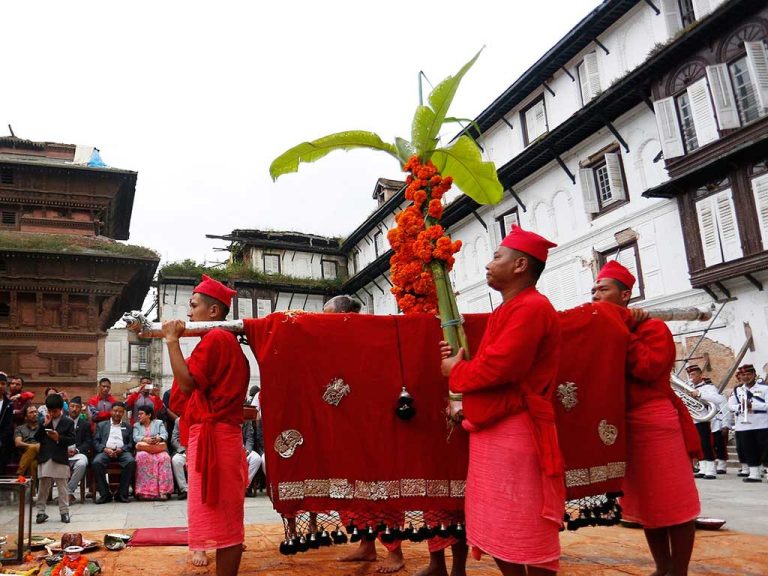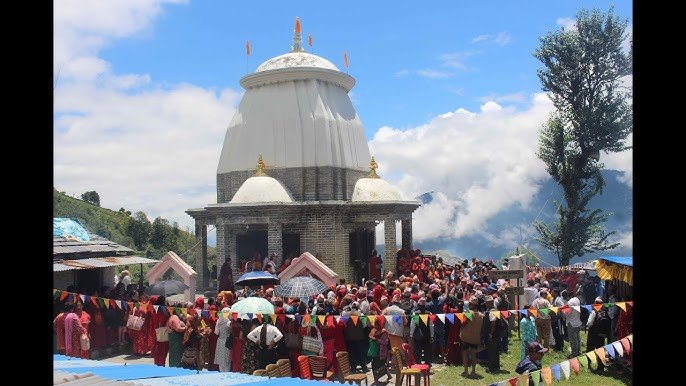
In a display of rich religious tradition and cultural heritage, the annual Rath Yatra (Chariot Procession) of Lord Jagannath was observed with great enthusiasm and reverence on Wednesday at the historic Jagannath Temple in Gajane, Beni Municipality–5, Myagdi. The event was organized by the Jagannath Mandir Dham Guthi Operation and Management Committee, coinciding with the Dvadasi Tithi of the Shukla Paksha in the month of Shrawan. This sacred day marks the only time each year when the idol of Lord Jagannath is taken out of the temple for public viewing through a grand procession, drawing hundreds of devotees from within and outside the district.
Annual Chariot Procession Honors Centuries-Old Legacy
The Jagannath Temple holds significant historical, religious, and archaeological value, believed to have been established during the reign of King Dilip Bam Malla of the ancient Baise-Chaubise states around 1550 B.S. (1493 A.D.). As per historical accounts shared by the Guthi Committee Chairperson Nilkantha Sharma, the king initiated the tradition of installing Lord Jagannath’s idol at the temple and began the practice of organizing annual royal feasts and ceremonial replacement of the deity’s decorations.
According to Sharma, “The Rath Yatra is conducted only once a year on Shrawan Shukla Dwadashi, and it is the only day when devotees can witness Lord Jagannath’s idol outside the sanctum. As a result, the temple premises are filled with a massive crowd of pilgrims on this special occasion.”
Massive Influx of Devotees and Enthusiastic Participation
The festival attracted thousands of devotees from various neighboring regions, including Raghuganga and Mangala Rural Municipalities of Myagdi, and even from the adjoining Jaljala Rural Municipality of Parbat district. The chariot procession was carried out amid chants, bhajans, and devotional hymns, with active participation from locals, elected representatives, and spiritual leaders.
In earlier years, the event was primarily a localized religious function, but now, owing to growing recognition of Lord Jagannath’s spiritual significance, people from distant locations also make the pilgrimage. Guthi Committee Secretary Ramchandra Paudel noted this growing trend, attributing it to both word-of-mouth promotion and the temple’s enhanced status as a center of devotion and history.
Improved Infrastructure Enhancing Access to the Sacred Site
Access to Jagannath Temple has become more convenient in recent years, thanks to improved road infrastructure. Devotees can now reach the site via two major road routes—one from Beni through Pulachaur and Naya Gaun via Jagne, and another from Beni via Toripani and Dholthan to Naya Gaun and finally to Jagannath.
Speaking on the occasion, Mayor of Beni Municipality, Surat KC, emphasized the importance of developing the site further, both in terms of infrastructure and promotion. “The Jagannath area holds immense religious and historical value,” he said. “We are committed to promoting this region as a national and international pilgrimage site, and we will continue working on both development and outreach efforts.”
A Temple Steeped in History, Legend, and Sacred Practices
The Jagannath Temple is believed to be over 531 years old, and it is one of Nepal’s few temples where the architecture and idol structure differ from the more common Hindu temple formats found across the country. The temple houses idols of Jagannath, Dimb Maharaj, Ganesh, Ram-Laxman, Krishna, Balram, Narasimha, and Chaturbahu Vishnu, making it a rare ensemble of deities under one sacred roof.
Local legends say that King Dilipbam Malla not only established the temple but entered samadhi (final rest) at the same location, enhancing the site’s mystique. It is also believed that the idol of Lord Jagannath was brought from Odisha, India, mirroring the famous Jagannath Temple of Puri, and was installed here to reflect similar spiritual traditions.
In an effort to preserve the sanctity of the temple, the local Gajane village has enforced strict bans on poultry farming and alcohol production in the vicinity, recognizing the temple’s spiritual gravity. This cultural discipline has remained intact for generations and is respected by all residents.
Spiritual Belief and Cultural Preservation at the Core
There is a deep-rooted belief among locals and pilgrims alike that worshipping at the Jagannath Temple fulfills spiritual desires and brings blessings. As a result, many people make it a point to attend the Rath Yatra each year, even if it involves traveling long distances.
The Guthi committee has also taken initiatives to preserve ancient customs, maintain the temple premises, and promote the site as a hub of cultural and religious tourism. Plans are underway to develop surrounding areas into pilgrimage circuits, and appeals have been made to both the provincial and federal governments for support in this regard.
The annual Rath Yatra of Jagannath Temple in Gajane, Myagdi, is more than just a religious festival, it is a celebration of Nepal’s centuries-old cultural heritage, devotion, and historical legacy. As infrastructure improves and awareness grows, this sacred site is gradually transforming into a prominent religious destination in western Nepal. The event continues to bind communities together in faith while inviting new visitors to witness the spiritual grandeur of a temple that has stood the test of time for over half a millennium.