Nepal Rastra Bank (NRB), the country’s central monetary authority, has published the official foreign exchange rates for today. The rates, which apply to commercial transactions across the nation, determine the buying and selling values of various international currencies against the Nepalese rupee. NRB has also noted that these rates may be subject to change at any time based on market conditions and monetary policy adjustments.
Key Exchange Rates for Major Currencies
According to today’s update, the buying rate for one U.S. dollar is set at NPR 138.83, while the selling rate is NPR 139.43. The euro, another widely used global currency, is being bought at NPR 162.19 and sold at NPR 162.89.
The British pound sterling continues to maintain a strong position, with the buying rate set at NPR 187.67 and the selling rate at NPR 188.48. Similarly, the Swiss franc stands at NPR 172.35 for buying and NPR 173.10 for selling. These currencies are often considered benchmarks for international trade and investment, and their strength reflects global economic trends.
Exchange Rates for Dollar-Linked and Regional Currencies
For the Australian dollar, NRB has fixed the buying rate at NPR 90.09 and the selling rate at NPR 90.48. The Canadian dollar is being traded at NPR 100.52 for buying and NPR 100.96 for selling. The Singapore dollar, an important currency for trade in Southeast Asia, is being bought at NPR 108.20 and sold at NPR 108.67.
Japan’s currency, the yen, is quoted at NPR 9.39 for buying and NPR 9.43 for selling per 10 yen. The Chinese yuan stands at NPR 19.34 for buying and NPR 19.42 for selling. These rates are significant for Nepal’s trade and tourism sectors, as China and Japan are both important partners in imports, exports, and travel.
Exchange Rates for Middle Eastern Currencies
With many Nepalese working in Gulf countries, Middle Eastern currencies play a crucial role in remittance inflows. For the Saudi Arabian riyal, the buying rate is NPR 37.00 and the selling rate is NPR 37.16. The Qatari riyal is being traded at NPR 38.09 for buying and NPR 38.26 for selling.
The UAE dirham stands at NPR 37.80 for buying and NPR 37.96 for selling, while the Omani riyal, a high-value currency, is being bought at NPR 360.58 and sold at NPR 362.14. Similarly, the Kuwaiti dinar remains the most valuable currency in the basket, with a buying rate of NPR 454.24 and a selling rate of NPR 456.21. The Bahraini dinar is being traded at NPR 368.25 for buying and NPR 369.84 for selling.
Exchange Rates for Asian and Other Global Currencies
The Thai baht is set at NPR 4.27 for buying and NPR 4.29 for selling. Malaysia’s ringgit is valued at NPR 32.87 for buying and NPR 33.01 for selling. The South Korean won, calculated per 100 units, has a buying rate of NPR 9.99 and a selling rate of NPR 10.04.
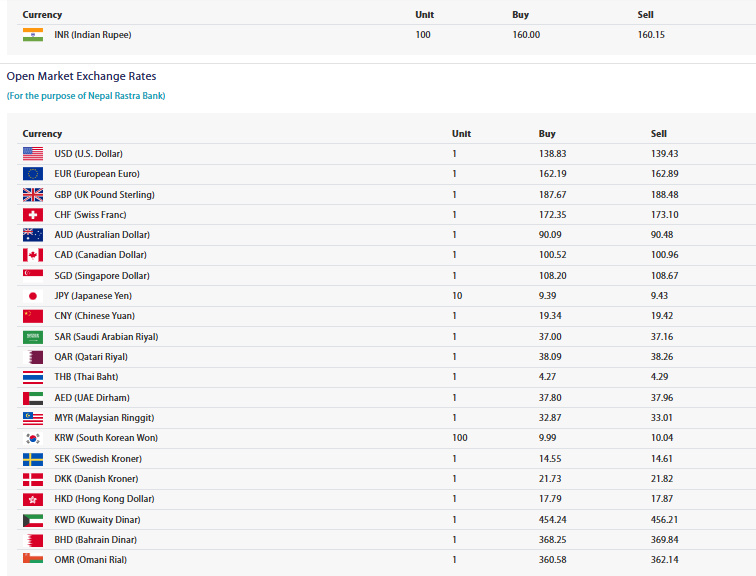
European regional currencies such as the Swedish krona and the Danish krone are also included in the rate list. The Swedish krona is being traded at NPR 14.55 for buying and NPR 14.61 for selling, while the Danish krone is at NPR 21.73 for buying and NPR 21.82 for selling.
The Hong Kong dollar stands at NPR 17.79 for buying and NPR 17.87 for selling. These currencies, though not as heavily traded as the U.S. dollar or euro, still play a role in Nepal’s tourism industry and selective trade activities.
Indian Rupee Exchange Rate Remains Fixed
As in previous years, the exchange rate between the Nepalese rupee and the Indian rupee remains pegged. Today, NRB has maintained the buying rate for INR 100 at NPR 160.00 and the selling rate at NPR 160.15. This fixed peg provides stability in cross-border trade and travel between Nepal and India, given the high volume of economic activity and the open border between the two countries.
Flexibility in Exchange Rate Adjustments
The central bank has clarified that the published rates may be revised at any time if required, based on international currency market movements and Nepal’s macroeconomic priorities. While these rates serve as a guideline, NRB has stated that commercial banks in Nepal may set slightly different rates for customer transactions depending on demand, supply, and transaction size.
For transparency, the updated exchange rates are made available daily on the Nepal Rastra Bank’s official website. Businesses engaged in imports, exports, travel, and remittances are advised to check the latest rates before making any currency transactions.
Impact on Trade, Tourism, and Remittances
The daily exchange rate announcement is vital for multiple sectors of Nepal’s economy. Importers and exporters depend on accurate rates to calculate costs and revenues, while the tourism sector monitors foreign currency values to assess tourist spending patterns. For the millions of Nepalese working abroad, especially in the Gulf, Malaysia, Korea, and Japan, the rates directly influence remittance amounts received by their families.
Strong currencies like the U.S. dollar, pound sterling, and Kuwaiti dinar yield higher returns for remittance recipients, while fluctuations in other currencies can impact household incomes. Likewise, changes in the value of the Indian rupee can affect cross-border trade pricing for goods and services.
As global markets remain volatile due to economic uncertainties, central banks worldwide, including NRB, continue to monitor foreign exchange movements closely. Nepal’s dependency on imports, tourism, and remittances makes it especially sensitive to currency value shifts, making daily exchange rate updates essential for informed financial decision-making.