Nepal Rastra Bank (NRB), the country’s central bank, has published the official foreign exchange rates for today, setting the buying and selling values for a wide range of international currencies. These rates, which play a vital role in trade, remittances, and tourism, have been determined based on the prevailing market trends and currency fluctuations in the global financial system.
US Dollar and Major Global Currencies
According to NRB’s latest data, the buying rate for one US Dollar has been fixed at Rs. 140.00, while the selling rate stands at Rs. 140.60. The US Dollar remains one of the most traded foreign currencies in Nepal, primarily due to its widespread use in remittances, international trade settlements, and as a reference currency in global markets.
The European Euro has been set at Rs. 163.00 for buying and Rs. 163.69 for selling, reflecting its importance in Nepal’s imports from and exports to European Union member countries. Meanwhile, the British Pound Sterling is trading at Rs. 188.75 (buying) and Rs. 189.56 (selling), highlighting its high value against the Nepali Rupee. The Swiss Franc, another strong currency often used in luxury goods trade and tourism, has been pegged at Rs. 173.81 (buying) and Rs. 174.55 (selling).
Key Commodity and Trade-Linked Currencies
Among the major commodity-linked currencies, the Australian Dollar stands at Rs. 90.83 for buying and Rs. 91.21 for selling, while the Canadian Dollar is at Rs. 101.11 (buying) and Rs. 101.54 (selling). These currencies are significant due to Nepal’s growing trade in agricultural and natural resource-based products with Australia and Canada. Similarly, the Singapore Dollar has been fixed at Rs. 108.90 (buying) and Rs. 109.37 (selling), reflecting Singapore’s role as a major trade and financial hub for South Asia.
Asian Currencies: Regional Trade and Tourism Impact
The Japanese Yen, a key currency in Asia, is being traded at Rs. 9.49 (buying) and Rs. 9.53 (selling) per 10 units. The Chinese Yuan, crucial for Nepal’s northern trade, is valued at Rs. 19.55 (buying) and Rs. 19.64 (selling).
Middle Eastern currencies, which are important due to the large number of Nepali migrant workers in Gulf countries, have also been updated. The Saudi Arabian Riyal is at Rs. 37.31 (buying) and Rs. 37.47 (selling), while the Qatari Riyal is fixed at Rs. 38.41 (buying) and Rs. 38.57 (selling).
Other Regional and Global Currencies
According to the central bank, the Thai Baht is set at Rs. 4.31 for buying and Rs. 4.33 for selling, reflecting moderate trading activity between Nepal and Thailand, mostly in tourism and imports. The UAE Dirham, another significant currency for remittance inflows, is pegged at Rs. 38.12 (buying) and Rs. 38.28 (selling).
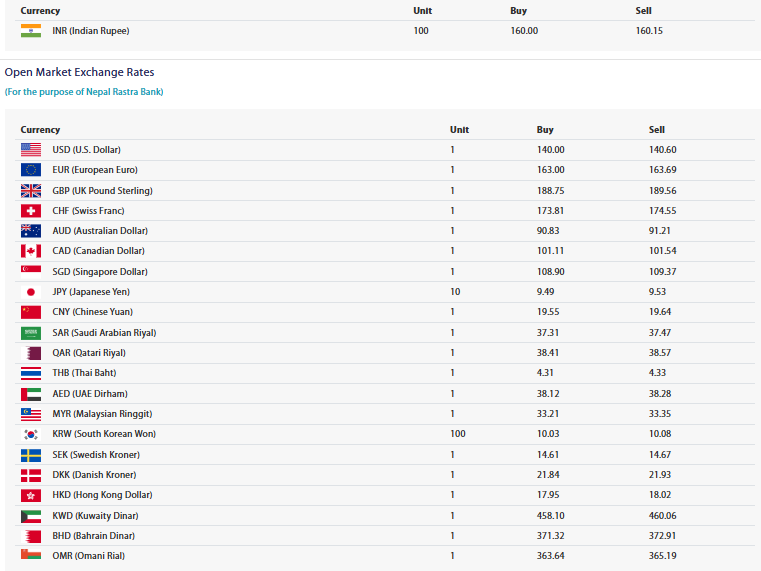
The Malaysian Ringgit stands at Rs. 33.21 (buying) and Rs. 33.35 (selling), while the South Korean Won is at Rs. 10.03 (buying) and Rs. 10.08 (selling) per 100 units, showing its importance in labor migration and technology imports.
European Minor Currencies and Gulf Region High-Value Units
Among other European currencies, the Swedish Kroner is fixed at Rs. 14.61 (buying) and Rs. 14.67 (selling), while the Danish Kroner is trading at Rs. 21.84 (buying) and Rs. 21.93 (selling). The Hong Kong Dollar is at Rs. 17.95 (buying) and Rs. 18.02 (selling), often used in trade with the East Asian region. The Kuwaiti Dinar, one of the highest-valued currencies in the world, is pegged at Rs. 458.10 (buying) and Rs. 460.06 (selling). The Bahraini Dinar is valued at Rs. 371.32 (buying) and Rs. 372.91 (selling), while the Omani Riyal stands at Rs. 363.64 (buying) and Rs. 365.19 (selling).
Indian Rupee: The Neighboring Trade Lifeline
The Indian Rupee, being the most frequently used currency in cross-border trade and tourism with Nepal’s southern neighbor, is set at Rs. 160.00 for buying and Rs. 160.15 for selling per 100 units. This rate is crucial as it affects the prices of imported goods from India, which form a large portion of Nepal’s market supply.
Central Bank Flexibility and Commercial Bank Variations
The NRB has stated that these exchange rates may be revised at any time depending on global market conditions and domestic demand. It has also clarified that the rates set by individual commercial banks may differ slightly due to transaction costs and competitive factors. The most up-to-date exchange rates are always available on the central bank’s official website, ensuring that importers, exporters, remittance receivers, and travelers can access accurate information.
Economic Significance of Daily Exchange Rates
Daily currency rate updates are critical for businesses, traders, investors, and individuals dealing in foreign exchange. These rates influence the cost of imports and exports, the value of remittances sent by Nepalis abroad, and the overall purchasing power of the economy in the global market.
For ordinary citizens, fluctuations in these rates can affect the prices of fuel, consumer goods, and even travel expenses abroad. For the government, they serve as an important economic indicator for policy-making and foreign reserve management.
The NRB’s daily exchange rate updates help keep Nepal aligned with global financial trends while ensuring stability in the domestic market. As currency values are influenced by international trade, geopolitical developments, and market speculation, staying informed about these rates is essential for businesses and individuals alike. The central bank has urged the public to rely on its official updates for accurate and verified information, as currency fluctuations can occur unexpectedly, requiring swift adjustments in trade and financial strategies.