The Nepal Rastra Bank (NRB), the country’s central bank, has announced the official foreign exchange rates for various international currencies for Tuesday. The rates will guide commercial banks and financial institutions in setting their own buying and selling prices for foreign currencies, though these may slightly differ from the central bank’s benchmarks.
US Dollar and Major Global Currencies
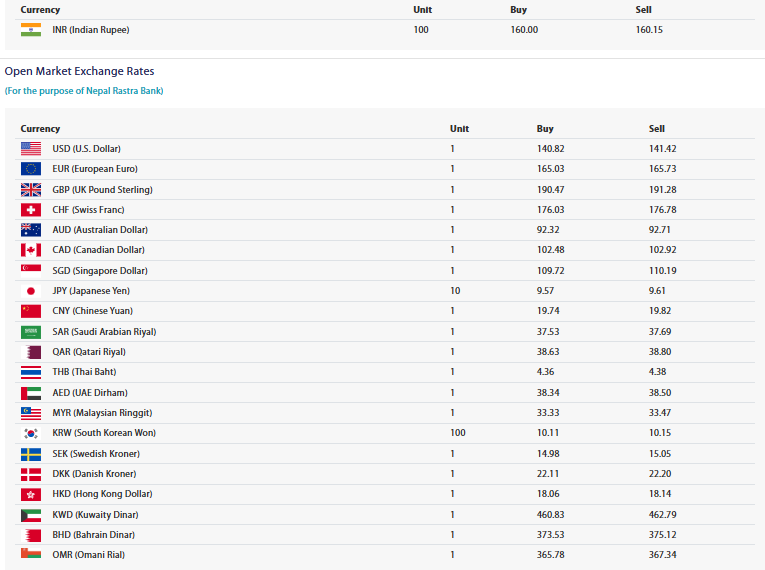
According to NRB, the US Dollar is set at Rs. 140.82 for buying and Rs. 141.42 for selling. The Euro, one of the most widely traded currencies globally, is priced at Rs. 165.03 for buying and Rs. 165.73 for selling. The British Pound Sterling, known for its high valuation, stands at Rs. 190.47 for buying and Rs. 191.28 for selling.
The Swiss Franc is valued at Rs. 176.03 for buying and Rs. 176.78 for selling, reflecting its continued strength in the global market. These major currencies play a crucial role in Nepal’s international trade, tourism, and remittance transactions.
Exchange Rates for Asian-Pacific Currencies
For Asia-Pacific currencies, the Australian Dollar is fixed at Rs. 92.32 for buying and Rs. 92.71 for selling. The Canadian Dollar is priced at Rs. 102.48 for buying and Rs. 102.92 for selling. Similarly, the Singapore Dollar is valued at Rs. 109.72 for buying and Rs. 110.19 for selling.
The Japanese Yen, quoted per 10 units, stands at Rs. 9.57 for buying and Rs. 9.61 for selling. The Chinese Yuan is priced at Rs. 19.74 for buying and Rs. 19.82 for selling. The Saudi Arabian Riyal is fixed at Rs. 37.53 for buying and Rs. 37.69 for selling, while the Qatari Riyal stands at Rs. 38.63 for buying and Rs. 38.80 for selling.
Exchange Rates for Other Regional Currencies
In the South and Southeast Asian region, the Thai Baht is priced at Rs. 4.36 for buying and Rs. 4.38 for selling. The UAE Dirham stands at Rs. 38.34 for buying and Rs. 38.50 for selling. The Malaysian Ringgit is valued at Rs. 33.33 for buying and Rs. 33.47 for selling. The South Korean Won, quoted per 100 units, is fixed at Rs. 10.11 for buying and Rs. 10.15 for selling.
Among European currencies outside the Eurozone, the Swedish Kroner is priced at Rs. 14.98 for buying and Rs. 15.05 for selling, while the Danish Kroner stands at Rs. 22.11 for buying and Rs. 22.20 for selling.
Exchange Rates for Middle Eastern Currencies
For Middle Eastern currencies, the Hong Kong Dollar is fixed at Rs. 18.06 for buying and Rs. 18.14 for selling. The Kuwaiti Dinar, one of the world’s highest-valued currencies, is priced at Rs. 460.83 for buying and Rs. 462.79 for selling. The Bahraini Dinar stands at Rs. 373.53 for buying and Rs. 375.12 for selling, while the Omani Riyal is set at Rs. 365.78 for buying and Rs. 367.34 for selling.
Indian Rupee Rate Remains Stable
As for Nepal’s closest neighbor and largest trade partner, the Indian Rupee is fixed at Rs. 160.00 for buying and Rs. 160.15 for selling per 100 units. The rate remains relatively stable due to the pegged currency system between the Nepalese Rupee and Indian Rupee, which helps maintain exchange rate stability for cross-border trade and remittance transactions.
Central Bank’s Role and Update Mechanism
The Nepal Rastra Bank has clarified that these rates can be revised at any time, depending on fluctuations in the international currency market. The official rates published today are primarily used by commercial banks, remittance companies, and currency exchange counters as a reference point for their own pricing.
The central bank also noted that the rates offered by commercial banks to customers might vary slightly from the NRB rates due to service charges, commissions, and market competition.
Importance of Exchange Rates for the Economy
Foreign exchange rates play a vital role in Nepal’s economy, influencing the cost of imports, tourism receipts, foreign investments, and remittance inflows. A stronger Nepalese Rupee reduces the cost of imports, while a weaker Rupee boosts the competitiveness of exports but increases import expenses.
Given that Nepal relies heavily on remittances from countries such as Qatar, Saudi Arabia, the UAE, Malaysia, and South Korea, the value of foreign currencies directly affects the income of Nepali households receiving money from abroad. Similarly, exchange rate trends influence travel and tourism, as currency valuation impacts the affordability of Nepal for foreign tourists.
Access to Updated Rates
The NRB has encouraged the public, businesses, and travelers to refer to its official website for the most up-to-date exchange rates. With global currency markets experiencing volatility due to economic policies, geopolitical events, and interest rate changes, the bank’s daily updates help maintain transparency and provide accurate guidance for financial transactions.