Nepal Rastra Bank (NRB), the central bank of the country, has published the official foreign exchange rates for today. The rates, which are reviewed and set on a daily basis, are an important benchmark for financial institutions, businesses, and individuals engaged in trade, remittances, and tourism-related transactions. According to the official bulletin, the exchange rate of the U.S. dollar against the Nepali rupee remains stable with minor adjustments in other major currencies.
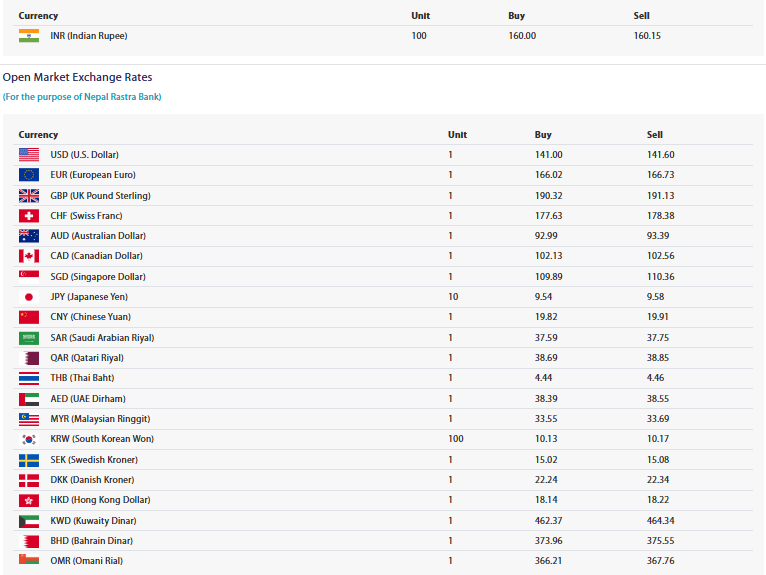
The central bank stated that the buying rate of one U.S. dollar has been set at NPR 141 while the selling rate stands at NPR 141.60. The slight difference between the buying and selling rates is consistent with the bank’s standard margin practice to facilitate commercial banks and financial institutions in managing foreign currency exchanges smoothly.

Exchange Rates of Major Currencies
In addition to the U.S. dollar, the NRB has announced the official exchange rates of other major international currencies. The Euro, widely used across Europe and an important currency for international trade, has been fixed at NPR 166.02 for buying and NPR 166.73 for selling. The British Pound Sterling, which traditionally holds a stronger value, has been set at NPR 190.32 for buying and NPR 191.13 for selling.
Similarly, the Swiss Franc, another globally significant currency, is trading at NPR 177.63 for buying and NPR 178.38 for selling. The rates of the Australian and Canadian dollars, both of which are linked closely to the remittance inflows from Nepali diaspora in Australia and Canada, have been set at NPR 92.99 and NPR 93.39 for the Australian dollar, and NPR 102.13 and NPR 102.56 for the Canadian dollar respectively.
The Singapore dollar, which plays a notable role in Nepal’s trade and business transactions with Southeast Asia, is valued at NPR 109.89 for buying and NPR 110.36 for selling.
Asian Currencies and Regional Impact
Asian currencies, which significantly affect trade and remittance inflows into Nepal, have also been reviewed. The Japanese yen, measured in units of 10, is set at NPR 9.54 for buying and NPR 9.58 for selling. The Chinese yuan, another vital currency due to Nepal’s growing trade relations with China, is set at NPR 19.82 for buying and NPR 19.91 for selling.
From the Middle Eastern region, the Saudi Arabian riyal, crucial for remittances as Nepal hosts a large number of migrant workers in the Gulf countries, has been valued at NPR 37.59 for buying and NPR 37.75 for selling. Similarly, the Qatari riyal stands at NPR 38.69 for buying and NPR 38.85 for selling, while the UAE dirham is set at NPR 38.39 for buying and NPR 38.55 for selling.
The Malaysian ringgit, another currency relevant for Nepali migrant workers in Malaysia, has been valued at NPR 33.55 for buying and NPR 33.69 for selling. The South Korean won, measured per 100 units, is fixed at NPR 10.13 for buying and NPR 10.17 for selling.
European Currencies and Other Key Rates
The central bank has also disclosed the rates of other European currencies. The Swedish krona is valued at NPR 15.02 for buying and NPR 15.08 for selling, while the Danish krone is trading at NPR 22.24 for buying and NPR 22.34 for selling.
The Hong Kong dollar has been set at NPR 18.14 for buying and NPR 18.22 for selling. Among the strongest global currencies, the Kuwaiti dinar is trading at NPR 462.37 for buying and NPR 464.34 for selling, reflecting its position as one of the highest-valued currencies worldwide. The Bahraini dinar is valued at NPR 373.96 for buying and NPR 375.55 for selling, while the Omani riyal is fixed at NPR 366.21 for buying and NPR 367.76 for selling.
Indian Rupee and Bilateral Trade
Given Nepal’s open border and significant trade dependence with India, the Indian rupee continues to play a vital role in the country’s economy. The exchange rate of 100 Indian rupees has been set at NPR 160 for buying and NPR 160.15 for selling. This fixed peg, which has remained consistent for several years, provides stability in bilateral trade and is particularly important for daily cross-border transactions.
Implications and Advisory
Nepal Rastra Bank has also clarified that these rates are subject to revision depending on market conditions and international fluctuations. Commercial banks may set slightly different rates depending on their individual transactions and service charges, but the rates issued by the central bank serve as the standard reference point.
The bank also informed the public that updated exchange rates can be accessed at any time through its official website. Moreover, it urged individuals and businesses involved in foreign currency dealings to rely on authentic sources to avoid confusion or misinformation.
Foreign exchange rates are not only crucial for banks and traders but also for millions of Nepalis receiving remittances from abroad. A slight change in rates can directly affect the amount received by families of migrant workers. Similarly, importers and exporters closely monitor daily updates to plan their financial strategies, as fluctuations in rates can influence costs and competitiveness.

With the release of today’s updated exchange rates, Nepal Rastra Bank has once again underlined its role as the central authority in regulating foreign exchange and ensuring monetary stability. The U.S. dollar, Euro, Pound Sterling, and Gulf currencies remain the most influential in shaping Nepal’s financial inflows and outflows.
As the global economy remains uncertain due to changing geopolitical and economic conditions, the exchange rate mechanism managed by NRB continues to provide a structured framework for stability. The central bank reiterated that while the rates may be adjusted depending on international developments, it remains committed to maintaining balance in Nepal’s financial sector through transparent and timely updates.