Nepal Rastra Bank (NRB), the central bank of Nepal, has issued the official foreign currency exchange rates for today. These rates will be applicable across the country for foreign currency transactions, while noting that commercial banks may post slightly different rates based on their own adjustments.
US Dollar Rate Fixed Above Rs. 142 for Selling
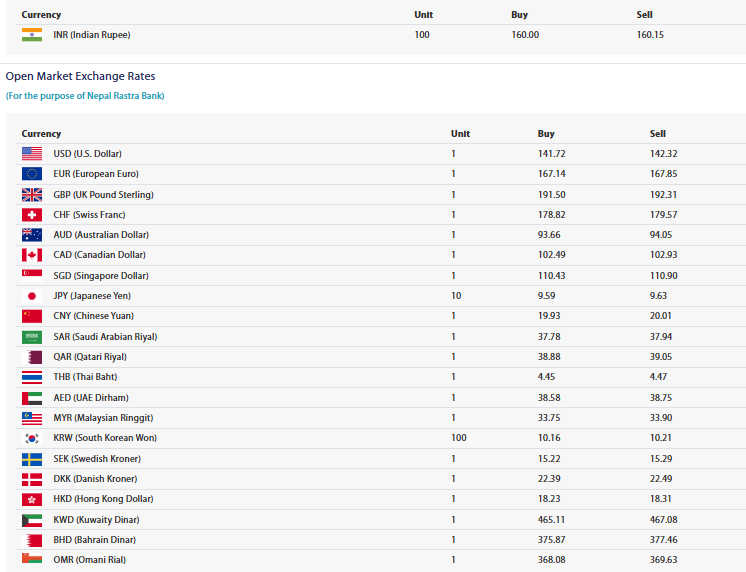
According to the central bank, the exchange rate for the US dollar has been fixed at Rs. 141.72 for buying and Rs. 142.32 for selling. The dollar continues to remain one of the most actively traded foreign currencies in Nepal due to its role in international trade, remittances, and tourism.
Euro and Pound Sterling Rates
For the European Euro, NRB has set the buying rate at Rs. 167.14 and the selling rate at Rs. 167.85. Similarly, the UK Pound Sterling has been valued higher, with the buying rate at Rs. 191.50 and the selling rate at Rs. 192.31. Both the Euro and Pound remain important currencies for Nepal’s financial sector, as large numbers of Nepalis live and work in European countries, sending remittances back home.

Swiss Franc, Australian and Canadian Dollars
The Swiss Franc, another widely traded global currency, has been fixed at Rs. 178.82 for buying and Rs. 179.57 for selling. The Australian Dollar has been set at Rs. 93.66 for buying and Rs. 94.05 for selling, while the Canadian Dollar stands at Rs. 102.49 for buying and Rs. 102.93 for selling. These currencies are significant for Nepal’s foreign exchange market due to sizable Nepali diaspora communities in Australia and Canada.
Singapore Dollar, Japanese Yen, and Chinese Yuan
The Singapore Dollar is priced at Rs. 110.43 for buying and Rs. 110.90 for selling.
For the Japanese Yen, the rate is based on a unit of 10 Yen, with Rs. 9.59 for buying and Rs. 9.63 for selling. The Chinese Yuan, which holds importance given Nepal’s growing trade ties with China, is fixed at Rs. 19.93 for buying and Rs. 20.01 for selling.
Middle Eastern Currencies
With thousands of Nepali migrant workers based in the Gulf countries, Middle Eastern currencies continue to play a vital role in remittance inflows:
- Saudi Arabian Riyal: Rs. 37.78 (buying), Rs. 37.94 (selling)
- Qatari Riyal: Rs. 38.88 (buying), Rs. 39.05 (selling)
- UAE Dirham: Rs. 38.58 (buying), Rs. 38.75 (selling)
- Kuwaiti Dinar: Rs. 465.11 (buying), Rs. 467.08 (selling)
- Bahraini Dinar: Rs. 375.87 (buying), Rs. 377.46 (selling)
- Omani Riyal: Rs. 368.08 (buying), Rs. 369.63 (selling)
Among these, the Kuwaiti Dinar remains the strongest currency traded in Nepal’s market, valued at more than Rs. 465 per unit.
Asian Currencies: Thai Baht, Malaysian Ringgit, Korean Won
Other Asian currencies also hold significance due to labor migration and tourism:
- Thai Baht: Rs. 4.45 (buying), Rs. 4.47 (selling)
- Malaysian Ringgit: Rs. 33.75 (buying), Rs. 33.90 (selling)
- South Korean Won (per 100 units): Rs. 10.16 (buying), Rs. 10.21 (selling)
South Korea and Malaysia, in particular, are popular destinations for Nepali migrant workers, making these exchange rates relevant for remittance and foreign labor transactions.
Scandinavian Currencies
The central bank has also published rates for Scandinavian currencies, including:
- Swedish Kroner: Rs. 15.22 (buying), Rs. 15.29 (selling)
- Danish Kroner: Rs. 22.39 (buying), Rs. 22.49 (selling)
Though not as widely used as other currencies in Nepal, these rates are important for trade and remittances from Europe.
Hong Kong Dollar and Others
The Hong Kong Dollar has been fixed at Rs. 18.23 for buying and Rs. 18.31 for selling. This currency remains relevant for Nepali workers and traders engaged in East Asian markets.
Indian Rupee
The Indian Rupee, Nepal’s closest and most frequently traded foreign currency—has been set at Rs. 160 for buying and Rs. 160.15 for selling per 100 units. The Indian currency is pegged to the Nepali rupee and is widely used in border trade, tourism, and remittance transactions.
Flexibility in Exchange Rates
Nepal Rastra Bank has clarified that the exchange rates may be revised at any time as per market necessity. The bank has also reminded the public that the official exchange rates set by NRB are primarily for reference, while commercial banks may offer slightly different rates depending on their trading positions.
To ensure transparency, the updated exchange rates are made available daily on the central bank’s official website, allowing individuals and businesses to stay informed about currency movements.
Importance of Daily Exchange Rate Updates
The daily publication of exchange rates by the central bank is critical for maintaining economic stability. It helps businesses involved in imports and exports calculate costs accurately, guides banks in their foreign exchange transactions, and provides migrant workers and remittance receivers with clarity on the value of money transfers.

Foreign exchange management also plays a vital role in supporting Nepal’s balance of payments, foreign reserves, and overall economic growth. With remittances forming a large share of Nepal’s GDP, accurate and transparent exchange rate information remains essential.
By fixing today’s rates across a wide range of global currencies, Nepal Rastra Bank has provided a clear reference point for both businesses and individuals engaged in foreign exchange activities. From the strong Kuwaiti Dinar to the widely used US Dollar and Indian Rupee, today’s exchange rate table reflects Nepal’s diverse economic ties with countries around the world.
The central bank’s policy of updating and publishing these rates daily ensures stability, transparency, and confidence in the country’s financial system, while also helping to protect the interests of ordinary citizens who rely on remittances and foreign trade for their livelihood.